Books Quote by Fyodor Dostoyevsky
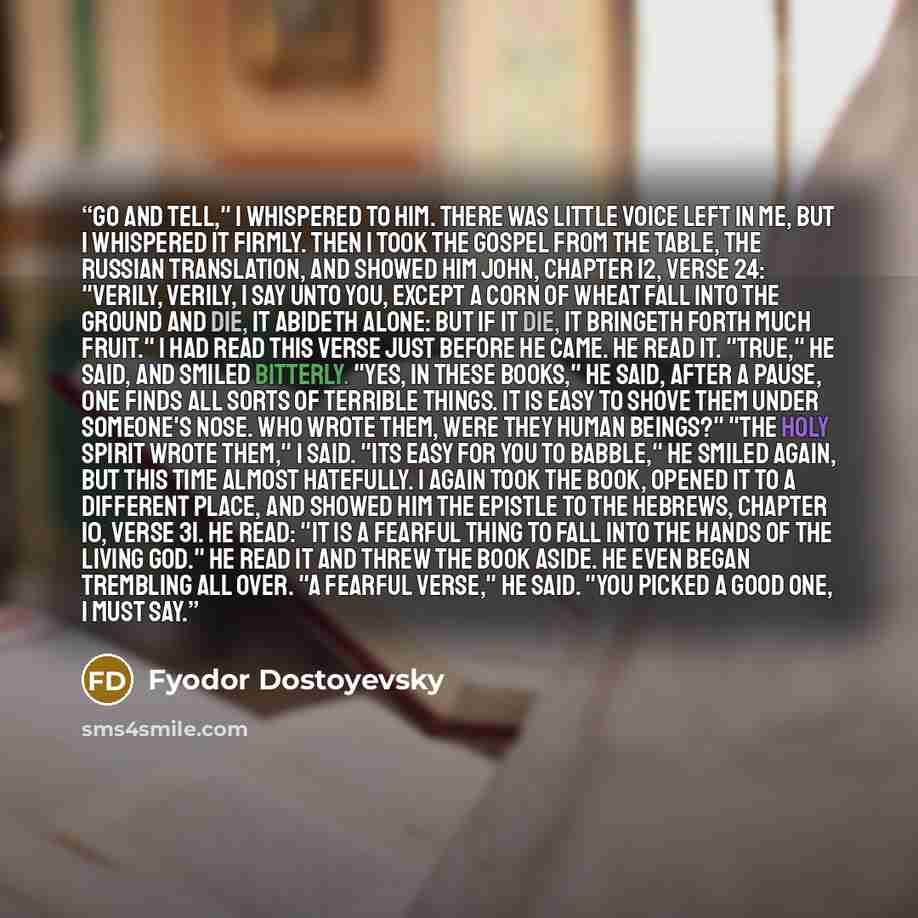
““Go and tell," I whispered to him. There was little voice left in me, but I whispered it firmly. Then I took the Gospel from the table, the Russian translation, and showed him John, chapter 12, verse 24: "Verily, verily, I say unto you, except a corn of wheat fall into the ground and die, it abideth alone: but if it die, it bringeth forth much fruit." I had read this verse just before he came. He read it. "True," he said, and smiled bitterly. "Yes, in these books," he said, after a pause, one finds all sorts of terrible things. It is easy to shove them under someone's nose. Who wrote them, were they human beings?" "The Holy Spirit wrote them," I said. "Its easy for you to babble," he smiled again, but this time almost hatefully. I again took the book, opened it to a different place, and showed him the Epistle to the Hebrews, chapter 10, verse 31. He read: "It is a fearful thing to fall into the hands of the living God." He read it and threw the book aside. He even began trembling all over. "A fearful verse," he said. "You picked a good one, I must say.””
About This Quote
Source Novel: The Brothers Karamazov by Fyodor Dostoyevsky, 1880
The passage shows how scripture can provoke fear and awe, revealing the tension between divine authority and human interpretation.
In simple terms: Scripture can inspire both fear and contemplation.
Key Takeaway
Consider the impact of sacred texts on belief.
Themes
faith
interpretation
authority
fear
spiritual struggle
Mood
intense
thoughtful
conflicted
Type
literary
theological
When to use this quote
- personal crisis
- religious debate
- reading sacred texts
- ethical questioning
Key Concepts
Existentialism
theology
Questions to Reflect On
- What does this verse reveal about power in religion?
- How do you reconcile fear and love in spiritual practice?
A Different Perspective
Faith may be weaponized to control or intimidate.







![“if [God] doesn't exist, man is the chief of the earth, of the universe. Magnificent! Only how is he going to be good without God?” quote by Fyodor Dostoyevsky](https://sms4smile.com/quotes/img-quotes/09b/fyodor-dostoyevsky-94_ethics_if-god-doesn-t-exist-man-is-the-chief-of_16023.jpg)