Cause and effect Quote by Friedrich Nietzsche
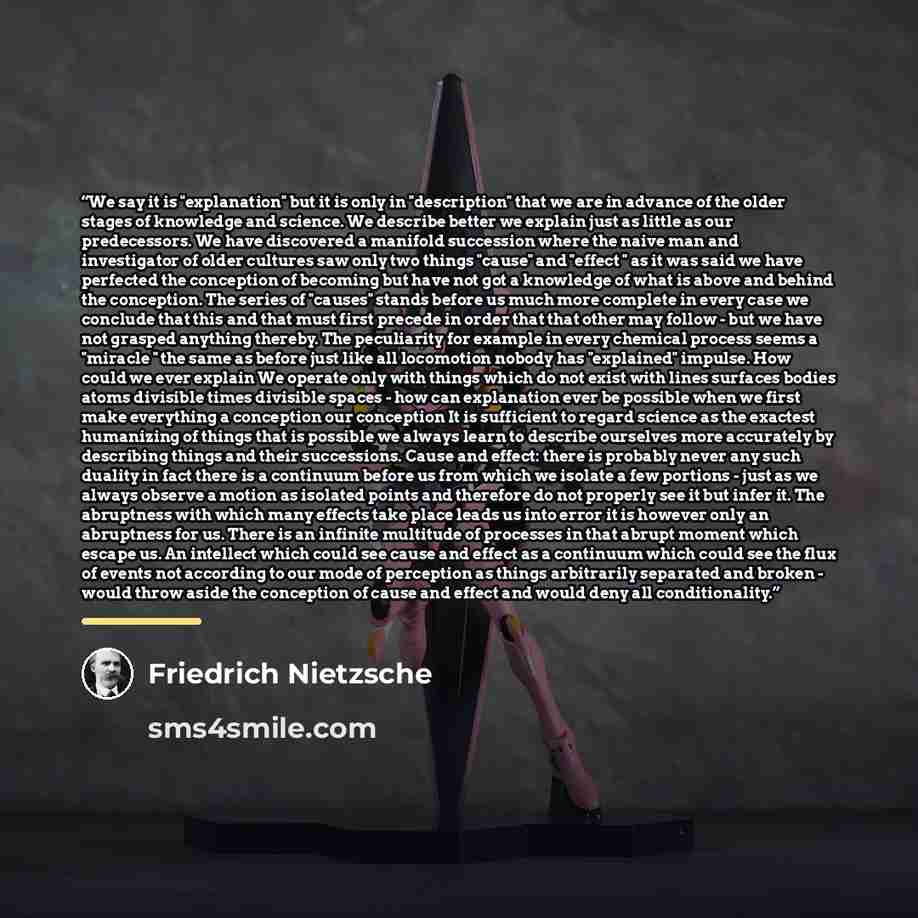
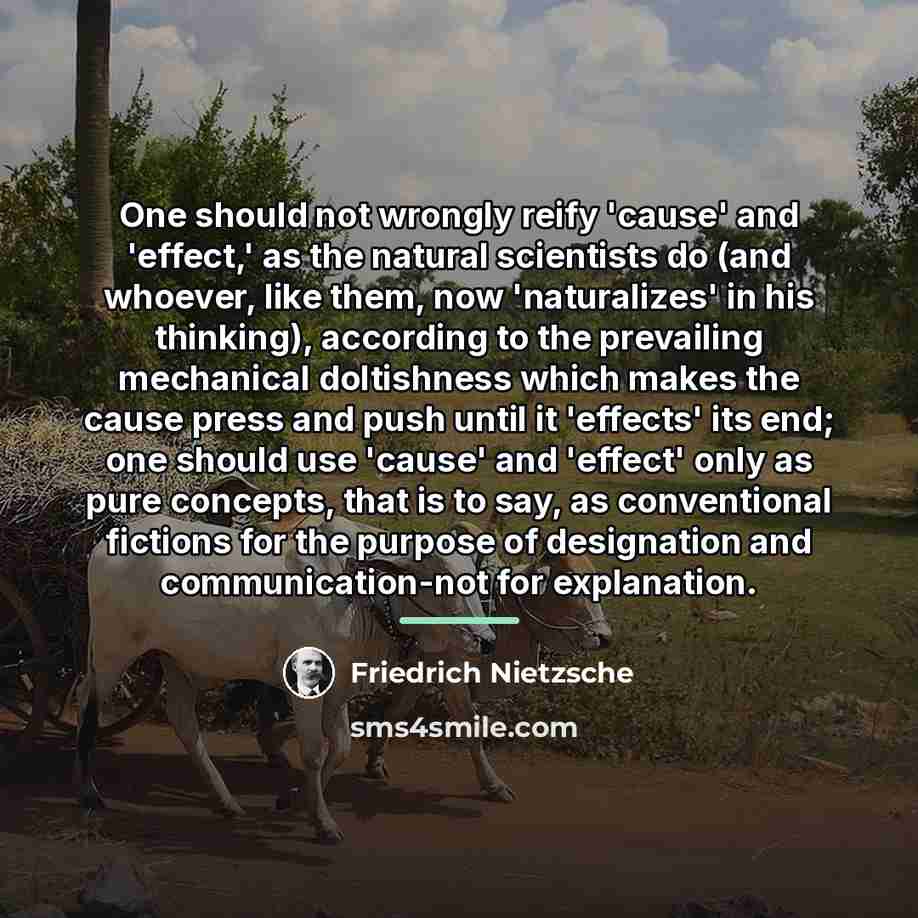
““We say it is "explanation" but it is only in "description" that we are in advance of the older stages of knowledge and science. We describe better we explain just as little as our predecessors. We have discovered a manifold succession where the naive man and investigator of older cultures saw only two things "cause" and "effect " as it was said we have perfected the conception of becoming but have not got a knowledge of what is above and behind the conception. The series of "causes" stands before us much more complete in every case we conclude that this and that must first precede in order that that other may follow - but we have not grasped anything thereby. The peculiarity for example in every chemical process seems a "miracle " the same as before just like all locomotion nobody has "explained" impulse. How could we ever explain We operate only with things which do not exist with lines surfaces bodies atoms divisible times divisible spaces - how can explanation ever be possible when we first make everything a conception our conception It is sufficient to regard science as the exactest humanizing of things that is possible we always learn to describe ourselves more accurately by describing things and their successions. Cause and effect: there is probably never any such duality in fact there is a continuum before us from which we isolate a few portions - just as we always observe a motion as isolated points and therefore do not properly see it but infer it. The abruptness with which many effects take place leads us into error it is however only an abruptness for us. There is an infinite multitude of processes in that abrupt moment which escape us. An intellect which could see cause and effect as a continuum which could see the flux of events not according to our mode of perception as things arbitrarily separated and broken - would throw aside the conception of cause and effect and would deny all conditionality.””
About This Quote
Source Philosophy: Beyond Good and Evil, 1886
The quote argues that scientific description outpaces true explanation, suggesting that our concepts of cause and effect are fragmented and incomplete, and that a deeper, continuous understanding is beyond current perception.
In simple terms: Science describes more than it explains; cause and effect are fragmented.
Key Takeaway
Seek deeper, continuous insight beyond isolated causes.
Themes
philosophy
science
knowledge
perception
continuity
Mood
reflective
inquisitive
Type
philosophical
analytical
When to use this quote
- academic research
- philosophical debate
- scientific inquiry
- education
- critical thinking
Key Concepts
causality
epistemology
metaphysics
Questions to Reflect On
- How can we balance detailed description with meaningful explanation?
- What methods help reveal underlying continuities?
A Different Perspective
It may overstate the impossibility of explanation, ignoring practical progress made through reductionist models.