Endless life Quote by Frank Kermode
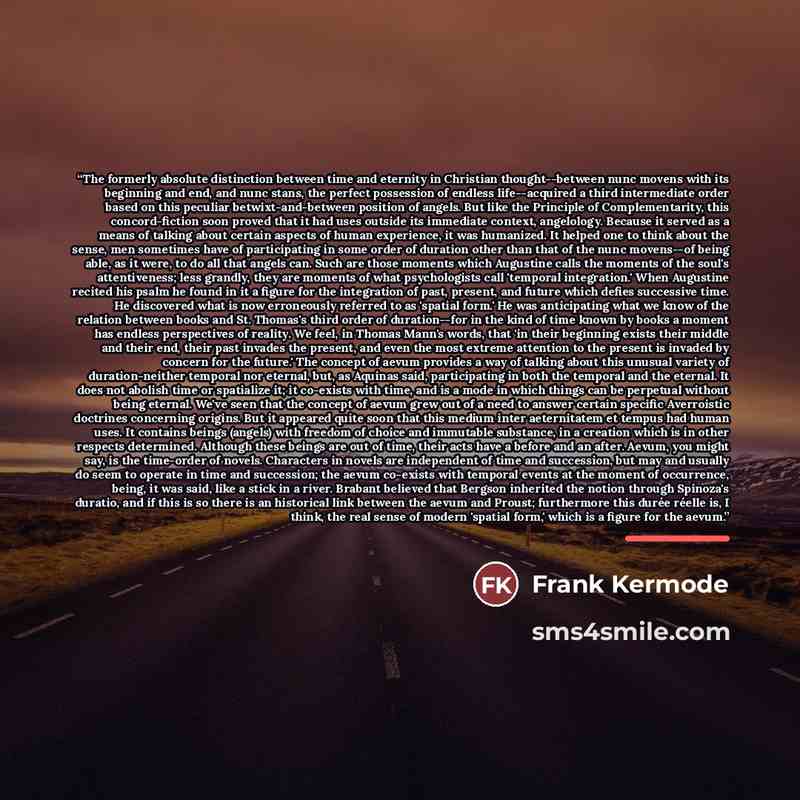
““The formerly absolute distinction between time and eternity in Christian thought--between nunc movens with its beginning and end, and nunc stans, the perfect possession of endless life--acquired a third intermediate order based on this peculiar betwixt-and-between position of angels. But like the Principle of Complementarity, this concord-fiction soon proved that it had uses outside its immediate context, angelology. Because it served as a means of talking about certain aspects of human experience, it was humanized. It helped one to think about the sense, men sometimes have of participating in some order of duration other than that of the nunc movens--of being able, as it were, to do all that angels can. Such are those moments which Augustine calls the moments of the soul's attentiveness; less grandly, they are moments of what psychologists call 'temporal integration.' When Augustine recited his psalm he found in it a figure for the integration of past, present, and future which defies successive time. He discovered what is now erroneously referred to as 'spatial form.' He was anticipating what we know of the relation between books and St. Thomas's third order of duration--for in the kind of time known by books a moment has endless perspectives of reality. We feel, in Thomas Mann's words, that 'in their beginning exists their middle and their end, their past invades the present, and even the most extreme attention to the present is invaded by concern for the future.' The concept of aevum provides a way of talking about this unusual variety of duration-neither temporal nor eternal, but, as Aquinas said, participating in both the temporal and the eternal. It does not abolish time or spatialize it; it co-exists with time, and is a mode in which things can be perpetual without being eternal. We've seen that the concept of aevum grew out of a need to answer certain specific Averroistic doctrines concerning origins. But it appeared quite soon that this medium inter aeternitatem et tempus had human uses. It contains beings (angels) with freedom of choice and immutable substance, in a creation which is in other respects determined. Although these beings are out of time, their acts have a before and an after. Aevum, you might say, is the time-order of novels. Characters in novels are independent of time and succession, but may and usually do seem to operate in time and succession; the aevum co-exists with temporal events at the moment of occurrence, being, it was said, like a stick in a river. Brabant believed that Bergson inherited the notion through Spinoza's duratio, and if this is so there is an historical link between the aevum and Proust; furthermore this durée réelle is, I think, the real sense of modern 'spatial form,' which is a figure for the aevum.””
About This Quote
Source Essay: The Sense of an Ending, 1967
Human experience includes a middle state that blends temporal flow with eternal timelessness, allowing moments of deep attentiveness that transcend ordinary time.
In simple terms: A middle time exists between past and future.
Key Takeaway
Recognize and cherish moments of timeless focus.
Themes
time
eternity
human experience
attention
philosophy
Mood
reflective
thoughtful
Type
philosophical
inspirational
When to use this quote
- meditation
- creative work
- learning
- spiritual practice
Key Concepts
metaphysics
psychology
theology
Questions to Reflect On
- How do you experience “timeless” moments?
- Can you hold multiple senses of time simultaneously?
A Different Perspective
Such concepts can be abstract, making practical application difficult.