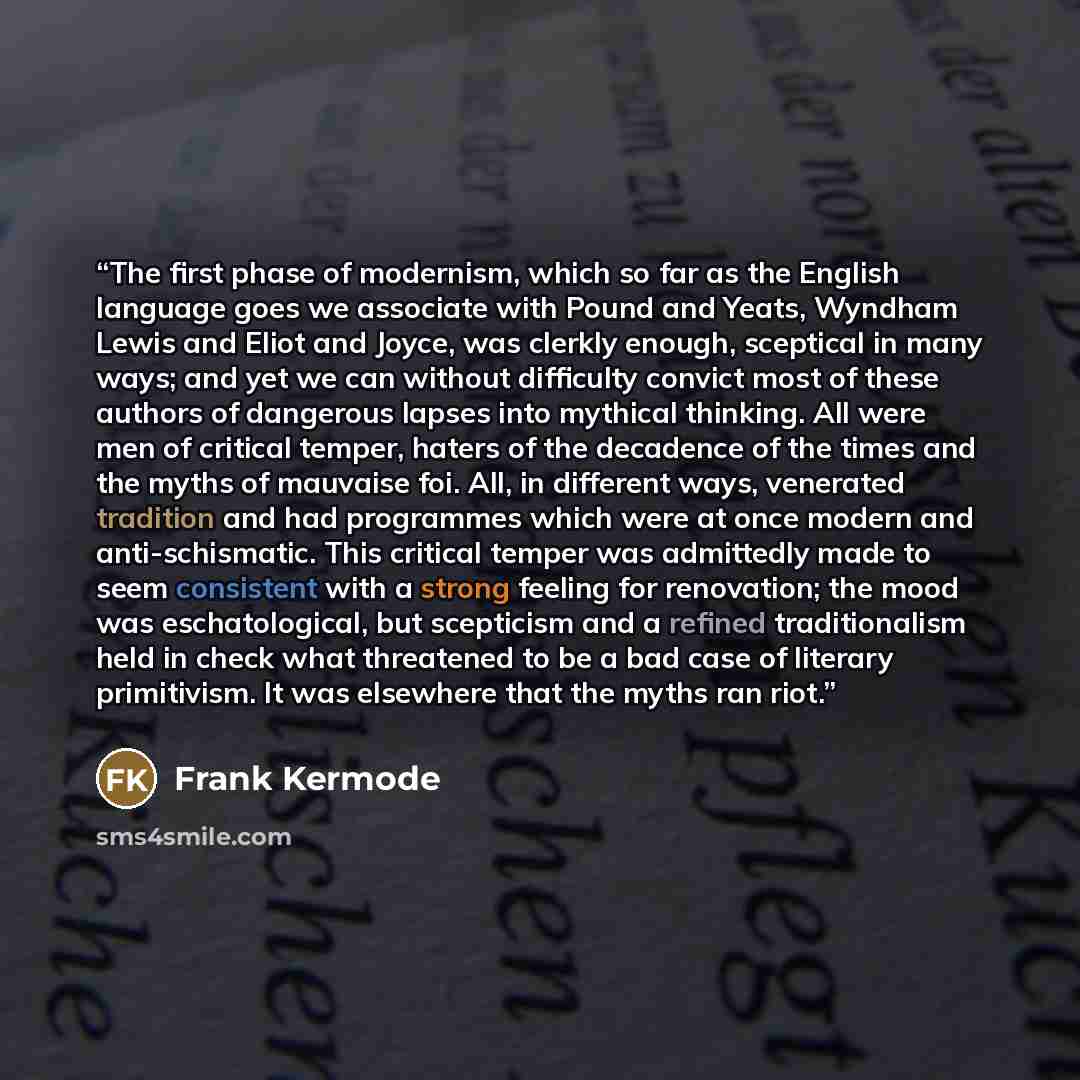
Christian philosophy Quote by Frank Kermode

““IT is worth remembering that the rise of what we call literary fiction happened at a time when the revealed, authenticated account of the beginning was losing its authority. Now that changes in things as they are change beginnings to make them fit, beginnings have lost their mythical rigidity. There are, it is true, modern attempts to restore this rigidity. But on the whole there is a correlation between subtlety and variety in our fictions and remoteness and doubtfulness about ends and origins. There is a necessary relation between the fictions by which we order our world and the increasing complexity of what we take to be the 'real' history of that world. I propose in this talk to ask some questions about an early and very interesting example of this relation. There was a long-established opinion that the beginning was as described in Genesis, and that the end is to be as obscurely predicted in Revelation. But what if this came to seem doubtful? Supposing reason proved capable of a quite different account of the matter, an account contradicting that of faith? On the argument of these talks so far as they have gone, you would expect two developments: there should be generated fictions of concord between the old and the new explanations; and there should be consequential changes in fictive accounts of the world. And of course I should not be troubling you with all this if I did not think that such developments occurred. The changes to which I refer came with a new wave of Greek influence on Christian philosophy. The provision of accommodations between Greek and Hebrew thought is an old story, and a story of concord-fictions--necessary, as Berdyaev says, because to the Greeks the world was a cosmos, but to the Hebrews a history. But this is too enormous a tract in the history of ideas for me to wander in. I shall make do with my single illustration, and speak of what happened in the thirteenth century when Christian philosophers grappled with the view of the Aristotelians that nothing can come of nothing--ex nihilo nihil fit--so that the world must be thought to be eternal. In the Bible the world is made out of nothing. For the Aristotelians, however, it is eternal, without beginning or end. To examine the Aristotelian arguments impartially one would need to behave as if the Bible might be wrong. And this was done. The thirteenth-century rediscovery of Aristotle led to the invention of double-truth. It takes a good deal of sophistication to do what certain philosophers then did, namely, to pursue with vigour rational enquiries the validity of which one is obliged to deny. And the eternity of the world was, of course, more than a question in a scholarly game. It called into question all that might seem ragged and implausible in the usual accounts of the temporal structure of the world, the relation of time to eternity (certainly untidy and discordant compared with the Neo-Platonic version) and of heaven to hell.””
About This Quote
Source Speech: Lecture on Literary Fiction and History, 20th Century Academic Conference
The quote argues that as historical narratives become less authoritative, literary fiction grows more subtle and varied, reflecting doubts about origins and ends, especially when Greek and Hebrew ideas intersect.
In simple terms: When traditional histories lose authority, stories become more complex and uncertain.
Key Takeaway
Embrace narrative complexity and question fixed origins.
Themes
history
literature
philosophy
culture
myth
truth
Mood
reflective
inquisitive
analytical
Type
explanatory
critical
philosophical
When to use this quote
- academic lecture
- university seminar
- philosophical discussion
- literary analysis
Key Concepts
mythic rigidity
origins
Greek influence
Hebrew thought
Aristotelianism
Berdyaev
Questions to Reflect On
- How does questioning origins affect our understanding of truth?
- What role do cultural exchanges play in shaping narratives?
A Different Perspective
The claim may overstate the uniformity of literary trends across cultures.