Character Quote by F. A. Hayek
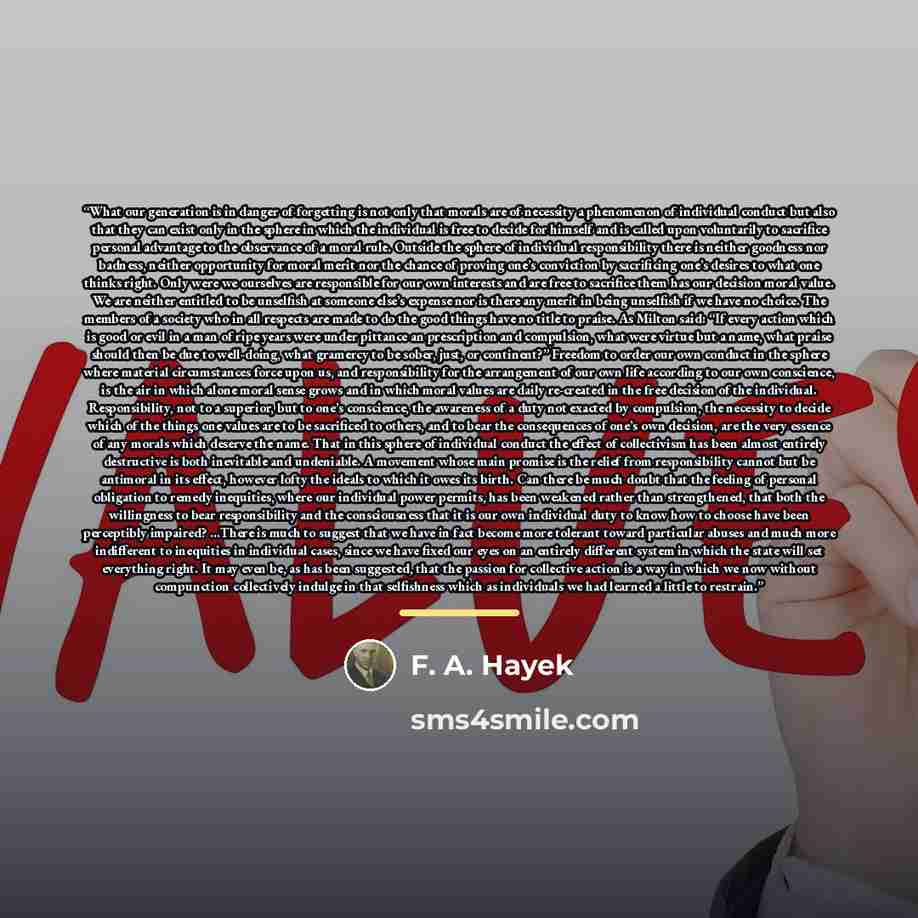
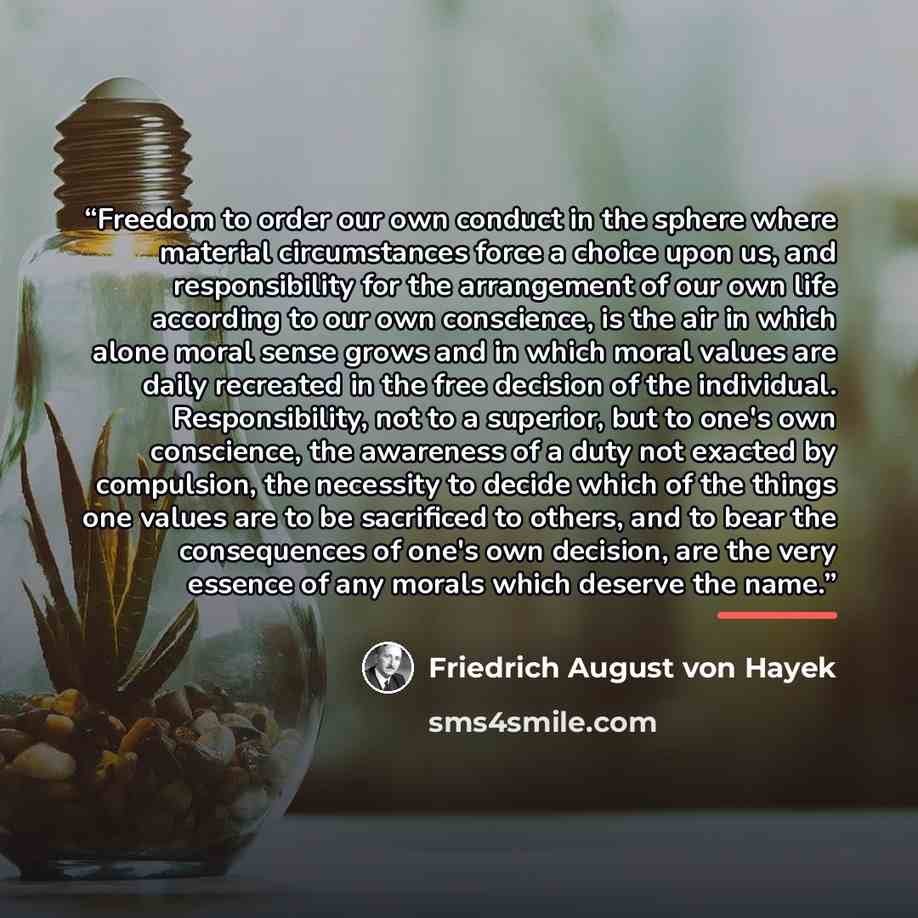
““What our generation is in danger of forgetting is not only that morals are of necessity a phenomenon of individual conduct but also that they can exist only in the sphere in which the individual is free to decide for himself and is called upon voluntarily to sacrifice personal advantage to the observance of a moral rule. Outside the sphere of individual responsibility there is neither goodness nor badness, neither opportunity for moral merit nor the chance of proving one’s conviction by sacrificing one’s desires to what one thinks right. Only were we ourselves are responsible for our own interests and are free to sacrifice them has our decision moral value. We are neither entitled to be unselfish at someone else’s expense nor is there any merit in being unselfish if we have no choice. The members of a society who in all respects are made to do the good things have no title to praise. As Milton said: “If every action which is good or evil in a man of ripe years were under pittance an prescription and compulsion, what were virtue but a name, what praise should then be due to well-doing, what gramercy to be sober, just, or continent?” Freedom to order our own conduct in the sphere where material circumstances force upon us, and responsibility for the arrangement of our own life according to our own conscience, is the air in which alone moral sense grows and in which moral values are daily re-created in the free decision of the individual. Responsibility, not to a superior, but to one’s conscience, the awareness of a duty not exacted by compulsion, the necessity to decide which of the things one values are to be sacrificed to others, and to bear the consequences of one’s own decision, are the very essence of any morals which deserve the name. That in this sphere of individual conduct the effect of collectivism has been almost entirely destructive is both inevitable and undeniable. A movement whose main promise is the relief from responsibility cannot but be antimoral in its effect, however lofty the ideals to which it owes its birth. Can there be much doubt that the feeling of personal obligation to remedy inequities, where our individual power permits, has been weakened rather than strengthened, that both the willingness to bear responsibility and the consciousness that it is our own individual duty to know how to choose have been perceptibly impaired? …There is much to suggest that we have in fact become more tolerant toward particular abuses and much more indifferent to inequities in individual cases, since we have fixed our eyes on an entirely different system in which the state will set everything right. It may even be, as has been suggested, that the passion for collective action is a way in which we now without compunction collectively indulge in that selfishness which as individuals we had learned a little to restrain.””
About This Quote
Source Book: The Road to Serfdom by F. A. Hayek, 1944
Hayek argues that morality exists only when individuals are free to choose self-sacrifice. Forced good deeds lack moral value, so collectivism that removes responsibility erodes ethics itself.
In simple terms: Freedom is necessary for true morality.
Key Takeaway
Preserve personal responsibility to keep morals alive.
Themes
morality
freedom
responsibility
collectivism
individualism
Mood
intellectual
serious
defiant
Type
philosophical argument
essay
When to use this quote
- political debate
- organizational ethics
- legal versus moral choices
- civic duty
Key Concepts
moral autonomy
voluntary sacrifice
liberty
ethical agency
Questions to Reflect On
- Where do you draw the line between duty and choice?
- Can society enforce goodness without losing its moral worth?
A Different Perspective
Some virtues, like care for others, can be socially conditioned or relational, not purely voluntary choices.