Conscious mind Quote by Ernest Jones
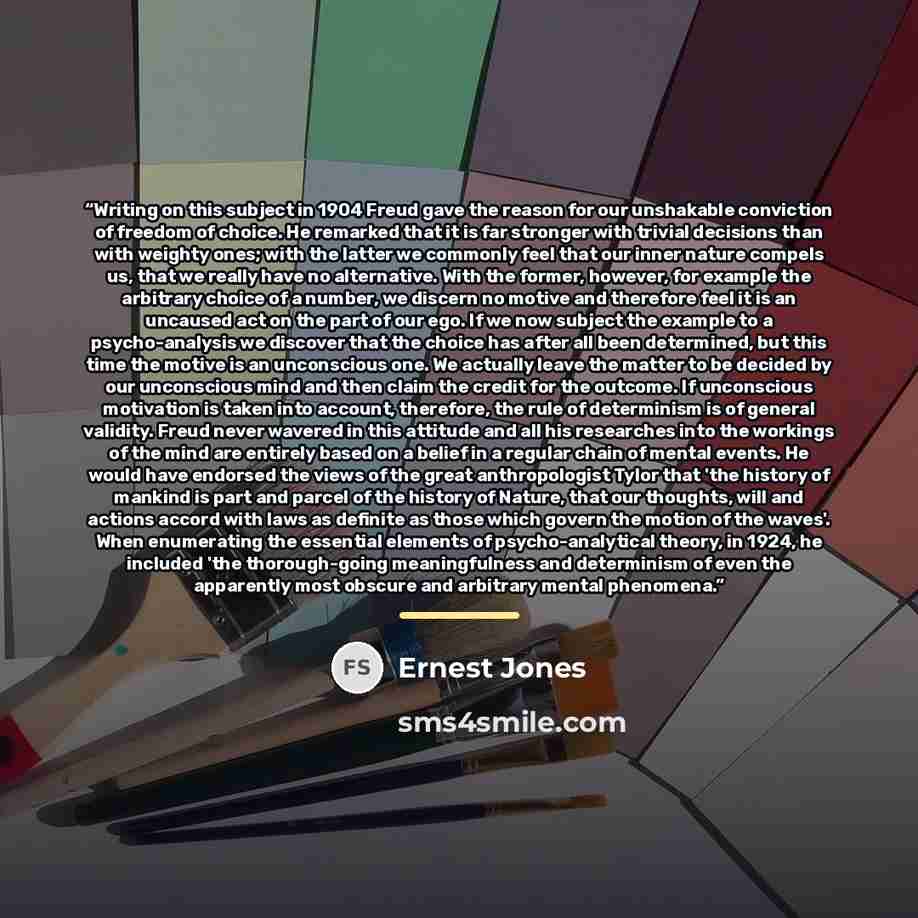
““Writing on this subject in 1904 Freud gave the reason for our unshakable conviction of freedom of choice. He remarked that it is far stronger with trivial decisions than with weighty ones; with the latter we commonly feel that our inner nature compels us, that we really have no alternative. With the former, however, for example the arbitrary choice of a number, we discern no motive and therefore feel it is an uncaused act on the part of our ego. If we now subject the example to a psycho-analysis we discover that the choice has after all been determined, but this time the motive is an unconscious one. We actually leave the matter to be decided by our unconscious mind and then claim the credit for the outcome. If unconscious motivation is taken into account, therefore, the rule of determinism is of general validity. Freud never wavered in this attitude and all his researches into the workings of the mind are entirely based on a belief in a regular chain of mental events. He would have endorsed the views of the great anthropologist Tylor that 'the history of mankind is part and parcel of the history of Nature, that our thoughts, will and actions accord with laws as definite as those which govern the motion of the waves'. When enumerating the essential elements of psycho-analytical theory, in 1924, he included 'the thorough-going meaningfulness and determinism of even the apparently most obscure and arbitrary mental phenomena.””
About This Quote
Source Book: The History of the Psycho-Analytical Movement, Ernest Jones, 1961
Freud argued that both conscious and unconscious processes determine even seemingly arbitrary choices, supporting a deterministic view of the mind.
In simple terms: Freud saw all choices as determined, even trivial ones.
Key Takeaway
Recognize hidden motives in decisions.
Themes
determinism
psychoanalysis
free will
unconscious
philosophy
Mood
reflective
analytical
Type
philosophical
psychological
When to use this quote
- personal decision making
- clinical therapy
- self‑reflection
- ethical debates
- policy making
Key Concepts
causality
mental processes
psychology
anthropology
Questions to Reflect On
- Do you feel your choices are truly free?
- How can we balance deterministic insights with personal responsibility?
A Different Perspective
Freud’s view may overlook genuine agency and the complexity of emergent behavior.
![“The ideas for my books come about in two ways. There can be an intellectual idea that seems to be the reason for writing the book. [...] The other motive is unconscious. There is something deeply psychological and emotional that draws me to the material in the first place.” quote by Jeffrey Eugenides](https://sms4smile.com/quotes/img-quotes/357/jeffrey-eugenides-462_book_the-ideas-for-my-books-come-about-in-two_541787.jpg)


![“Any argument where one supposes an arbitrary choice to be made an uncountably infinite number of times ...[is] outside the domain of mathematics.” quote by Emile Borel](https://sms4smile.com/quotes/img-quotes/70e/emile-borel-64739_arbitrary_any-argument-where-one-supposes-an-arbit_2039880.jpg)





![“[Censors are] people with secret attractions to various temptations... They are defending themselves under the pretext of defending others, because at heart they fear their own weaknesses.” quote by Ernest Jones](https://sms4smile.com/quotes/img-quotes/1d4/ernest-jones-36409_attraction_censors-are-people-with-secret-attractio_103107.jpg)




![“[Freud's] great strength, though sometimes also his weakness, was the quite extraordinary respect he had for the singular fact... When he got hold of a simple but significant fact he would feel, and know, that it was an example of something general or universal, and the idea of collecting…” quote by Ernest Jones](https://sms4smile.com/quotes/img-quotes/145/ernest-jones-36409_aliens_freud-s-great-strength-though-sometimes_2212239.jpg)