Hong kong Quote by Edwin H. Friedman
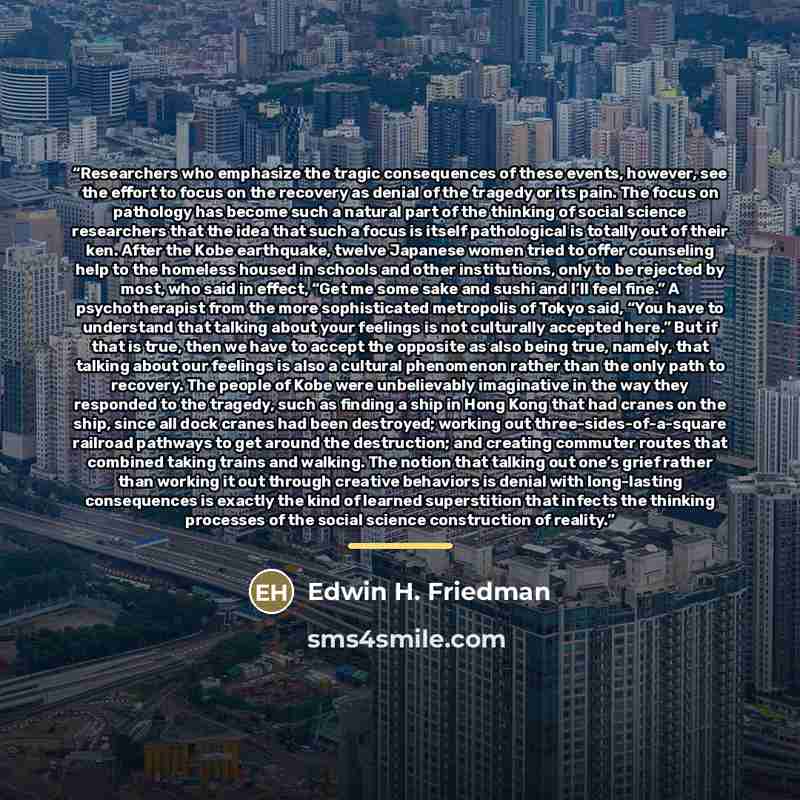
““Researchers who emphasize the tragic consequences of these events, however, see the effort to focus on the recovery as denial of the tragedy or its pain. The focus on pathology has become such a natural part of the thinking of social science researchers that the idea that such a focus is itself pathological is totally out of their ken. After the Kobe earthquake, twelve Japanese women tried to offer counseling help to the homeless housed in schools and other institutions, only to be rejected by most, who said in effect, “Get me some sake and sushi and I’ll feel fine.” A psychotherapist from the more sophisticated metropolis of Tokyo said, “You have to understand that talking about your feelings is not culturally accepted here.” But if that is true, then we have to accept the opposite as also being true, namely, that talking about our feelings is also a cultural phenomenon rather than the only path to recovery. The people of Kobe were unbelievably imaginative in the way they responded to the tragedy, such as finding a ship in Hong Kong that had cranes on the ship, since all dock cranes had been destroyed; working out three-sides-of-a-square railroad pathways to get around the destruction; and creating commuter routes that combined taking trains and walking. The notion that talking out one’s grief rather than working it out through creative behaviors is denial with long-lasting consequences is exactly the kind of learned superstition that infects the thinking processes of the social science construction of reality.””
About This Quote
Source Book: Social Science and Disaster Recovery, 1995
The quote argues that over‑emphasizing emotional talk can ignore practical, creative coping, and that labeling this as pathological is itself a bias.
In simple terms: Focusing only on feelings may block practical solutions.
Key Takeaway
Balance emotional expression with creative action.
Themes
disaster response
culture
psychology
creativity
recovery
Mood
reflective
critical
insightful
Type
analytical
philosophical
observational
When to use this quote
- community rebuilding
- mental health counseling
- urban planning
- post‑trauma support
Key Concepts
social construction
learned superstition
cultural norms
Questions to Reflect On
- How can we integrate emotional and practical coping?
- When does cultural denial become harmful?
A Different Perspective
Over‑emphasis on feelings can hinder resilience; cultural resistance may limit therapeutic approaches.