African american Quote by E.R. Bills
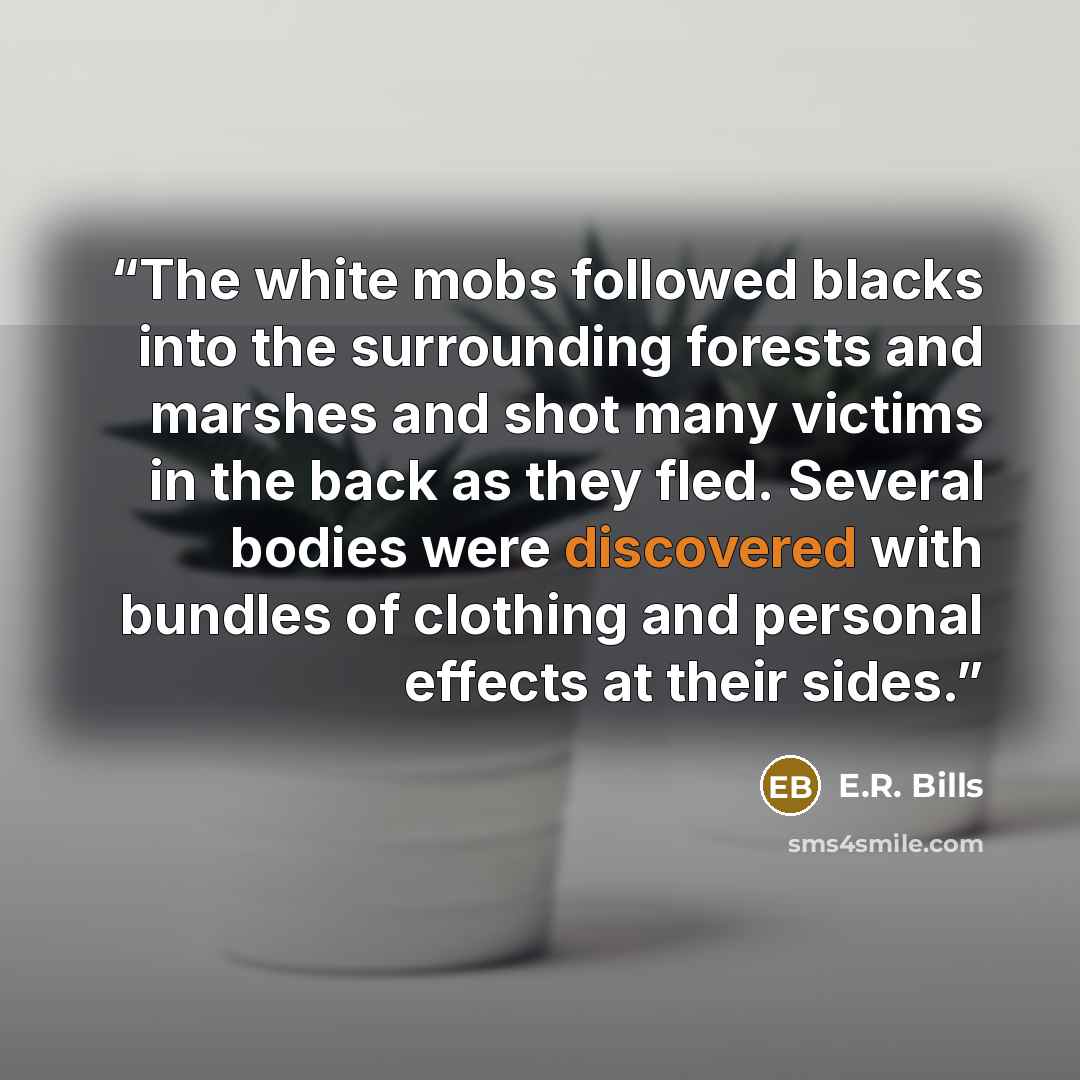
““When Hodges was presented to Harmon the next morning for a positive ID, Harmon reportedly couldn’t be sure he was her attacker. “I can’t tell,” she said. “I can’t say he is the negro, but I can’t say he is not the negro.” Unfortunately, many citizens of Tyler subscribed to the guilty until proven innocent philosophy where African Americans were concerned. At approximately 11:15 a.m., a white mob three to four thousand strong broke into the county jail and seized Hodges. The lynch mob transported Hodges to the site of the new Smith County Courthouse, which was then under construction. A few members threw a rope up over an enormous derrick—which was being utilized at the site for hoisting large stones for the new courthouse—and fashioned a noose on one end, placing it around Hodges’s neck. Several men then took hold of the other end and, with one simultaneous pull, jerked Hodges up into the sky. Hodges squirmed as he swung back and forth high above the mob, and then his movements dwindled to a twitch or two before he grew still. Within ten minutes, the construction site was empty, save the deceased, whose gruesome figure hung motionless in midair. No one involved in the crime even attempted to conceal his identity. As the May 7, 1909 edition of the Alto Herald put it, “Those who took part in the lynching went about it just as they went about their daily business.””
About This Quote
Source Historical Account: Alto Herald, May 7 1909, newspaper report
The lynching illustrates how racial prejudice and mob mentality can override justice, leading to brutal extrajudicial killings.
In simple terms: Racism and mob violence can destroy due process.
Key Takeaway
Recognize and confront systemic racism.
Themes
justice
racism
mob violence
history
Mood
somber
reflective
Type
historical
social commentary
When to use this quote
- civil rights education
- community reconciliation
- historical remembrance
- law enforcement reform
- public policy
Key Concepts
racial injustice
social hysteria
legal failure
Questions to Reflect On
- What mechanisms allow such violence to be normalized?
- How can societies heal from historical racial trauma?
A Different Perspective
The narrative may lack broader context of systemic oppression.