Final words Quote by Dustin Hoffman
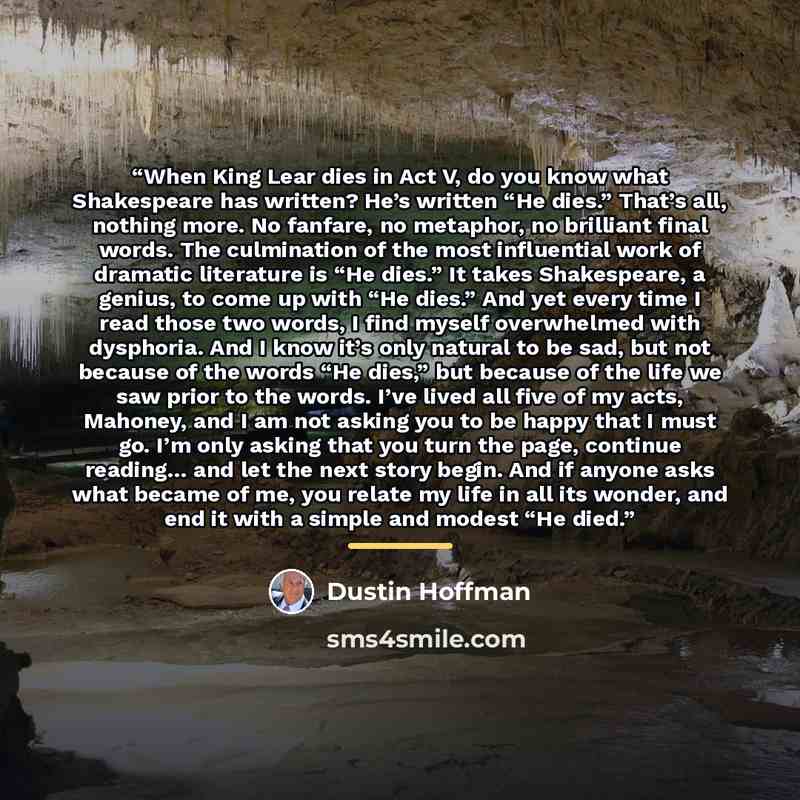
““When King Lear dies in Act V, do you know what Shakespeare has written? He’s written “He dies.” That’s all, nothing more. No fanfare, no metaphor, no brilliant final words. The culmination of the most influential work of dramatic literature is “He dies.” It takes Shakespeare, a genius, to come up with “He dies.” And yet every time I read those two words, I find myself overwhelmed with dysphoria. And I know it’s only natural to be sad, but not because of the words “He dies,” but because of the life we saw prior to the words. I’ve lived all five of my acts, Mahoney, and I am not asking you to be happy that I must go. I’m only asking that you turn the page, continue reading… and let the next story begin. And if anyone asks what became of me, you relate my life in all its wonder, and end it with a simple and modest “He died.””
About This Quote
Source Play: King Lear, William Shakespeare, 1606
The ending’s stark simplicity highlights how all the preceding drama collapses into a single, inevitable fact, evoking grief for the lost journey rather than the words themselves.
In simple terms: The final line’s plainness makes us mourn the story, not the phrase.
Key Takeaway
Acknowledge endings and move forward.
Themes
mortality
storytelling
grief
transition
Mood
melancholic
contemplative
reflective
Type
literary
philosophical
When to use this quote
- reading a tragedy
- reflecting on personal milestones
- coping with loss
- writing a memoir
- delivering a eulogy
Key Concepts
existentialism
narrative closure
emotional resonance
Questions to Reflect On
- What does the simplicity of an ending reveal about the story’s impact?
- How can we honor a life without over‑embellishing its conclusion?
A Different Perspective
The brevity may feel anticlimactic, leaving audiences craving more resolution.