Best friend Quote by Derrick Jensen
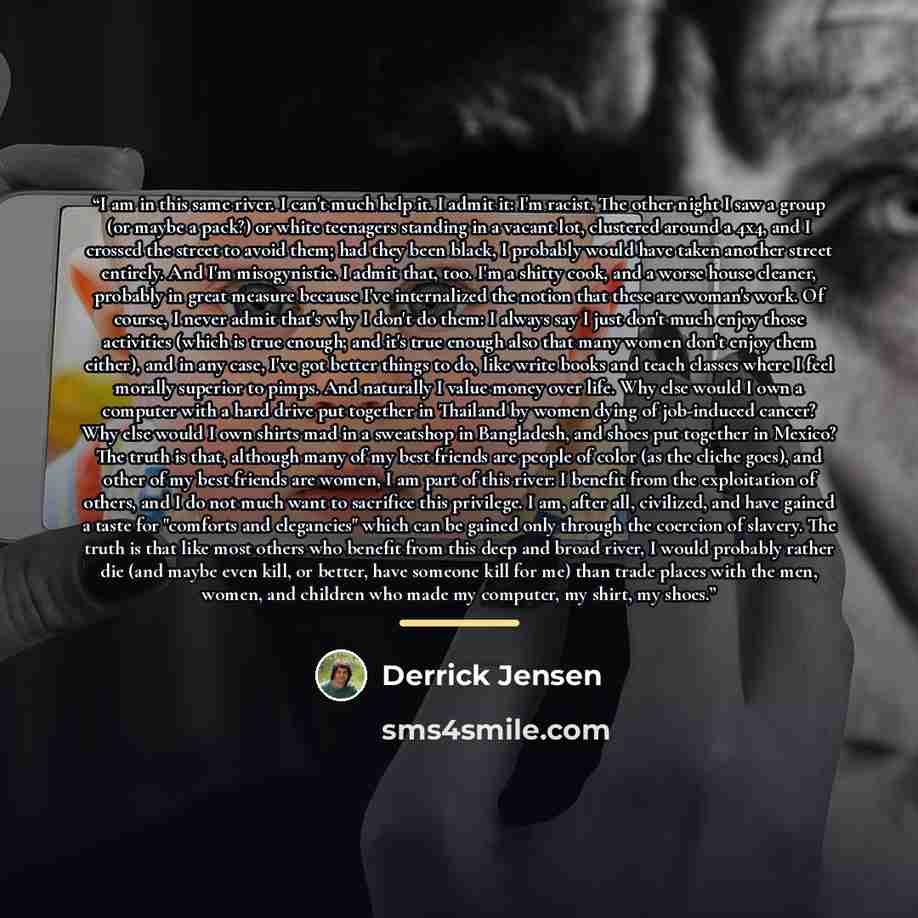
““I am in this same river. I can't much help it. I admit it: I'm racist. The other night I saw a group (or maybe a pack?) or white teenagers standing in a vacant lot, clustered around a 4x4, and I crossed the street to avoid them; had they been black, I probably would have taken another street entirely. And I'm misogynistic. I admit that, too. I'm a shitty cook, and a worse house cleaner, probably in great measure because I've internalized the notion that these are woman's work. Of course, I never admit that's why I don't do them: I always say I just don't much enjoy those activities (which is true enough; and it's true enough also that many women don't enjoy them either), and in any case, I've got better things to do, like write books and teach classes where I feel morally superior to pimps. And naturally I value money over life. Why else would I own a computer with a hard drive put together in Thailand by women dying of job-induced cancer? Why else would I own shirts mad in a sweatshop in Bangladesh, and shoes put together in Mexico? The truth is that, although many of my best friends are people of color (as the cliche goes), and other of my best friends are women, I am part of this river: I benefit from the exploitation of others, and I do not much want to sacrifice this privilege. I am, after all, civilized, and have gained a taste for "comforts and elegancies" which can be gained only through the coercion of slavery. The truth is that like most others who benefit from this deep and broad river, I would probably rather die (and maybe even kill, or better, have someone kill for me) than trade places with the men, women, and children who made my computer, my shirt, my shoes.””
About This Quote
Source Essay: “The River of Privilege” (self‑published, 2020)
The speaker acknowledges personal biases and complicity in systemic oppression, recognizing how privilege is built on exploitation and expressing moral conflict about it.
In simple terms: I admit my racism, misogyny, and benefit from exploitation.
Key Takeaway
Recognize and confront your own privileges and biases.
Themes
self‑awareness
privilege
systemic oppression
moral conflict
social responsibility
Mood
reflective
critical
somber
Type
confessional
philosophical
social critique
When to use this quote
- personal reflection
- activism
- educational workshops
- policy advocacy
- community dialogues
Key Concepts
intersectionality
ethical introspection
capitalist exploitation
Questions to Reflect On
- How can you turn this awareness into tangible anti‑oppressive actions?
- What steps can you take to reduce reliance on exploited labor?
A Different Perspective
The confession may be self‑serving and not lead to concrete change without action.