Books Quote by Deirdre McCloskey
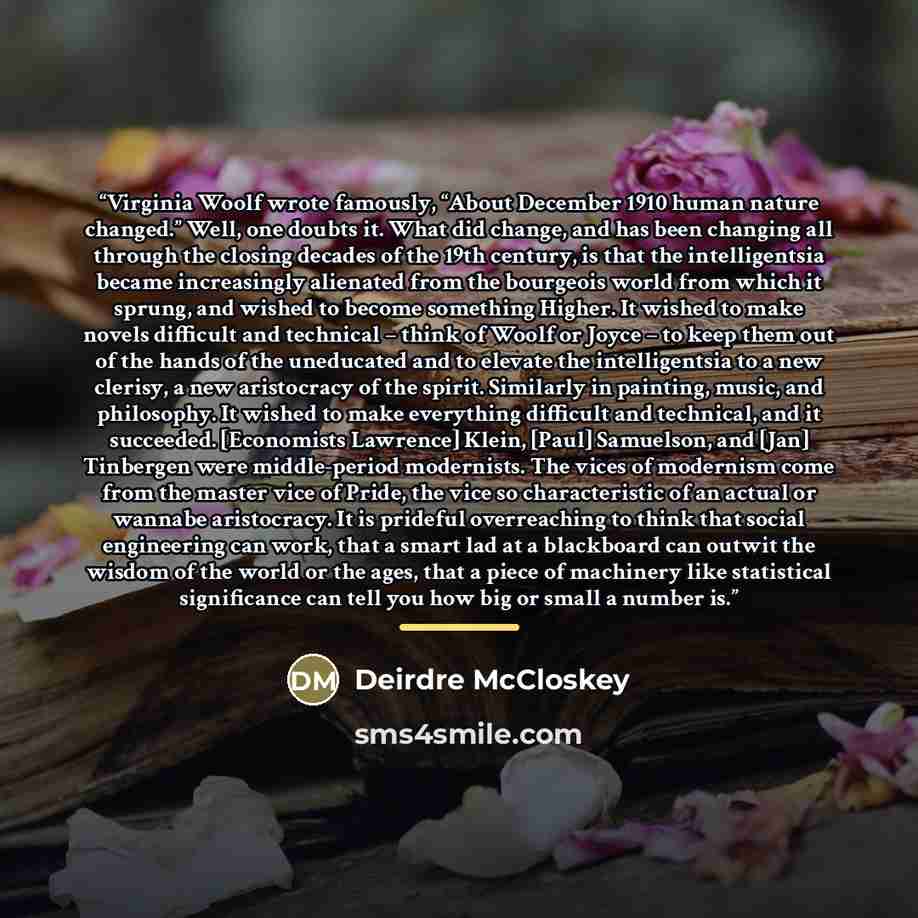
““Virginia Woolf wrote famously, “About December 1910 human nature changed.” Well, one doubts it. What did change, and has been changing all through the closing decades of the 19th century, is that the intelligentsia became increasingly alienated from the bourgeois world from which it sprung, and wished to become something Higher. It wished to make novels difficult and technical – think of Woolf or Joyce – to keep them out of the hands of the uneducated and to elevate the intelligentsia to a new clerisy, a new aristocracy of the spirit. Similarly in painting, music, and philosophy. It wished to make everything difficult and technical, and it succeeded. [Economists Lawrence] Klein, [Paul] Samuelson, and [Jan] Tinbergen were middle-period modernists. The vices of modernism come from the master vice of Pride, the vice so characteristic of an actual or wannabe aristocracy. It is prideful overreaching to think that social engineering can work, that a smart lad at a blackboard can outwit the wisdom of the world or the ages, that a piece of machinery like statistical significance can tell you how big or small a number is.””
About This Quote
Source Essay: The Rise of Modernism, 1990s
Modernism’s drive for elite distinction created elitist art and economics, rooted in pride and overconfidence in technical mastery.
In simple terms: Elitist art and economics stem from pride and overconfidence.
Key Takeaway
Beware prideful overreach in intellectual pursuits.
Themes
elitism
pride
modernism
intellectualism
social engineering
Mood
critical
reflective
skeptical
Type
philosophical
critical
When to use this quote
- academic circles
- art criticism
- economic policy design
- philosophical debates
- media analysis
Key Concepts
cultural hierarchy
technical elitism
statistical significance
social engineering
intellectual arrogance
Questions to Reflect On
- How does pride shape cultural movements?
- Can technical expertise be democratized?
A Different Perspective
It can alienate broader audiences and stifle inclusive progress.


![“Such fire was not by water to be drown'd, Nor he his nature changed by changing ground. [Lat., Ne spegner puo per star nell'acqua il foco; Ne puo stato mutar per mutar loco.]” quote by Ludovico Ariosto](https://sms4smile.com/quotes/img-quotes/bc3/ludovico-ariosto-32086_change_such-fire-was-not-by-water-to-be-drown-d_1768038.jpg)