Adventure Quote by David Graeber
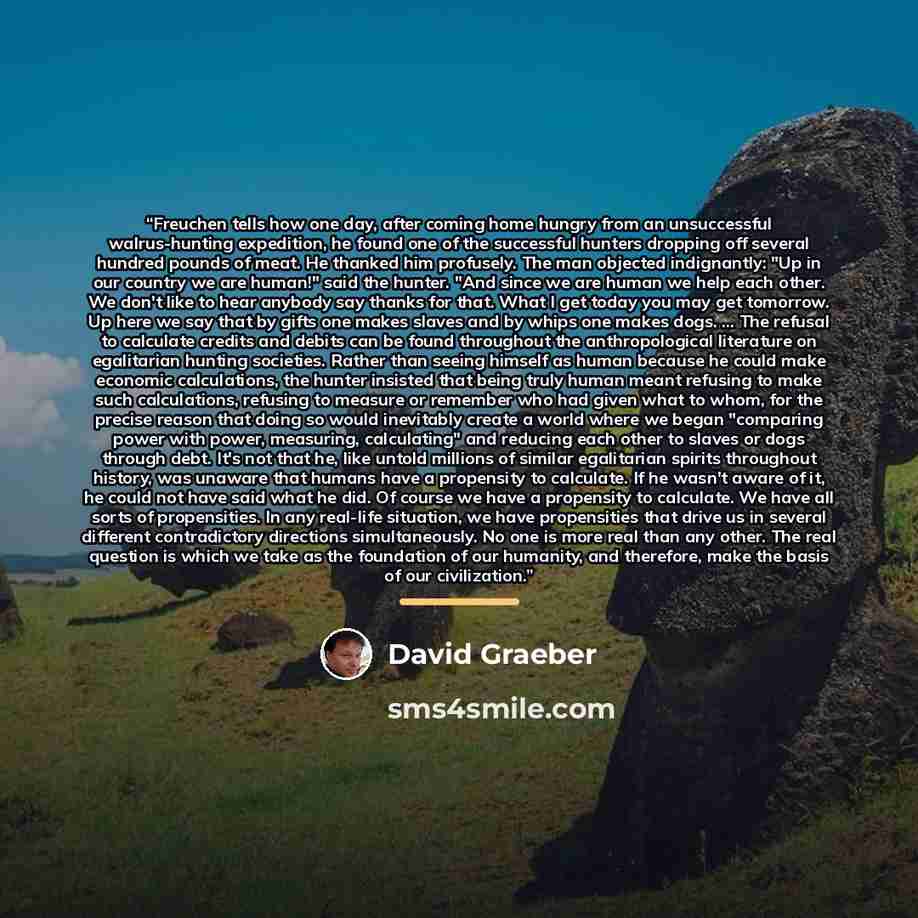
““Freuchen tells how one day, after coming home hungry from an unsuccessful walrus-hunting expedition, he found one of the successful hunters dropping off several hundred pounds of meat. He thanked him profusely. The man objected indignantly: "Up in our country we are human!" said the hunter. "And since we are human we help each other. We don't like to hear anybody say thanks for that. What I get today you may get tomorrow. Up here we say that by gifts one makes slaves and by whips one makes dogs. ... The refusal to calculate credits and debits can be found throughout the anthropological literature on egalitarian hunting societies. Rather than seeing himself as human because he could make economic calculations, the hunter insisted that being truly human meant refusing to make such calculations, refusing to measure or remember who had given what to whom, for the precise reason that doing so would inevitably create a world where we began "comparing power with power, measuring, calculating" and reducing each other to slaves or dogs through debt. It's not that he, like untold millions of similar egalitarian spirits throughout history, was unaware that humans have a propensity to calculate. If he wasn't aware of it, he could not have said what he did. Of course we have a propensity to calculate. We have all sorts of propensities. In any real-life situation, we have propensities that drive us in several different contradictory directions simultaneously. No one is more real than any other. The real question is which we take as the foundation of our humanity, and therefore, make the basis of our civilization.””
About This Quote
Source Book: Debt: The First 50 Years, David Graeber, 2011
Humanity is defined by refusing to reduce social bonds to transactional calculations, fostering egalitarian solidarity.
In simple terms: Being human means helping without keeping score.
Key Takeaway
Prioritize generosity over accounting.
Themes
solidarity
humanity
egalitarianism
social bonds
Mood
reflective
thoughtful
inspirational
Type
philosophical
ethical
When to use this quote
- community building
- conflict resolution
- social policy
- education
- nonprofit work
Key Concepts
reciprocity
gift economy
anthropology
moral philosophy
Questions to Reflect On
- How can we recognize invisible debts in our relationships?
- What practices keep generosity authentic?
A Different Perspective
Even in egalitarian contexts, hidden debts and power imbalances can emerge unnoticed.












![“I've used the Phoenix Centrifuge to replicate what the body's going to go through on the flight up. I've also done some gravity tests with ZERO-G [a charter-flight service in Arlington, Va., that uses modified Boeing 727s to simulate weightlessness], which went great.” quote by Richard Branson](https://sms4smile.com/quotes/img-quotes/aa1/richard-branson-256_adventure_i-ve-used-the-phoenix-centrifuge-to-repl_903.jpg)