Art Quote by David Foster Wallace
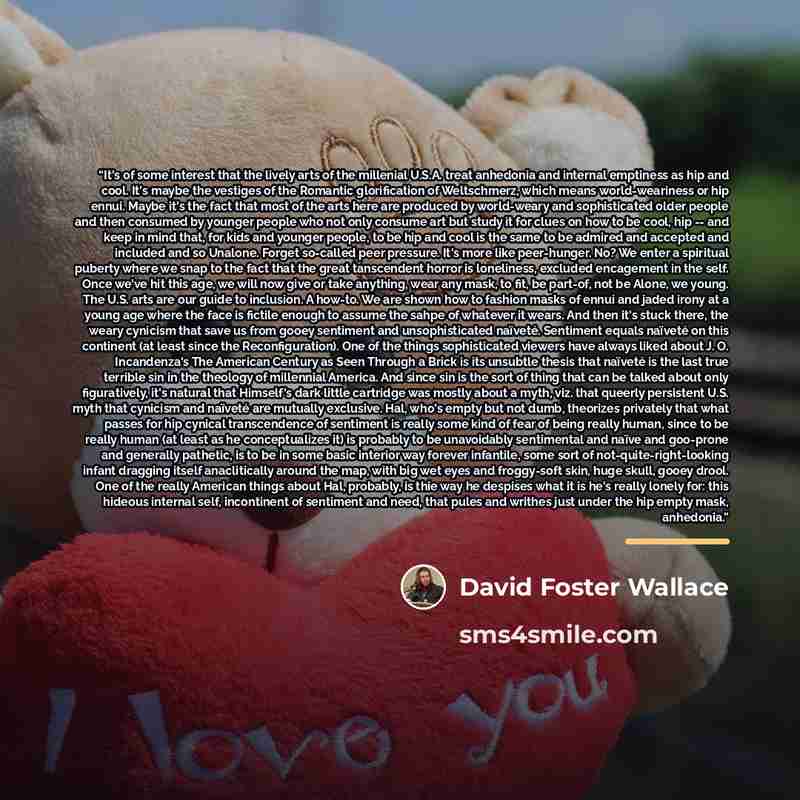
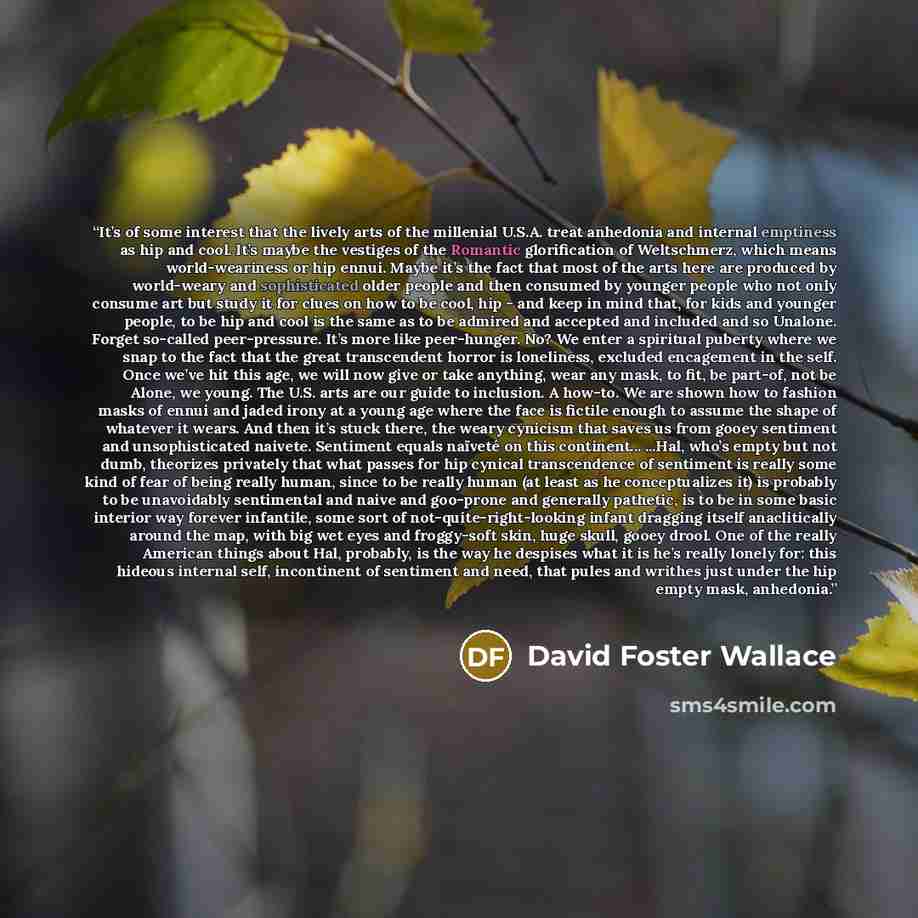
““It's of some interest that the lively arts of the millenial U.S.A. treat anhedonia and internal emptiness as hip and cool. It's maybe the vestiges of the Romantic glorification of Weltschmerz, which means world-weariness or hip ennui. Maybe it's the fact that most of the arts here are produced by world-weary and sophisticated older people and then consumed by younger people who not only consume art but study it for clues on how to be cool, hip -- and keep in mind that, for kids and younger people, to be hip and cool is the same to be admired and accepted and included and so Unalone. Forget so-called peer pressure. It's more like peer-hunger. No? We enter a spiritual puberty where we snap to the fact that the great tanscendent horror is loneliness, excluded encagement in the self. Once we've hit this age, we will now give or take anything, wear any mask, to fit, be part-of, not be Alone, we young. The U.S. arts are our guide to inclusion. A how-to. We are shown how to fashion masks of ennui and jaded irony at a young age where the face is fictile enough to assume the sahpe of whatever it wears. And then it's stuck there, the weary cynicism that save us from gooey sentiment and unsophisticated naïveté. Sentiment equals naïveté on this continent (at least since the Reconfiguration). One of the things sophisticated viewers have always liked about J. O. Incandenza's The American Century as Seen Through a Brick is its unsubtle thesis that naïveté is the last true terrible sin in the theology of millennial America. And since sin is the sort of thing that can be talked about only figuratively, it's natural that Himself's dark little cartridge was mostly about a myth, viz. that queerly persistent U.S. myth that cynicism and naïveté are mutually exclusive. Hal, who's empty but not dumb, theorizes privately that what passes for hip cynical transcendence of sentiment is really some kind of fear of being really human, since to be really human (at least as he conceptualizes it) is probably to be unavoidably sentimental and naïve and goo-prone and generally pathetic, is to be in some basic interior way forever infantile, some sort of not-quite-right-looking infant dragging itself anaclitically around the map, with big wet eyes and froggy-soft skin, huge skull, gooey drool. One of the really American things about Hal, probably, is thie way he despises what it is he's really lonely for: this hideous internal self, incontinent of sentiment and need, that pules and writhes just under the hip empty mask, anhedonia.””
About This Quote
The quote critiques how contemporary American culture glorifies ennui and cynicism as markers of coolness, turning loneliness into a social performance and masking genuine feeling with ironic detachment.
In simple terms: Hipness is a mask for loneliness and fear of authentic emotion.
Key Takeaway
Cynical coolness hides deep isolation.
Themes
culture
authenticity
loneliness
cynicism
identity
Mood
critical
wry
reflective
Type
cultural critique
philosophical observation
When to use this quote
- teenagers adopting ironic fashion
- social media personas
- art critics praising nihilistic works
Key Concepts
social performance
emotional avoidance
Practical Applications
- Encourage spaces for sincere expression
- Teach media literacy that distinguishes irony from authenticity
Questions to Reflect On
- How does ironic self‑presentation affect mental health?
- Can authenticity coexist with cultural trends of irony?
A Different Perspective
Some argue that irony can be a legitimate artistic tool, not merely a shield against vulnerability.

![“What passes for hip cynical transcendence of sentiment is really some kind of fear of being really human, since to be really human [...] is probably to be unavoidably sentimental and naïve and goo-prone and generally pathetic.” quote by David Foster Wallace](https://sms4smile.com/quotes/img-quotes/be2/david-foster-wallace-161_cynical_what-passes-for-hip-cynical-transcendenc_1913993.jpg)