Darkness Quote by Dallas Willard
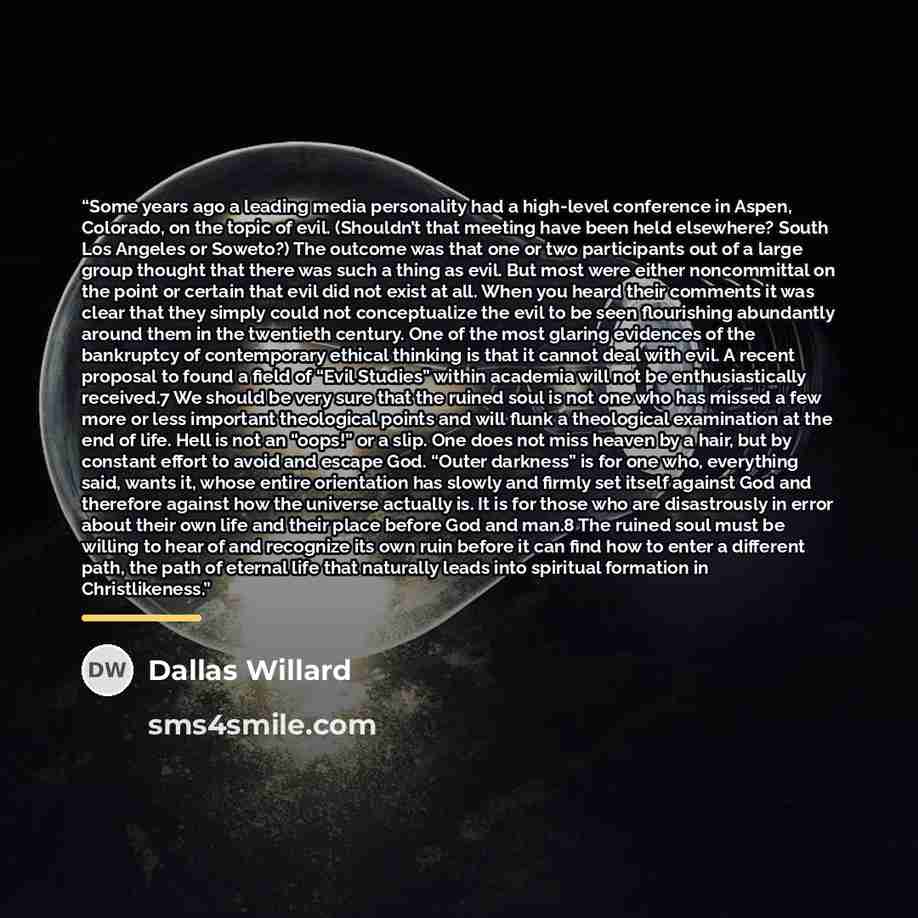
““Some years ago a leading media personality had a high-level conference in Aspen, Colorado, on the topic of evil. (Shouldn’t that meeting have been held elsewhere? South Los Angeles or Soweto?) The outcome was that one or two participants out of a large group thought that there was such a thing as evil. But most were either noncommittal on the point or certain that evil did not exist at all. When you heard their comments it was clear that they simply could not conceptualize the evil to be seen flourishing abundantly around them in the twentieth century. One of the most glaring evidences of the bankruptcy of contemporary ethical thinking is that it cannot deal with evil. A recent proposal to found a field of “Evil Studies” within academia will not be enthusiastically received.7 We should be very sure that the ruined soul is not one who has missed a few more or less important theological points and will flunk a theological examination at the end of life. Hell is not an “oops!” or a slip. One does not miss heaven by a hair, but by constant effort to avoid and escape God. “Outer darkness” is for one who, everything said, wants it, whose entire orientation has slowly and firmly set itself against God and therefore against how the universe actually is. It is for those who are disastrously in error about their own life and their place before God and man.8 The ruined soul must be willing to hear of and recognize its own ruin before it can find how to enter a different path, the path of eternal life that naturally leads into spiritual formation in Christlikeness.””
About This Quote
Source Book: The Divine Conspiracy, Dallas Willard, 1998
The quote argues that modern ethical discourse fails to address the reality of evil, suggesting a need for deeper theological self‑examination and a path toward spiritual renewal.
In simple terms: Modern ethics ignore evil; we need true self‑reflection and spiritual growth.
Key Takeaway
Recognize personal ruin and seek spiritual transformation.
Themes
ethics
theology
evil
spirituality
self‑examination
Mood
reflective
serious
hopeful
Type
theological
philosophical
inspirational
When to use this quote
- personal crisis
- religious study
- counseling
- community dialogue
- academic curricula
Key Concepts
theology of evil
moral bankruptcy
spiritual formation
Questions to Reflect On
- How can we balance theological insight with practical ethics?
- What steps help individuals recognize and overcome personal ruin?
A Different Perspective
Some may argue that labeling evil as a theological issue limits secular solutions to societal problems.