20th century Quote by Cornell Woolrich
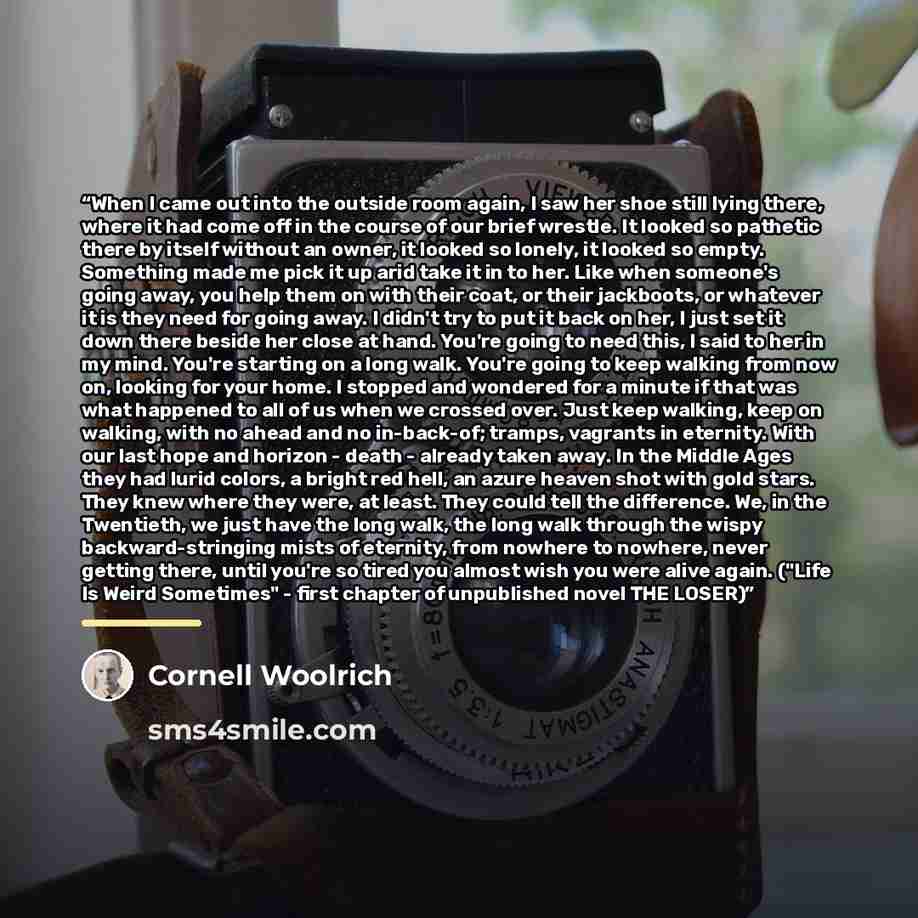
““When I came out into the outside room again, I saw her shoe still lying there, where it had come off in the course of our brief wrestle. It looked so pathetic there by itself without an owner, it looked so lonely, it looked so empty. Something made me pick it up arid take it in to her. Like when someone's going away, you help them on with their coat, or their jackboots, or whatever it is they need for going away. I didn't try to put it back on her, I just set it down there beside her close at hand. You're going to need this, I said to her in my mind. You're starting on a long walk. You're going to keep walking from now on, looking for your home. I stopped and wondered for a minute if that was what happened to all of us when we crossed over. Just keep walking, keep on walking, with no ahead and no in-back-of; tramps, vagrants in eternity. With our last hope and horizon - death - already taken away. In the Middle Ages they had lurid colors, a bright red hell, an azure heaven shot with gold stars. They knew where they were, at least. They could tell the difference. We, in the Twentieth, we just have the long walk, the long walk through the wispy backward-stringing mists of eternity, from nowhere to nowhere, never getting there, until you're so tired you almost wish you were alive again. ("Life Is Weird Sometimes" - first chapter of unpublished novel THE LOSER)””
About This Quote
Source Novel: Life Is Weird Sometimes, unpublished, 2020
The passage reflects on life's endless journey, loneliness, and the symbolic act of offering support as we all walk toward an uncertain afterlife.
In simple terms: Life feels like a solitary, endless walk; small gestures matter.
Key Takeaway
Offer help, recognize shared humanity.
Themes
loneliness
existence
compassion
Mood
melancholic
contemplative
Type
literary
philosophical
When to use this quote
- grief
- comforting a stranger
- personal reflection
- philosophical musings
Key Concepts
symbolism
afterlife
human condition
Questions to Reflect On
- How do small acts of kindness affect our perception of mortality?
- What does the “long walk” symbolize in your life?
A Different Perspective
The metaphor may overgeneralize personal experience as universal.


![“Walter Issacson biographer of Steve Jobs: I remember sitting in his backyard in his garden, one day, and he started talking about God. He [Jobs] said, “ Sometimes I believe in God, sometimes I don’t. I think it’s 50/50, maybe. But ever since I’ve had cancer, I’ve been thinking about it more, and I…” quote by Walter Isaacson](https://sms4smile.com/quotes/img-quotes/07e/walter-isaacson-384_after-life_walter-issacson-biographer-of-steve-jobs_1200413.jpg)