Books Quote by Christopher Hitchens
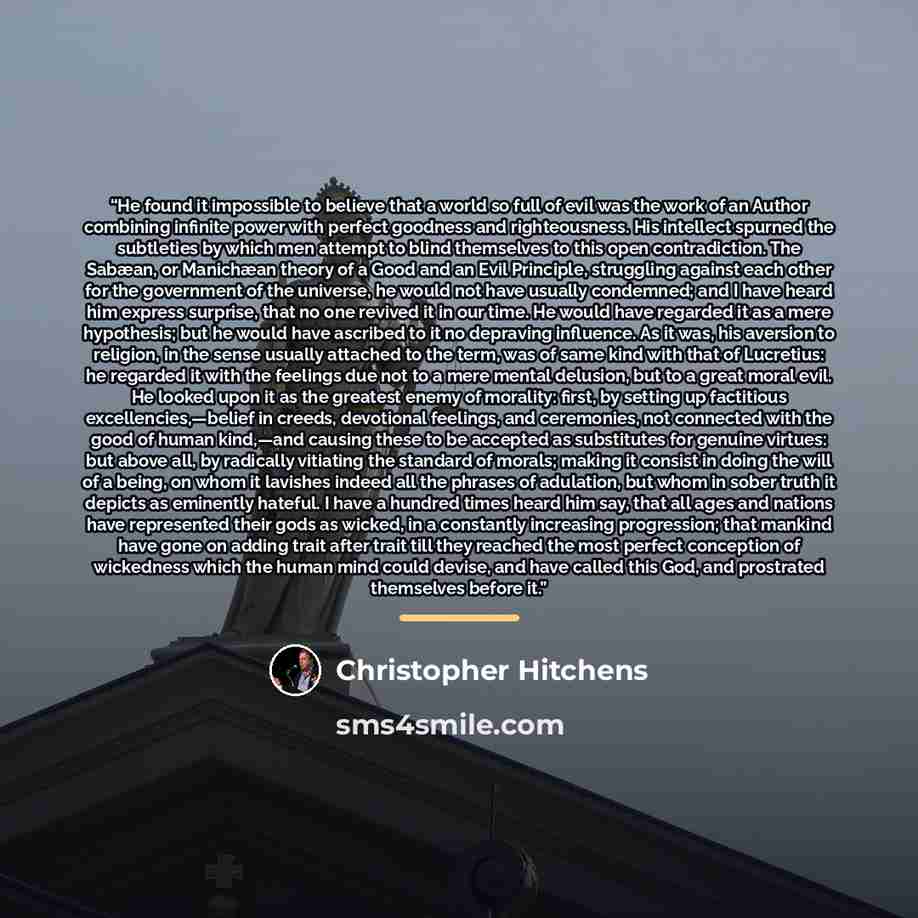
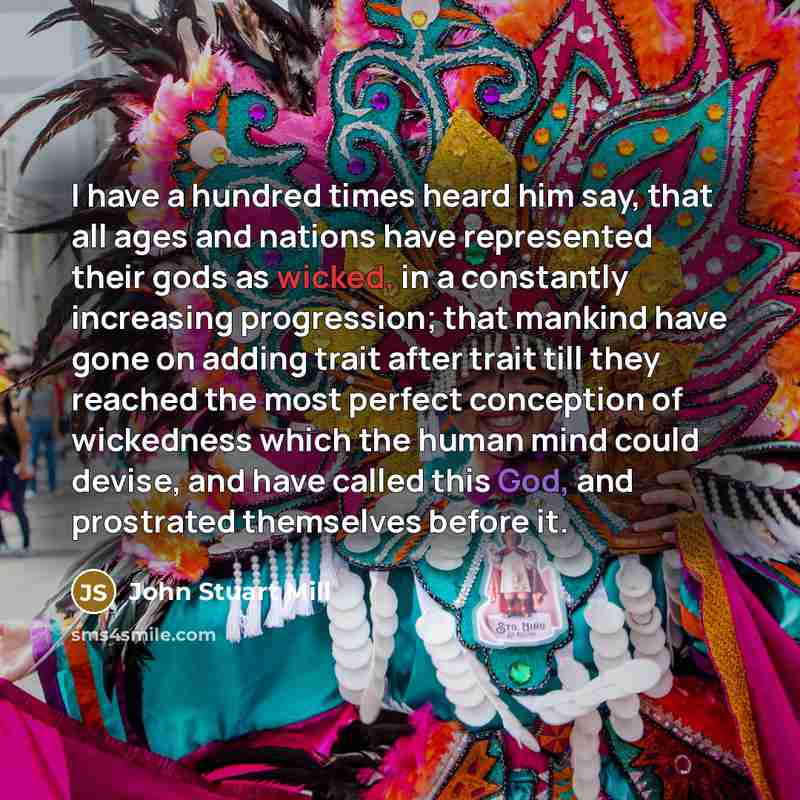
““He found it impossible to believe that a world so full of evil was the work of an Author combining infinite power with perfect goodness and righteousness. His intellect spurned the subtleties by which men attempt to blind themselves to this open contradiction. The Sabæan, or Manichæan theory of a Good and an Evil Principle, struggling against each other for the government of the universe, he would not have usually condemned; and I have heard him express surprise, that no one revived it in our time. He would have regarded it as a mere hypothesis; but he would have ascribed to it no depraving influence. As it was, his aversion to religion, in the sense usually attached to the term, was of same kind with that of Lucretius: he regarded it with the feelings due not to a mere mental delusion, but to a great moral evil. He looked upon it as the greatest enemy of morality: first, by setting up factitious excellencies,—belief in creeds, devotional feelings, and ceremonies, not connected with the good of human kind,—and causing these to be accepted as substitutes for genuine virtues: but above all, by radically vitiating the standard of morals; making it consist in doing the will of a being, on whom it lavishes indeed all the phrases of adulation, but whom in sober truth it depicts as eminently hateful. I have a hundred times heard him say, that all ages and nations have represented their gods as wicked, in a constantly increasing progression; that mankind have gone on adding trait after trait till they reached the most perfect conception of wickedness which the human mind could devise, and have called this God, and prostrated themselves before it.””
About This Quote
Source Book: God Is Not Great, 2007
The passage argues that belief in a morally perfect, all-powerful deity is contradictory, and that such belief undermines genuine morality.
In simple terms: Believing in a perfect god contradicts the existence of evil and harms true ethics.
Key Takeaway
Question religious claims that claim moral perfection.
Themes
theology
morality
philosophy
skepticism
evil
Mood
critical
skeptical
provocative
Type
philosophical
controversial
When to use this quote
- academic debate
- personal belief assessment
- ethical decision making
- public discourse
Key Concepts
problem of evil
moral relativism
religious critique
intellectual honesty
Questions to Reflect On
- What alternative foundations can support morality?
- How does this view affect personal faith?
A Different Perspective
It may overlook positive social functions of religion.

![“It's [Los Angeles] mostly full of nonsense and delusion and egomania. They think they'll be young and beautiful forever, even though most of them aren't even young and beautiful now.” quote by Christopher Hitchens](https://sms4smile.com/quotes/img-quotes/a86/christopher-hitchens-117_beautiful_it-s-los-angeles-mostly-full-of-nonsense_10462.jpg)
![“[Religion] attacks us in our deepest integrity - the core of our self-respect. Religion says that we would not know right from wrong, we would not know an evil, wicked act from a decent human act without divine permission, without divine authority or without, even worse, either the fear of a…” quote by Christopher Hitchens](https://sms4smile.com/quotes/img-quotes/ab6/christopher-hitchens-117_action_religion-attacks-us-in-our-deepest-integ_23299.jpg)