White people Quote by Charles W. Mills
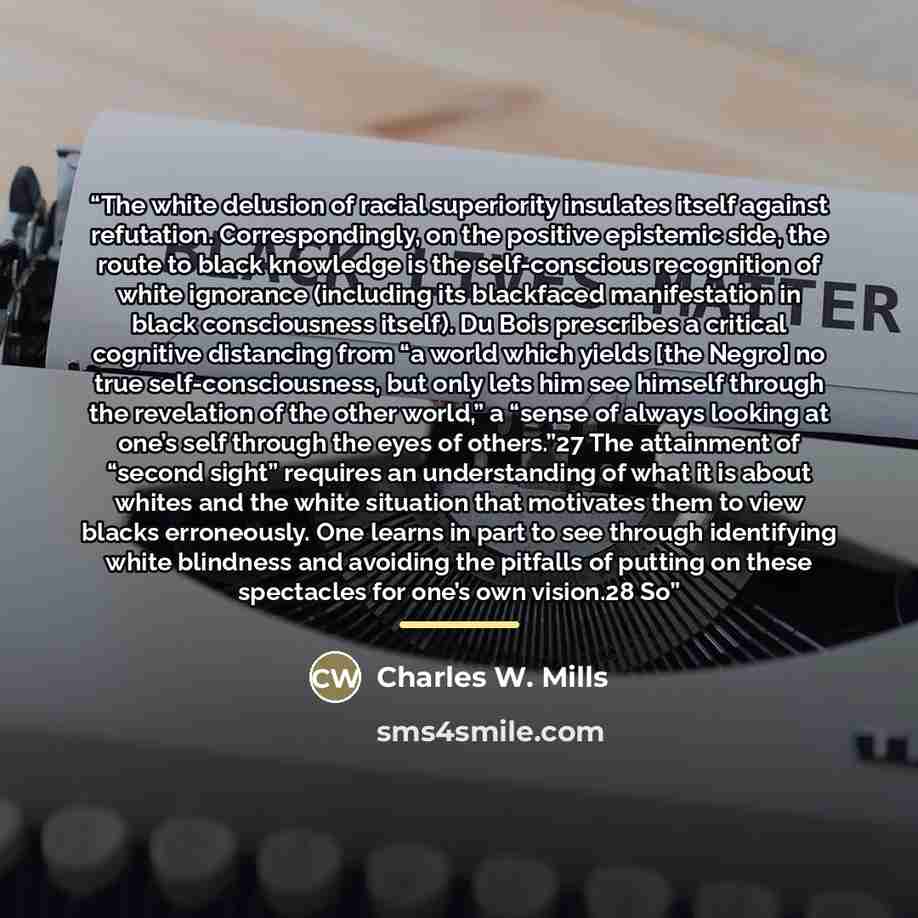
““For what people of color quickly come to see—in a sense the primary epistemic principle of the racialized social epistemology of which they are the object—is that they are not seen at all. Correspondingly, the “central metaphor” of W. E. B. Du Bois’s The Souls of Black Folk is the image of the “veil,”20 and the black American cognitive equivalent of the shocking moment of Cartesian realization of the uncertainty of everything one had taken to be knowledge is the moment when for Du Bois, as a child in New England, “it dawned upon me with a certain suddenness that I was different from the others; or like, mayhap, in heart and life and longing, but shut out from their [white] world by a vast veil.”21 Similarly, Ralph Ellison’s classic Invisible Man, generally regarded as the most important twentieth-century novel of the black experience, is arguably in key respects—while a multi-dimensional and multi-layered work of great depth and complexity, not to be reduced to a single theme—an epistemological novel.22 For what it recounts is the protagonist’s quest to determine what norms of belief are the right ones in a crazy looking-glass world where he is an invisible man “simply because [white] people refuse to see me… . When they approach me they see only my surroundings, themselves, or figments of their imagination—indeed, everything and anything except me.” And this systematic misperception is not, of course, due to biology, the intrinsic properties of his epidermis, or physical deficiencies in the white eye, but rather to “the construction of their inner eyes, those eyes with which they look through their physical eyes upon reality.”23””
About This Quote
Source Book: The Racial Contract by Charles W. Mills, 1997
People of color are often invisible to dominant groups, creating a “veil” that obscures their reality and knowledge.
In simple terms: They are unseen by the majority, like a veil.
Key Takeaway
Recognize and confront systemic invisibility.
Themes
Race
Epistemology
Visibility
Mood
critical
empathetic
Type
academic
social
When to use this quote
- education
- policy reform
- media representation
- activism
Key Concepts
Social perception
Knowledge construction
Questions to Reflect On
- How does invisibility affect identity?
- What steps can reveal hidden truths?
A Different Perspective
Individual bias also plays a role.