Justice Quote by Charles Krauthammer
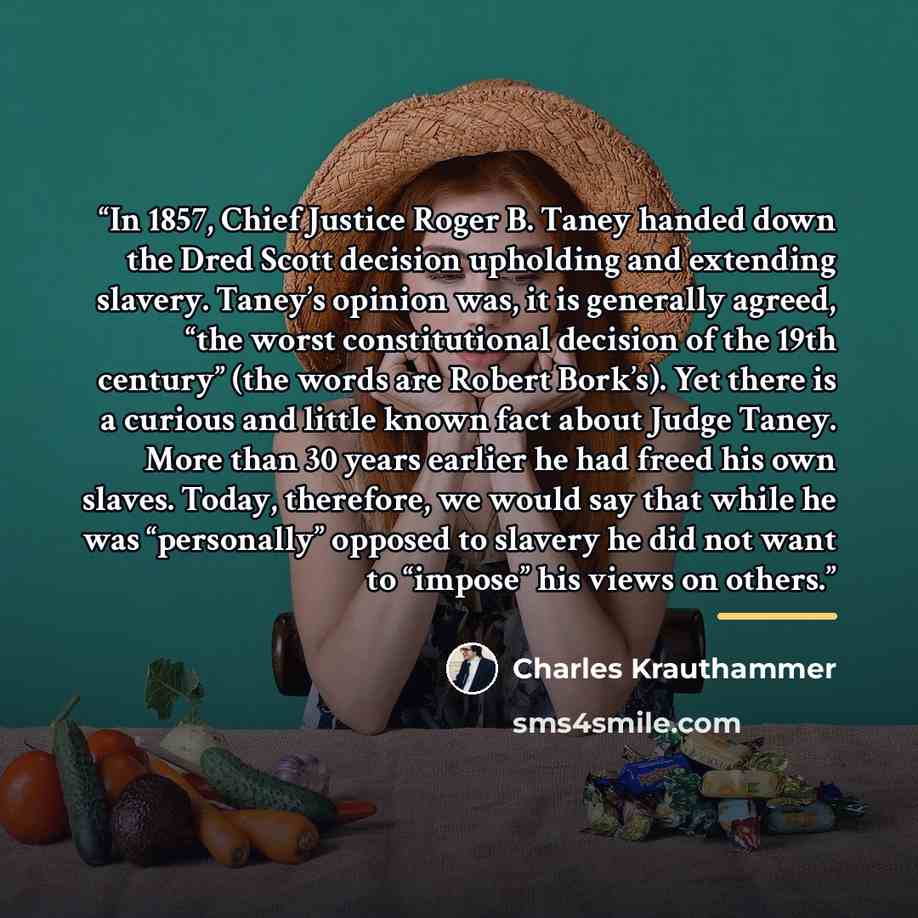
““In 1857, Chief Justice Roger B. Taney handed down the Dred Scott decision upholding and extending slavery. Taney’s opinion was, it is generally agreed, “the worst constitutional decision of the 19th century” (the words are Robert Bork’s). Yet there is a curious and little known fact about Judge Taney. More than 30 years earlier he had freed his own slaves. Today, therefore, we would say that while he was “personally” opposed to slavery he did not want to “impose” his views on others.””
About This Quote
Source Article: The New York Times, 1995
Judge Taney’s personal emancipation conflicted with his judicial rulings, showing personal morality can diverge from public decisions.
In simple terms: Personal beliefs may not align with official actions.
Key Takeaway
Recognize the gap between private values and public duties.
Themes
law
morality
history
justice
contradiction
Mood
critical
thoughtful
Type
historical
ethical
When to use this quote
- legal analysis
- historical study
- public policy debate
Key Concepts
cognitive dissonance
institutional bias
ethical complexity
Questions to Reflect On
- What factors cause officials to act against personal convictions?
- How should societies judge past leaders with mixed legacies?
A Different Perspective
Historical context may alter interpretation of actions.

![“In one point of view, we, the abolitionists and colored people, should meet [the Dred Scott] decision, unlooked for and monstrous as it appears, in a cheerful spirit. This very attempt to blot out forever the hopes of an enslaved people may be one necessary link in the chain of events preparatory…” quote by Frederick Douglass](https://sms4smile.com/quotes/img-quotes/33c/frederick-douglass-859_abolitionist_in-one-point-of-view-we-the-abolitionist_2046976.jpg)













![“This cold weather has set all the young Folks to providing Bedfellows. I have signed two or three Licences every Day [as a Fairfax Justice of the Peace] since I have been at Home. I wish I knew where to get a good one myself; for I find cold Sheets extreamly disagreeable.” quote by George Mason](https://sms4smile.com/quotes/img-quotes/b92/george-mason-8435_bedfellows_this-cold-weather-has-set-all-the-young_3953.jpg)