Fiction Quote by Brian Evenson
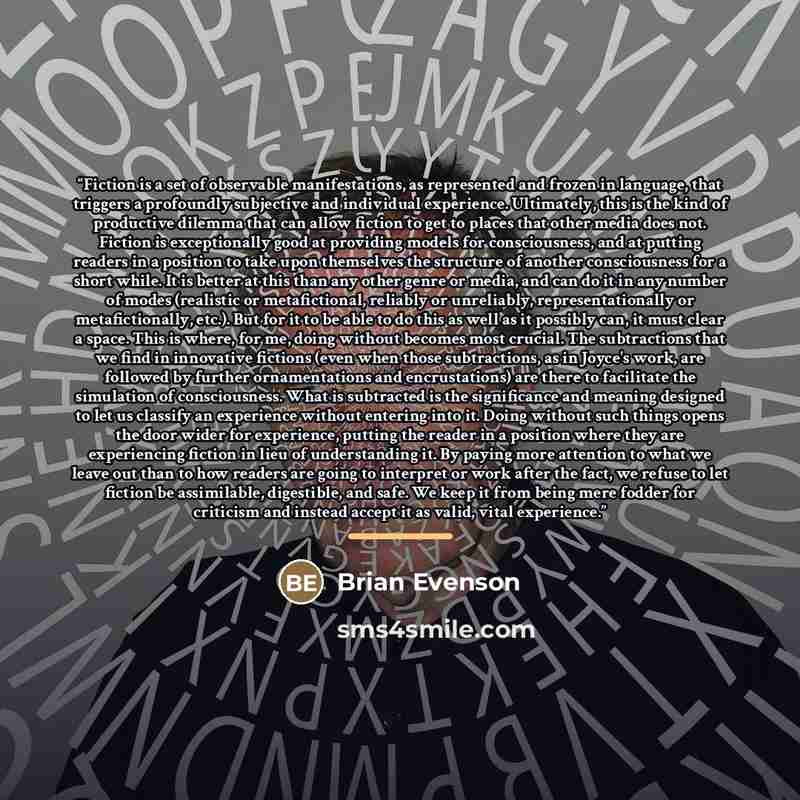
““Fiction is a set of observable manifestations, as represented and frozen in language, that triggers a profoundly subjective and individual experience. Ultimately, this is the kind of productive dilemma that can allow fiction to get to places that other media does not. Fiction is exceptionally good at providing models for consciousness, and at putting readers in a position to take upon themselves the structure of another consciousness for a short while. It is better at this than any other genre or media, and can do it in any number of modes (realistic or metafictional, reliably or unreliably, representationally or metafictionally, etc.). But for it to be able to do this as well as it possibly can, it must clear a space. This is where, for me, doing without becomes most crucial. The subtractions that we find in innovative fictions (even when those subtractions, as in Joyce's work, are followed by further ornamentations and encrustations) are there to facilitate the simulation of consciousness. What is subtracted is the significance and meaning designed to let us classify an experience without entering into it. Doing without such things opens the door wider for experience, putting the reader in a position where they are experiencing fiction in lieu of understanding it. By paying more attention to what we leave out than to how readers are going to interpret or work after the fact, we refuse to let fiction be assimilable, digestible, and safe. We keep it from being mere fodder for criticism and instead accept it as valid, vital experience.””
About This Quote
Source Essay: The Role of Subtraction in Fiction, Brian Evenson, 2015
Fiction creates deep personal experiences by omitting explicit meaning, forcing readers to inhabit another consciousness.
In simple terms: Fiction lets readers feel another mind by leaving out explanations.
Key Takeaway
Embrace narrative gaps to deepen immersion.
Themes
consciousness
empathy
literary technique
subtraction
experience
Mood
thoughtful
introspective
Type
analytical
philosophical
When to use this quote
- creative writing workshops
- literature classes
- book clubs
- novel analysis
- writing retreats
Key Concepts
simulation of consciousness
reader response
narrative omission
metafiction
psychology
Questions to Reflect On
- How does omission affect your connection to a story?
- When does lack of clarity become a barrier?
A Different Perspective
If too much is omitted, readers may feel alienated or confused.

![“Truth cannot be imparted. [] It must be inflicted.” quote by Brian Evenson](https://sms4smile.com/quotes/img-quotes/1e4/brian-evenson-21180_funny_truth-cannot-be-imparted-it-must-be-infl_117130.jpg)