Alarm clock Quote by Bret Anthony Johnston
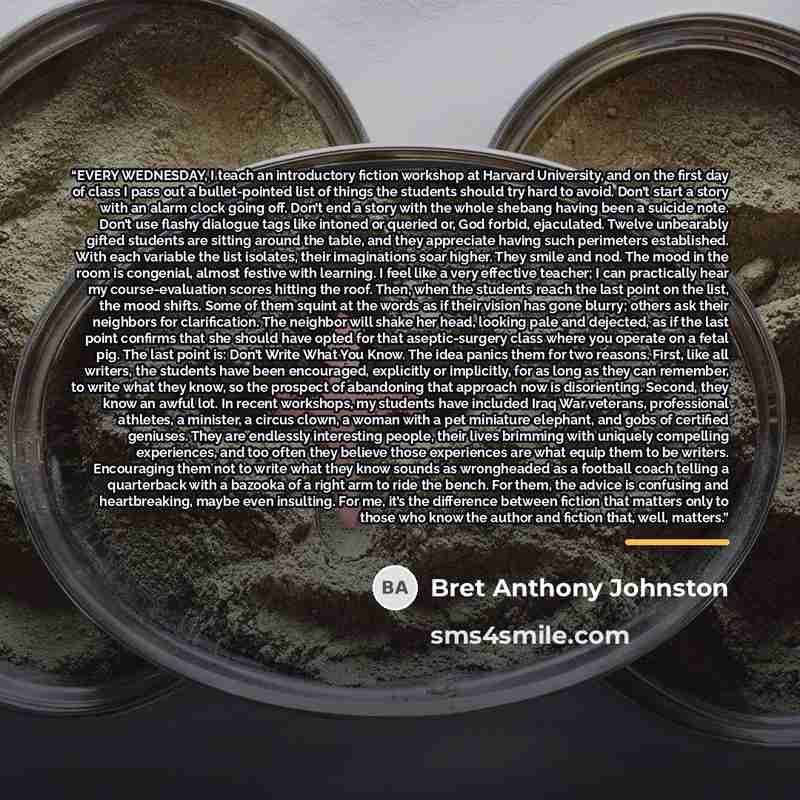
““EVERY WEDNESDAY, I teach an introductory fiction workshop at Harvard University, and on the first day of class I pass out a bullet-pointed list of things the students should try hard to avoid. Don’t start a story with an alarm clock going off. Don’t end a story with the whole shebang having been a suicide note. Don’t use flashy dialogue tags like intoned or queried or, God forbid, ejaculated. Twelve unbearably gifted students are sitting around the table, and they appreciate having such perimeters established. With each variable the list isolates, their imaginations soar higher. They smile and nod. The mood in the room is congenial, almost festive with learning. I feel like a very effective teacher; I can practically hear my course-evaluation scores hitting the roof. Then, when the students reach the last point on the list, the mood shifts. Some of them squint at the words as if their vision has gone blurry; others ask their neighbors for clarification. The neighbor will shake her head, looking pale and dejected, as if the last point confirms that she should have opted for that aseptic-surgery class where you operate on a fetal pig. The last point is: Don’t Write What You Know. The idea panics them for two reasons. First, like all writers, the students have been encouraged, explicitly or implicitly, for as long as they can remember, to write what they know, so the prospect of abandoning that approach now is disorienting. Second, they know an awful lot. In recent workshops, my students have included Iraq War veterans, professional athletes, a minister, a circus clown, a woman with a pet miniature elephant, and gobs of certified geniuses. They are endlessly interesting people, their lives brimming with uniquely compelling experiences, and too often they believe those experiences are what equip them to be writers. Encouraging them not to write what they know sounds as wrongheaded as a football coach telling a quarterback with a bazooka of a right arm to ride the bench. For them, the advice is confusing and heartbreaking, maybe even insulting. For me, it’s the difference between fiction that matters only to those who know the author and fiction that, well, matters.””
About This Quote
Source Speech: Lecture at Harvard University, Creative Writing Workshop, 2023
The instructor warns against common cliches and the advice to “write what you know,” urging writers to expand beyond familiar experiences.
In simple terms: Avoid clichés and over‑reliance on personal experience.
Key Takeaway
Challenge yourself to write beyond familiar.
Themes
writing
creativity
teaching
clichés
authenticity
Mood
thoughtful
inquisitive
Type
advisory
reflective
When to use this quote
- Creative writing classes
- fiction workshops
- personal memoirs
- genre experimentation
Key Concepts
Narrative technique
self‑imposed constraints
risk‑taking
Questions to Reflect On
- How can stepping outside familiar topics improve your storytelling?
- What risks do you face when you write about unknown subjects?
A Different Perspective
Over‑emphasizing “write what you know” can limit imagination and lead to safe, predictable work.
![“You know what I was thinking? [Ruthie] got so excited when she was spouting this ahistorical countertextual nonsense, and I caught myself thinking, 'What an idiot her teacher must be,' and thinking about her teacher made me realize - the kind of excitement she was showing as she mindlessly spouted…” quote by Orson Scott Card](https://sms4smile.com/quotes/img-quotes/795/orson-scott-card-134_teacher_you-know-what-i-was-thinking-ruthie-got_373758.jpg)