Change Quote by Baruch Spinoza
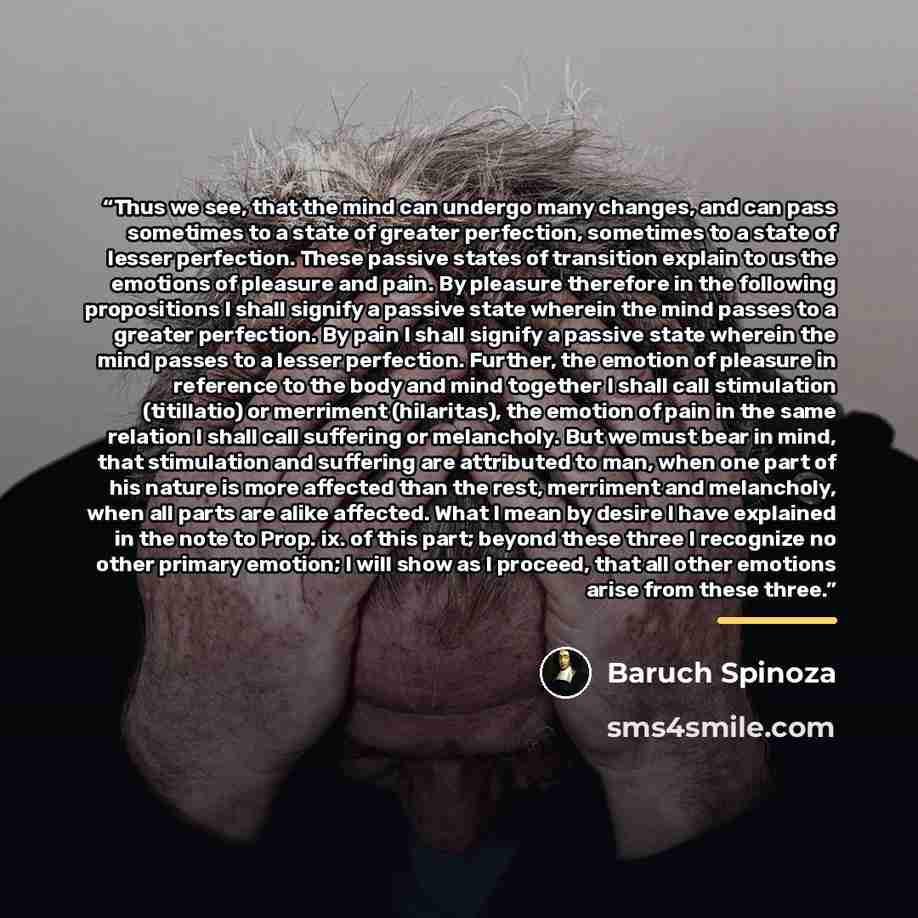
““Thus we see, that the mind can undergo many changes, and can pass sometimes to a state of greater perfection, sometimes to a state of lesser perfection. These passive states of transition explain to us the emotions of pleasure and pain. By pleasure therefore in the following propositions I shall signify a passive state wherein the mind passes to a greater perfection. By pain I shall signify a passive state wherein the mind passes to a lesser perfection. Further, the emotion of pleasure in reference to the body and mind together I shall call stimulation (titillatio) or merriment (hilaritas), the emotion of pain in the same relation I shall call suffering or melancholy. But we must bear in mind, that stimulation and suffering are attributed to man, when one part of his nature is more affected than the rest, merriment and melancholy, when all parts are alike affected. What I mean by desire I have explained in the note to Prop. ix. of this part; beyond these three I recognize no other primary emotion; I will show as I proceed, that all other emotions arise from these three.””
About This Quote
Source Book: Ethics, Part III, Proposition 16, 1677
Spinoza classifies emotions into three primary passive states—pleasure, pain, and desire—explaining how they arise from bodily and mental interactions.
In simple terms: Three basic emotions drive all feelings.
Key Takeaway
Recognize the roots of your emotions.
Themes
philosophy
psychology
ethics
Mood
thoughtful
analytical
Type
philosophical
educational
When to use this quote
- self‑reflection
- therapy
- conflict resolution
- creative work
Key Concepts
emotions
passivity
desire
pleasure
pain
Questions to Reflect On
- What primary emotion dominates your current mood?
- How can understanding this improve your choices?
A Different Perspective
Complex emotions often blend, defying simple categories.
![“We desire some pleasure, and the material means of obtaining it are lacking. “It is a mistake,” Labruyère tells us, “to be in love without an ample fortune.” There is nothing for it but to attempt a gradual elimination of our desire for that pleasure. [...] But the pleasure can never be realised…” quote by Marcel Proust](https://sms4smile.com/quotes/img-quotes/270/marcel-proust-114_change_we-desire-some-pleasure-and-the-material_1932257.jpg)