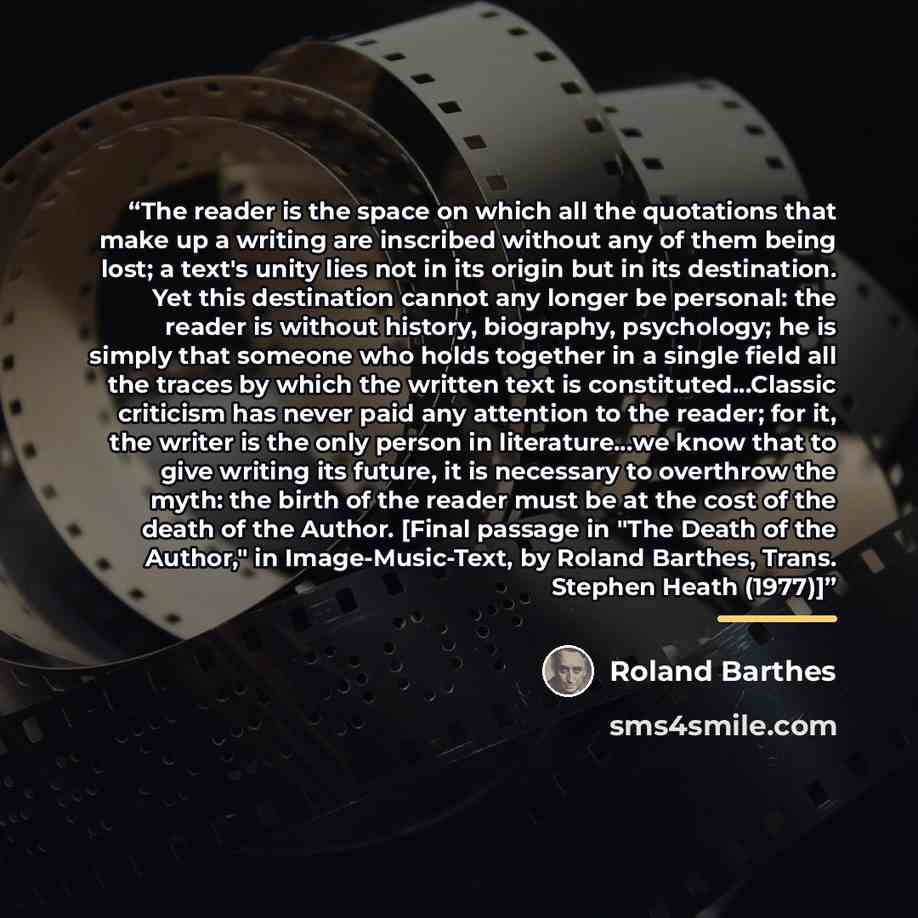
Books Quote by Barthes

““Probably this has always been the case: once an action is recounted, for intransitive ends, and no longer in order to act directly upon reality — that is, finally external to any function but the very exercise of the symbol — this disjunction occurs, the voice loses its origin, the author enters his own death, writing begins. Nevertheless, the feeling about this phenomenon has been variable; in primitive societies, narrative is never undertaken by a person, but by a mediator, shaman or speaker, whose “perfor - mance” may be admired (that is, his mastery of the narrative code), but not his “ge - nius” The author is a modern figure, produced no doubt by our society insofar as, at the end of the middle ages, with English empiricism, French rationalism and the per - sonal faith of the Reformation, it discovered the prestige of the individual, or, to put it more nobly, of the “human person” Hence it is logical that with regard to literature it should be positivism, resume and the result of capitalist ideology, which has accorded the greatest importance to the author’s “person” The author still rules in manuals of literary history, in biographies of writers, in magazine interviews, and even in the awareness of literary men, anxious to unite, by their private journals, their person and their work; the image of literature to be found in contemporary culture is tyrannically centered on the author, his person, his history, his tastes, his passions; criticism still consists, most of the time, in saying that Baudelaire’s work is the failure of the man Baudelaire, Van Gogh’s work his madness, Tchaikovsky’s his vice: the explanation of the work is always sought in the man who has produced it, as if, through the more or less transparent allegory of fiction, it was always finally the voice of one and the same person, the author, which delivered his “confidence.””
About This Quote
Source Book: Mythologies by Roland Barthes, 1957
The author’s voice becomes detached from reality, turning narrative into a symbol; modern focus on the author’s persona reflects capitalist and individualist ideologies.
In simple terms: Author’s voice loses origin, focus shifts to author’s persona.
Key Takeaway
Recognize the limits of author‑centric analysis.
Themes
literature
authorial focus
symbolism
Mood
analytical
critical
Type
theoretical
philosophical
When to use this quote
- academic study
- literary criticism
- media analysis
Key Concepts
Narrative authority
cultural critique
Questions to Reflect On
- How does focusing on the author shape interpretation?
- Can a text stand alone without authorial context?
A Different Perspective
Overemphasis on author can ignore text’s intrinsic value.