Considered subjectively, philosophy always begins in the middle, like an epic poem. — Karl Wilhelm Friedrich Schlegel Epic Copy Share Image
Plato's philosophy is a dignified preface to future religion. — Karl Wilhelm Friedrich Schlegel Philosophy Copy Share Image
To disrespect the masses is moral; to honor them, lawful. — Karl Wilhelm Friedrich Schlegel Disrespect Copy Share Image
Aphorisms are the true form of the universal philosophy. — Karl Wilhelm Friedrich Schlegel Aphorism Copy Share Image
A so-called happy marriage corresponds to love as a correct poem to an improvised song. — Karl Wilhelm Friedrich Schlegel Happy marriage Copy Share Image
Man is free whenever he produces or manifests God, and through this he becomes immortal. — Karl Wilhelm Friedrich Schlegel Free Copy Share Image
One mentions many artists who are actually art works of nature. — Karl Wilhelm Friedrich Schlegel Art Copy Share Image
Without poetry, religion becomes obscure, false, and malignant; without philosophy, licentious in all wantonness, and lascivious to the point of self-castration. — Karl Wilhelm Friedrich Schlegel Castration Copy Share Image
Nothing is more piquant than when a man of genius possesses mannerisms; not so when they possess him -- this leads to… — Karl Wilhelm Friedrich Schlegel Genius Copy Share Image
A classical work doesn't ever have to be understood entirely. But those who are educated and who are still educating themselves must… — Karl Wilhelm Friedrich Schlegel Classical Copy Share Image
It is individuality which is the original and eternal within man; personality doesn't matter so much. To pursue the education and development… — Karl Wilhelm Friedrich Schlegel Career Copy Share Image
Women are treated as unjustly in poetry as in life. The feminine ones are not idealistic, and the idealistic not feminine. — Karl Wilhelm Friedrich Schlegel Feminine Copy Share Image
Wit is the appearance, the external flash, of fantasy. Hence its divinity and the similarity to the wit of mysticism. — Karl Wilhelm Friedrich Schlegel Appearance Copy Share Image
All the great truths are basically trivial and so we have to find new ways, preferably paradoxical ways, of expressing them, in… — Karl Wilhelm Friedrich Schlegel Fall Copy Share Image
Whoever does not philosophize for the sake of philosophy, but rather uses philosophy as a means, is a sophist. — Karl Wilhelm Friedrich Schlegel Philosophy Copy Share Image
The naive is what is or appears to be natural, individual, or classical to the point of irony or to the point… — Karl Wilhelm Friedrich Schlegel Childish Copy Share Image
Some speak of the public as if it were someone with whom they have had dinner at the Leipzig Fair in the… — Karl Wilhelm Friedrich Schlegel Church Copy Share Image
True love should be, according to its origin, entirely arbitrary and entirely accidental at the same time; it should seem both necessary… — Karl Wilhelm Friedrich Schlegel Arbitrary Copy Share Image
The naive which is simultaneously beautiful, poetic, and idealistic, must be both intention and instinct. The essence of intention, in this sense,… — Karl Wilhelm Friedrich Schlegel Beautiful Copy Share Image
There are ancient and modern poems which breathe, in their entirety and in every detail, the divine breath of irony. In such… — Karl Wilhelm Friedrich Schlegel Ancient Copy Share Image
An artist is he who has his center within himself. He who lacks this must choose a particular leader and mediator outside… — Karl Wilhelm Friedrich Schlegel Art Copy Share Image
The most important thing in love is the sense for one another, and the highest thing the faith in one another. Devotion… — Karl Wilhelm Friedrich Schlegel Bad person Copy Share Image
Whoever has not arrived at the clear insight that there might be greatness entirely outside his own sphere for which he has… — Karl Wilhelm Friedrich Schlegel Areas Copy Share Image
Duty is for Kant the One and All. Out of the duty of gratitude, he claims, one has to defend and esteem… — Karl Wilhelm Friedrich Schlegel Claims Copy Share Image
The symmetry and organization of history teaches us that mankind, during its existence and development, genuinely was and became an individual, a… — Karl Wilhelm Friedrich Schlegel Development Copy Share Image
God is each truly and exalted thing, therefore the individual himself to the highest degree. But are not nature and the world… — Karl Wilhelm Friedrich Schlegel Exalted Copy Share Image
The surest method of being incomprehensible or, moreover, to be misunderstood is to use words in their original sense; especially words from… — Karl Wilhelm Friedrich Schlegel Ancient Copy Share Image
Is it not superfluous to write more than one novel if the writer has not become, say, a new man? Obviously, all… — Karl Wilhelm Friedrich Schlegel Books Copy Share Image
Nothing is more witty and grotesque than ancient mythology and Christianity; that is because they are so mystical. — Karl Wilhelm Friedrich Schlegel Ancient Copy Share Image
Can we expect the redemption of the world from scholars? I doubt it. But the time has come for all artists to… — Karl Wilhelm Friedrich Schlegel Art Copy Share Image
Novels are the Socratic dialogues of our time. Practical wisdom fled from school wisdom into this liberal form. — Karl Wilhelm Friedrich Schlegel Books Copy Share Image
The poetry of this one is called philosophical, of that one philological, of a third rhetorical, and so on. Which is then… — Karl Wilhelm Friedrich Schlegel Philosophical Copy Share Image
Religion can emerge in all forms of feeling: here wild anger, there the sweetest pain; here consuming hatred, there the childlike smile… — Karl Wilhelm Friedrich Schlegel Anger Copy Share Image
Every good man progressively becomes God. To become God, to be man, and to educate oneself, are expressions that are synonymous. — Karl Wilhelm Friedrich Schlegel Educate Copy Share Image
Both in their origins and effects, boredom and stuffy air resemble each other. They are usually generated whenever a large number of… — Karl Wilhelm Friedrich Schlegel Air Copy Share Image
There is no self-knowledge except historical self-knowledge. No one knows what he is if he doesn't know what his contemporaries are. — Karl Wilhelm Friedrich Schlegel Historical Copy Share Image
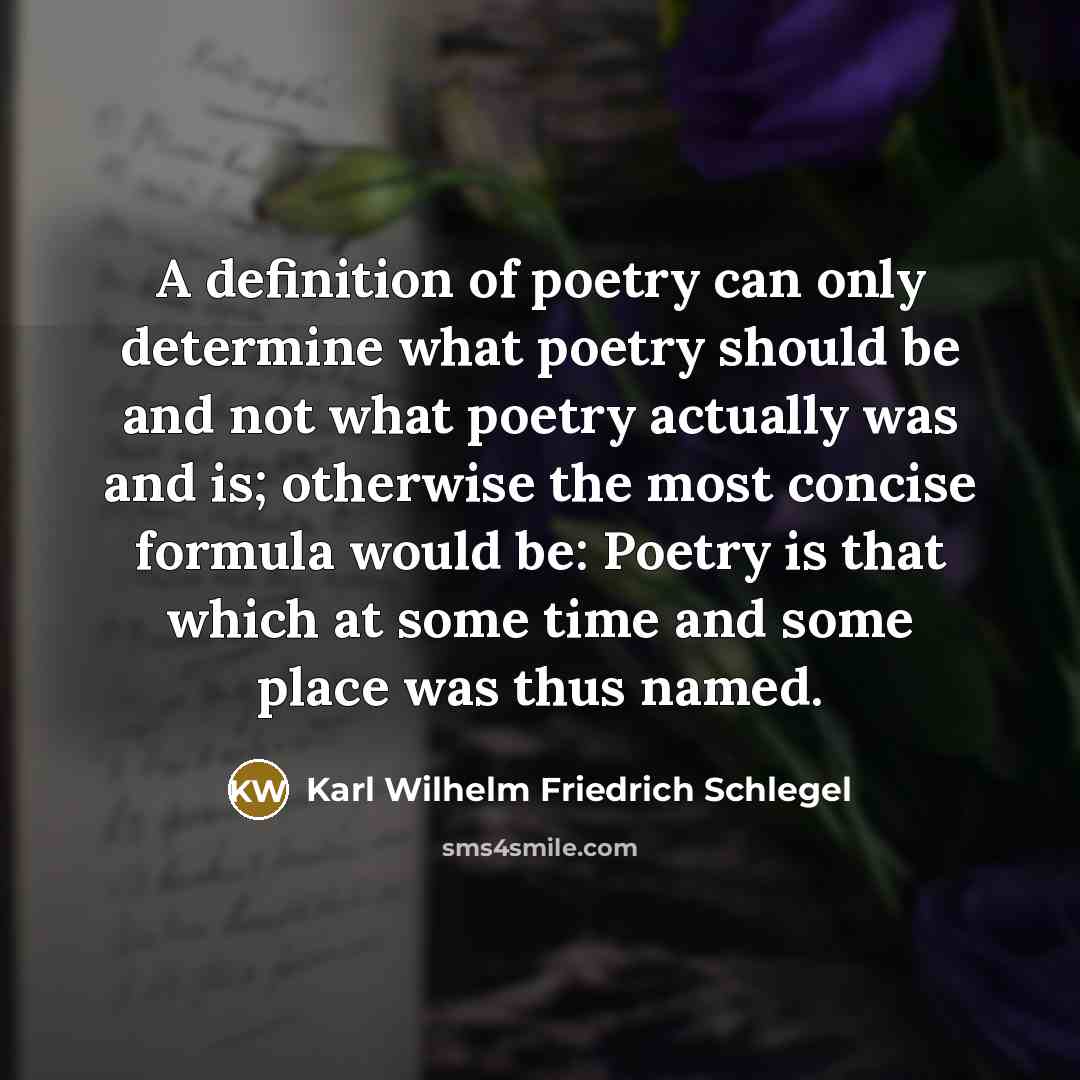
A definition of poetry can only determine what poetry should be and not what poetry actually was and is; otherwise the most… — Karl Wilhelm Friedrich Schlegel Concise Copy Share Image
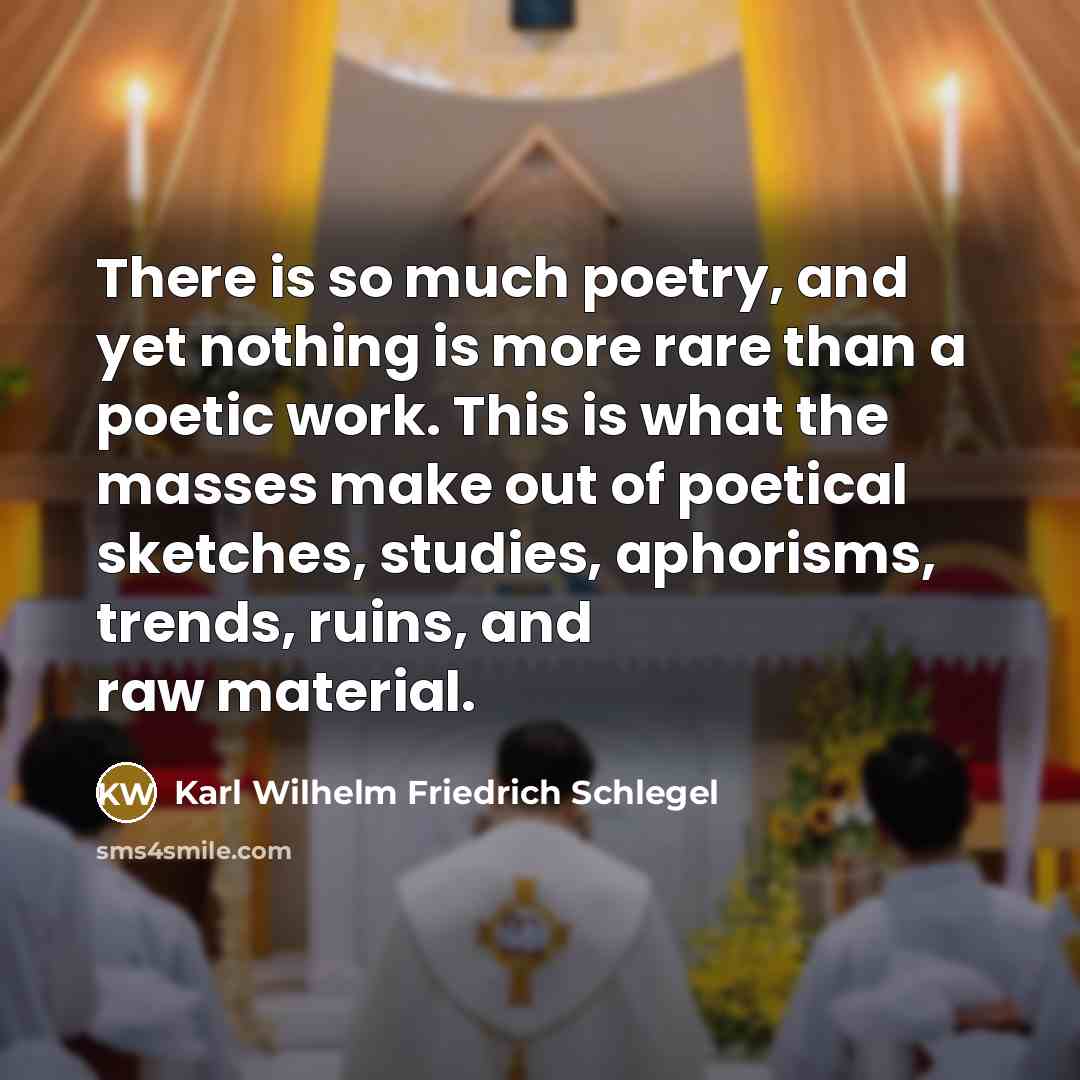
There is so much poetry, and yet nothing is more rare than a poetic work. This is what the masses make out… — Karl Wilhelm Friedrich Schlegel Aphorism Copy Share Image
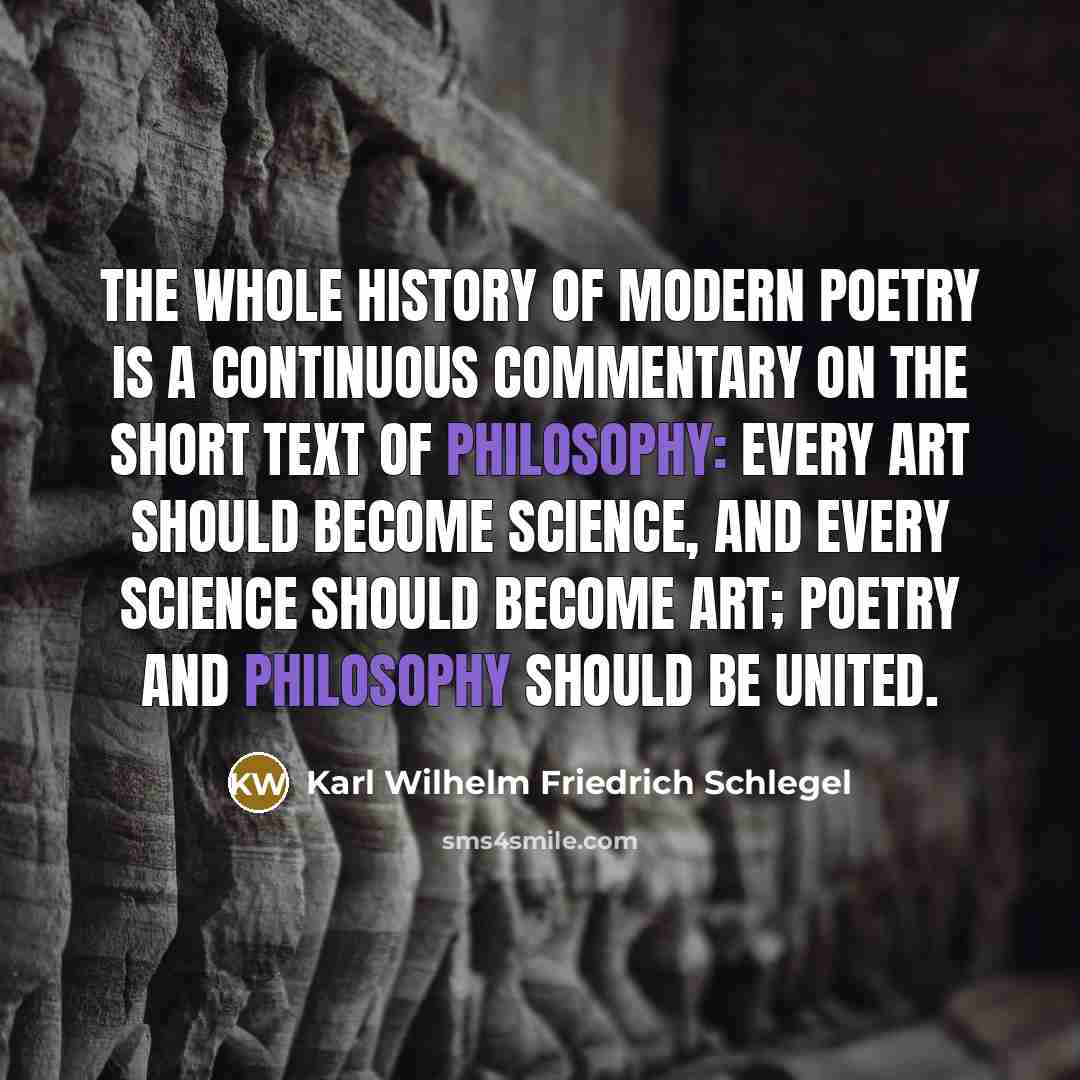
The whole history of modern poetry is a continuous commentary on the short text of philosophy: every art should become science, and… — Karl Wilhelm Friedrich Schlegel Art Copy Share Image
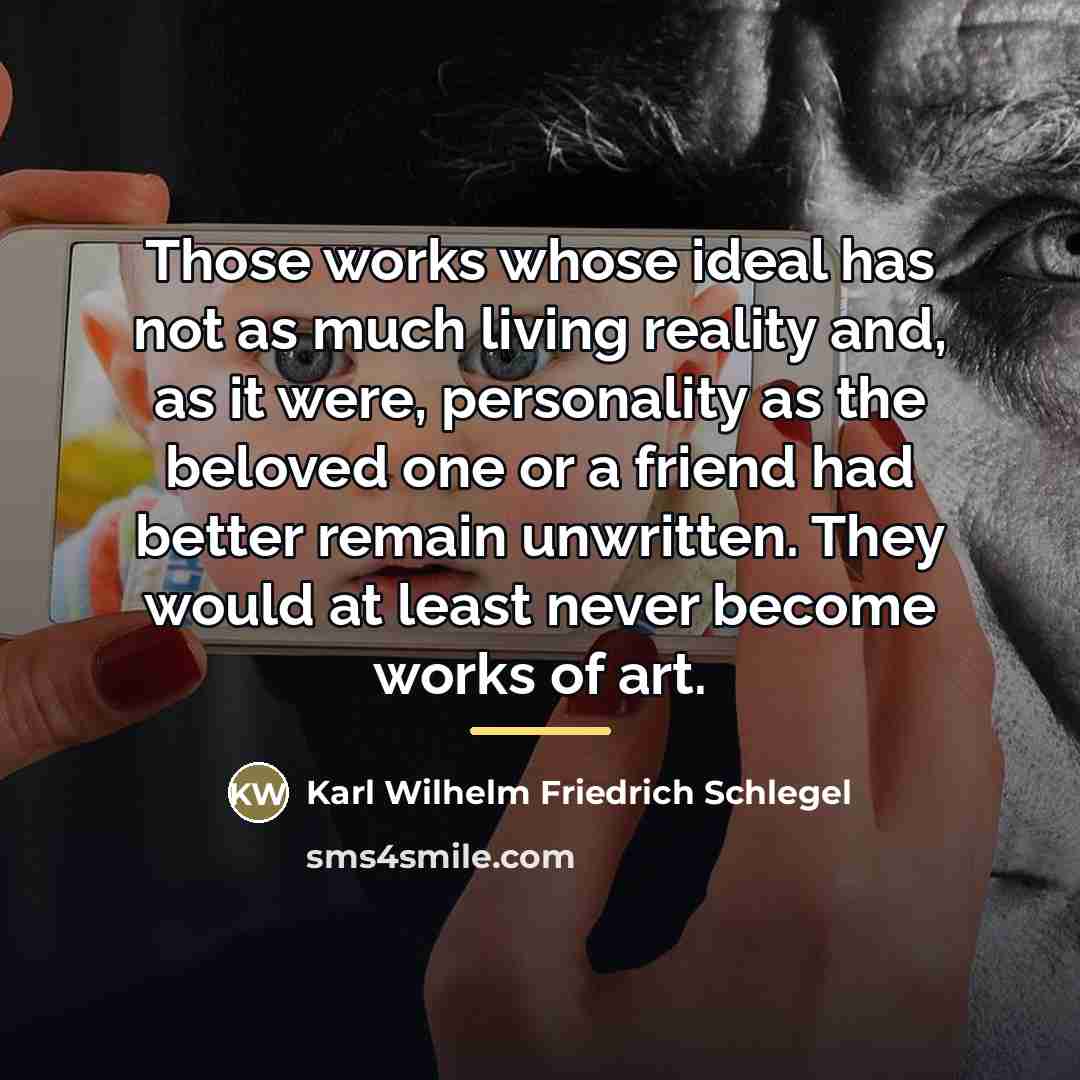
Those works whose ideal has not as much living reality and, as it were, personality as the beloved one or a friend… — Karl Wilhelm Friedrich Schlegel Art Copy Share Image