Novels are the Socratic dialogues of our time. Practical wisdom fled from school wisdom into this liberal form. — Karl Wilhelm Friedrich Schlegel Copy Share Image
A good preface must be the root and the square of the book at the same time. — Karl Wilhelm Friedrich Schlegel Copy Share Image
A critic is a reader who ruminates. Thus, he should have more than one stomach. — Karl Wilhelm Friedrich Schlegel Copy Share Image
Novels tend to end as the Paternoster begins: with the kingdom of God on earth. — Karl Wilhelm Friedrich Schlegel Copy Share Image
How many authors are there among writers? Author means originator. — Karl Wilhelm Friedrich Schlegel Copy Share Image
Whoever could properly characterize Goethe's Meister would have actually expressed what is the timely trend in literature. He would be able, as… — Karl Wilhelm Friedrich Schlegel Copy Share Image
Is it not superfluous to write more than one novel if the writer has not become, say, a new man? Obviously, all… — Karl Wilhelm Friedrich Schlegel Copy Share Image
When the author has no idea of what to reply to a critic, he then likes to say: you could not do… — Karl Wilhelm Friedrich Schlegel Copy Share Image
There are writers in Germany who drink the Absolute like water; and there are books in which even the dogs make references… — Karl Wilhelm Friedrich Schlegel Copy Share Image
The meanest authors have at least this similarity with the great author of heaven and earth, that they usually say after a… — Karl Wilhelm Friedrich Schlegel Copy Share Image
The history of imitation of the older literature, particularly abroad, has among other advantages this one, that the important concepts of unintentional… — Karl Wilhelm Friedrich Schlegel Copy Share Image
If one writes or reads novels from the point of view of psychology, it is very inconsistent and petty to want to… — Karl Wilhelm Friedrich Schlegel Copy Share Image
One of the two is almost always a prevailing tendency of every author: either not to say some things which certainly should… — Karl Wilhelm Friedrich Schlegel Copy Share Image
The analytical writer observes the reader as he is; accordingly, he makes his calculation, sets his machine to make the appropriate effect… — Karl Wilhelm Friedrich Schlegel Copy Share Image
The symmetry and organization of history teaches us that mankind, during its existence and development, genuinely was and became an individual, a person. In… — Karl Wilhelm Friedrich Schlegel Copy Share Image
Both in their origins and effects, boredom and stuffy air resemble each other. They are usually generated whenever a large number of people gather… — Karl Wilhelm Friedrich Schlegel Copy Share Image
Every good man progressively becomes God. To become God, to be man, and to educate oneself, are expressions that are synonymous. — Karl Wilhelm Friedrich Schlegel Copy Share Image
The naive is what is or appears to be natural, individual, or classical to the point of irony or to the point of continuous… — Karl Wilhelm Friedrich Schlegel Copy Share Image
Women are treated as unjustly in poetry as in life. The feminine ones are not idealistic, and the idealistic not feminine. — Karl Wilhelm Friedrich Schlegel Copy Share Image
In every good poem everything must be both deliberate and instinctive. That is how the poem becomes ideal. — Karl Wilhelm Friedrich Schlegel Copy Share Image
Only he who possesses a personal religion, an original view of infinity, can be an artist. — Karl Wilhelm Friedrich Schlegel Copy Share Image
Wit as an instrument of revenge is as infamous as art is as a means of sensual titillation. — Karl Wilhelm Friedrich Schlegel Copy Share Image
Where philosophy ends, poetry must commence. There should not be a common point of view, a natural manner of thinking which standsin contrast to… — Karl Wilhelm Friedrich Schlegel Copy Share Image
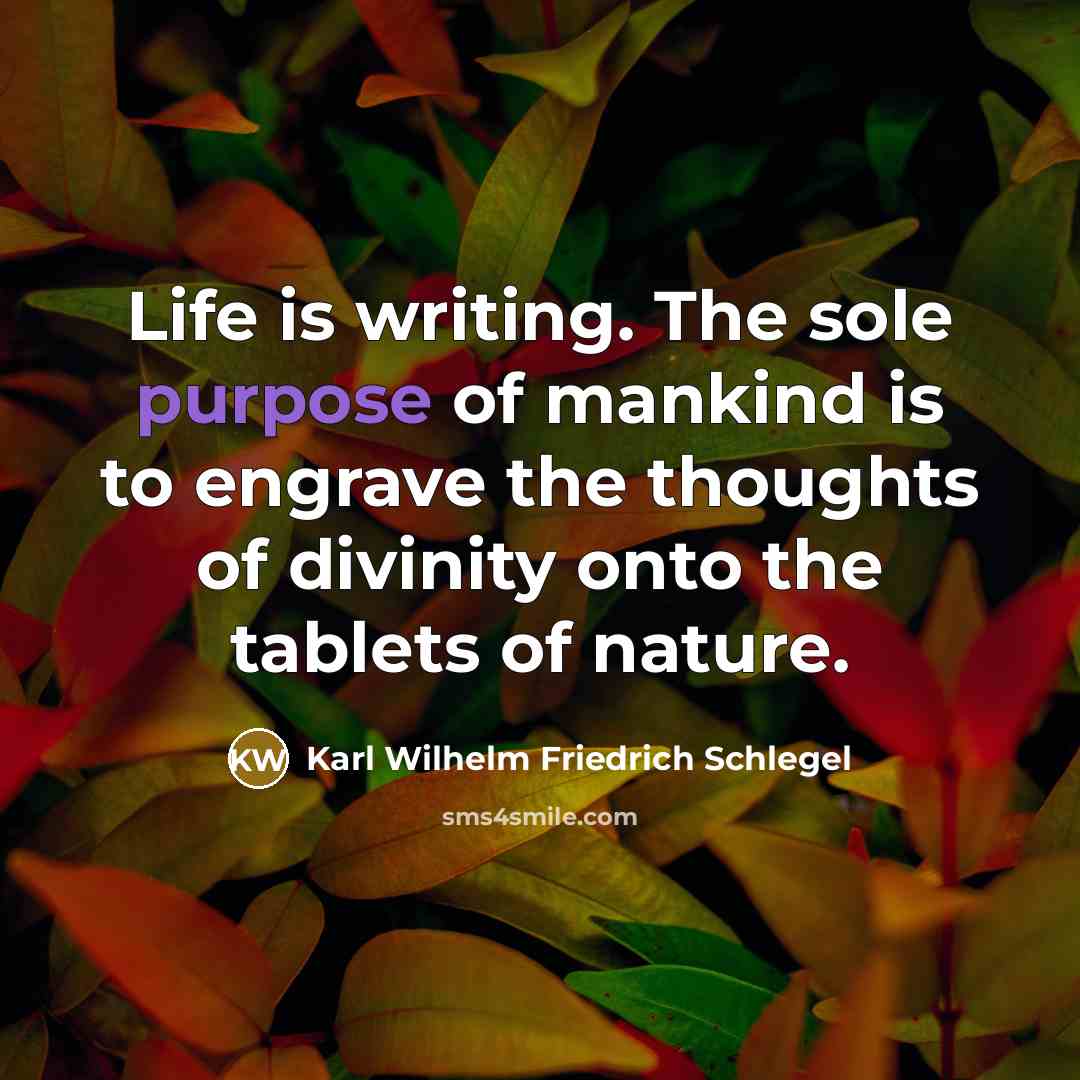
Life is writing. The sole purpose of mankind is to engrave the thoughts of divinity onto the tablets of nature. — Karl Wilhelm Friedrich Schlegel Copy Share Image
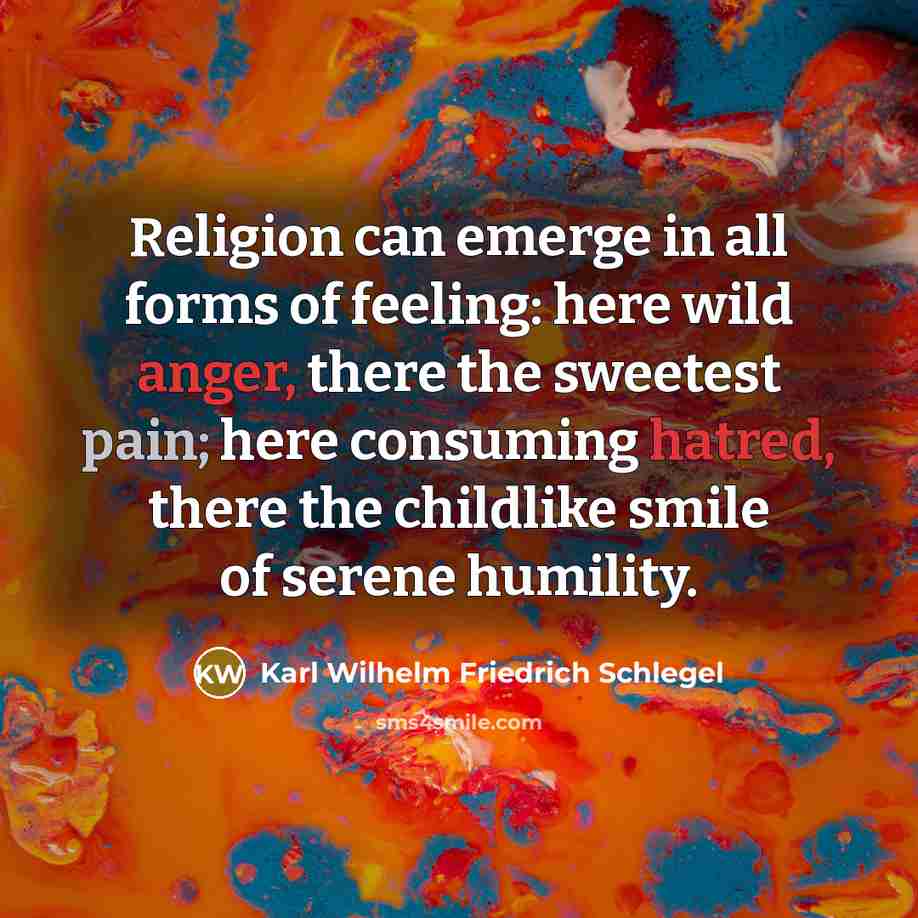
Religion can emerge in all forms of feeling: here wild anger, there the sweetest pain; here consuming hatred, there the childlike smile of serene… — Karl Wilhelm Friedrich Schlegel Copy Share Image