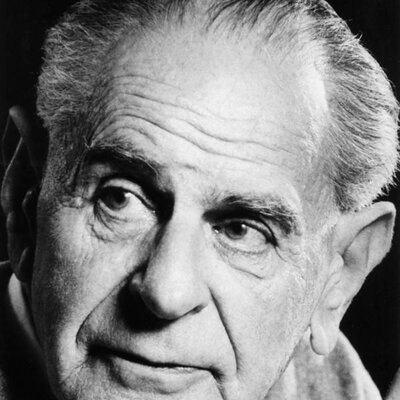
About Karl Popper
Sir Karl Raimund Popper was an Austrian–British philosopher, academic and social commentator. One of the 20th century's most influential philosophers of science, Popper is known for his rejection of the classical inductivist views on the scientific method in favour of empirical falsification made possible by his falsifiability criterion, and for founding the Department of Philosophy at the London School of Economics and Political Science. According to Popper, a theory in the empirical sciences can never be proven, but it can be falsified, meaning that it can be scrutinised with decisive experiments. Popper was opposed to the classical justificationist account of knowledge, which he replaced with "the first non-justificational philosophy of criticism in the history of philosophy", namely critical rationalism.
Known for:
The Open Society and Its Enemies|The Logic of Scientific Discovery|Conjectures and Refutations|The Poverty of Historicism|Unended Quest|The Self and Its Brain|Objective Knowledge
Notable works:
The Open Society and Its Enemies (1+2)
Awards:
Catalonia International Prize|Austrian Decoration for Science and Art|Otto Hahn Peace Medal|Montyon Prize|Goethe Medal|Knight Bachelor|Sonning Prize|Dr. Leopold Lucas Prize|Ring of Honour of the City of Vienna|Prix Alexis de Tocqueville|Companion of Honour|Great Golden Medal of Honour for Services to the Republic of Austria|Fellow of the British Academy|honorary doctor of the University of Vienna|Kyoto Prize in Arts and Philosophy|Benjamin E. Lippincott Award|Great Cross with Star and Sash of the Order of Merit of the Federal Republic of Germany|Pour le Mérite for Sciences and Arts order|honorary doctor of the University of Madrid Complutense|honorary doctorate of Salzburg University|honorary doctor of the Catholic University of Eichstätt-Ingolstadt|Honorary Fellow of the Royal Society Te Apārangi|honorary doctor of the University of Canterbury|http://www.wikidata.org/.well-known/genid/88340bfa2d5d13720dd939c9c1b0f453