The ugliness of the ideological lies in its legitimating the pursuit of the trivial. — John Carroll Ideological Copy Share Image
The original of morals lies with the thought that 'the community is more valuable than the individual' (Menschliches 2.1.89 — John Carroll Character Copy Share Image
This will of Stirner's, this restless probing of all given knowledge, this endless questioning, and the continuous bending towards new understanding. — John Carroll Bending Copy Share Image
The primary ambition of Nietzsche's critique of knowledge is ... to demonstrate that 'truths' are fictions masking moral commitments. — John Carroll Ambition Copy Share Image
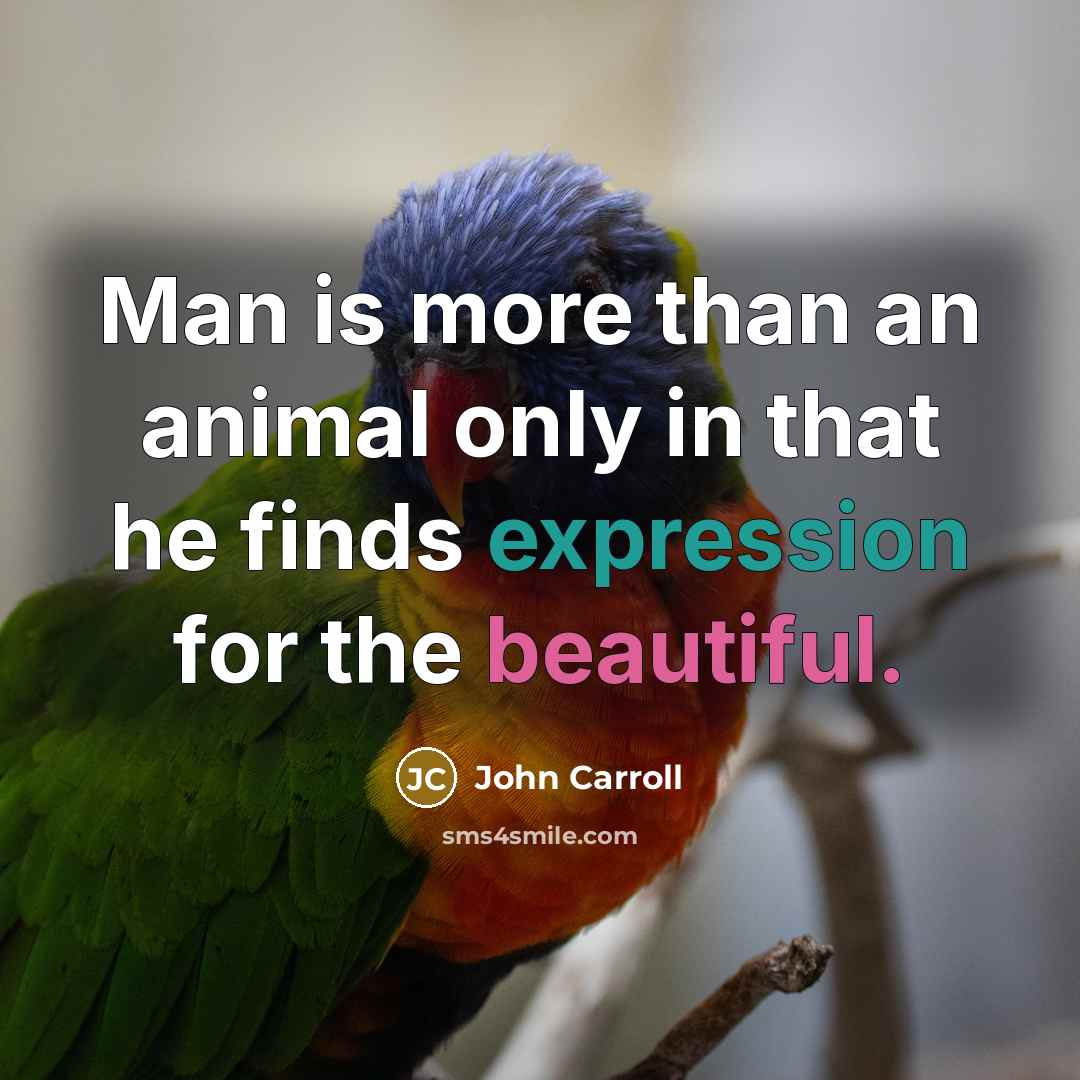
Man is more than an animal only in that he finds expression for the beautiful. — John Carroll Animal Copy Share Image
Any attempt to break with the past, or with existing social structures, is a failure if it leads to a bored, listless,… — John Carroll Assertive Copy Share Image
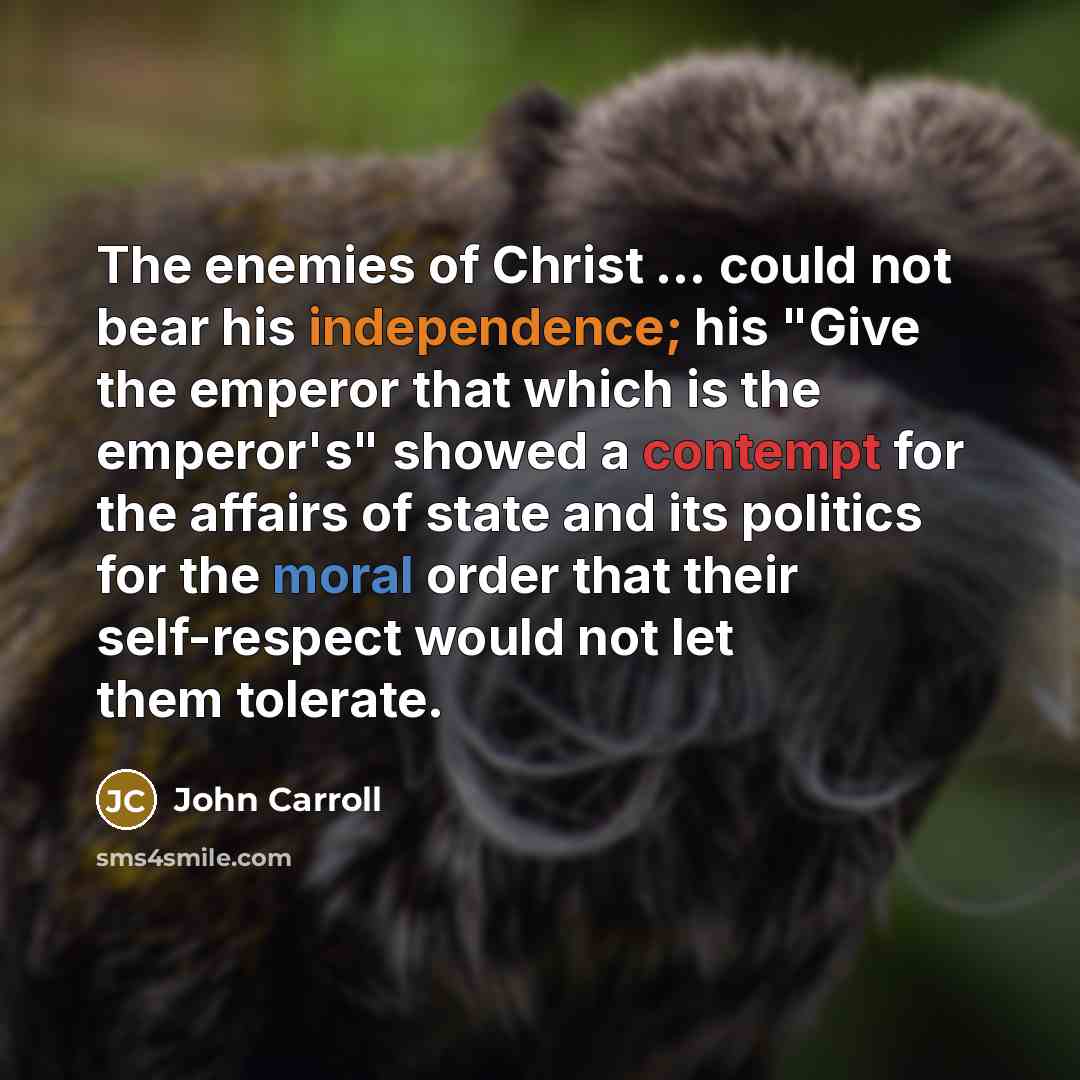
The enemies of Christ ... could not bear his independence; his "Give the emperor that which is the emperor's" showed a contempt… — John Carroll Affair Copy Share Image
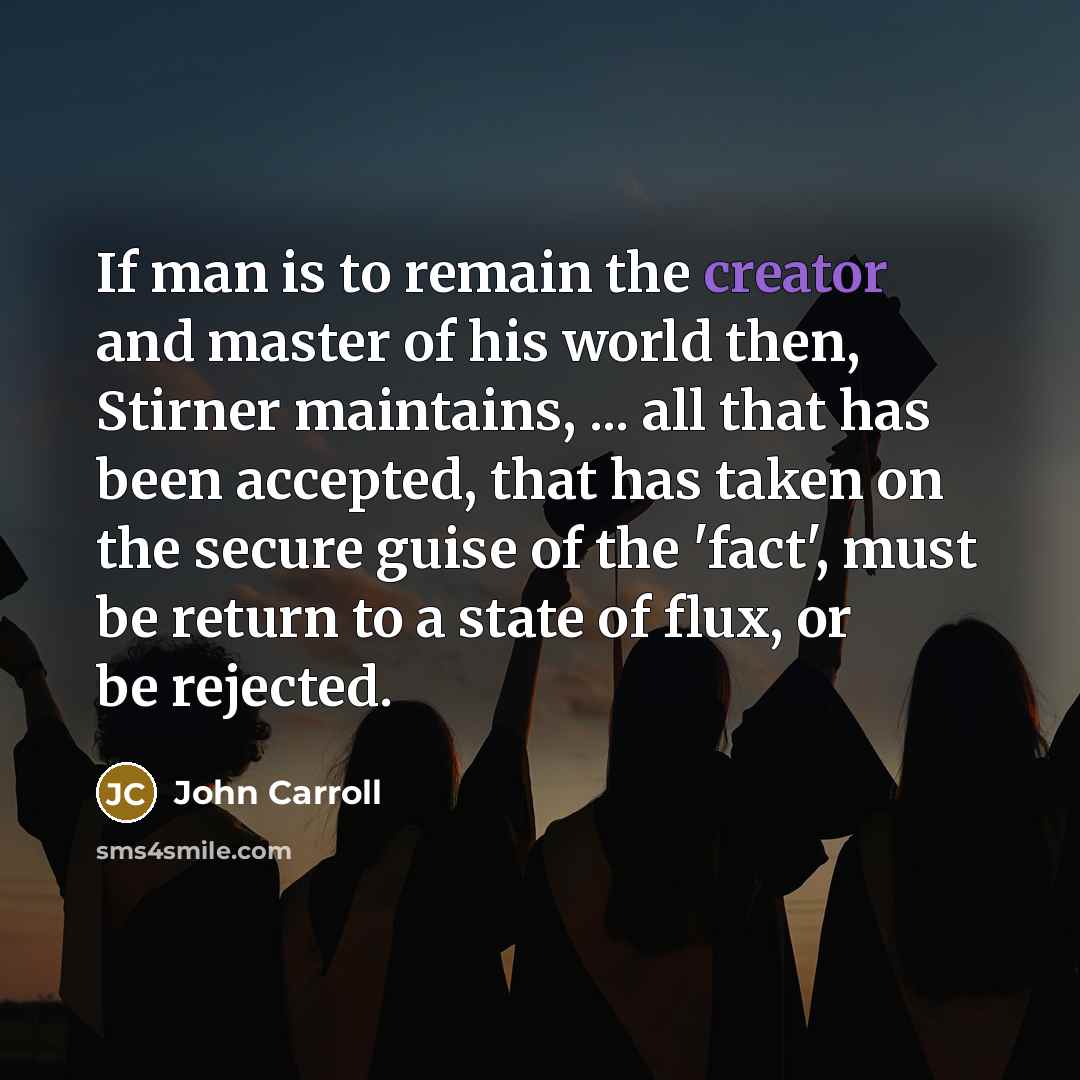
If man is to remain the creator and master of his world then, Stirner maintains, ... all that has been accepted, that… — John Carroll Accepted Copy Share Image
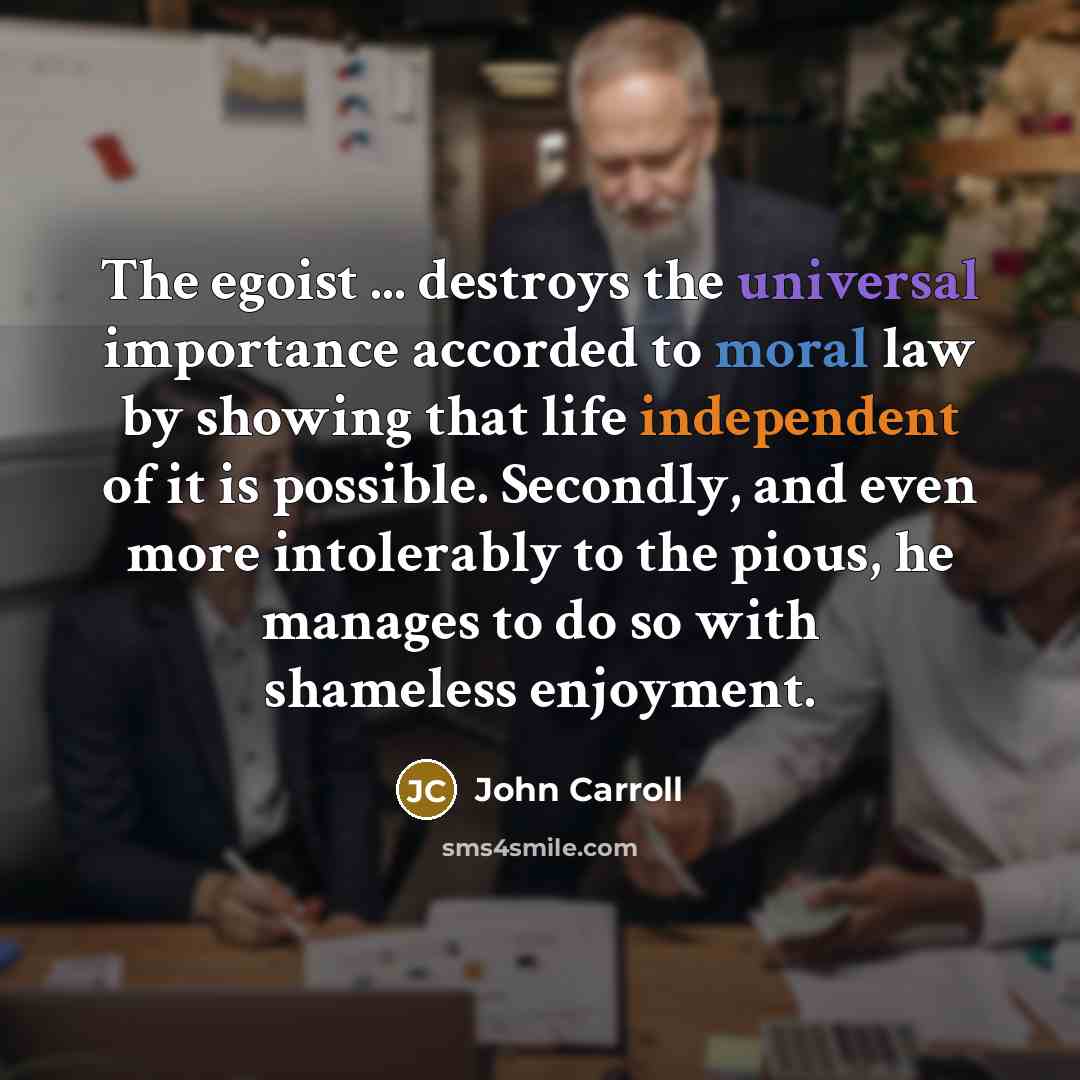
The egoist ... destroys the universal importance accorded to moral law by showing that life independent of it is possible. Secondly, and… — John Carroll Character Copy Share Image
The garden [of Eden] is the realm of pure beauty from which man is expelled when he becomes interested in ethics, in… — John Carroll Beauty Copy Share Image
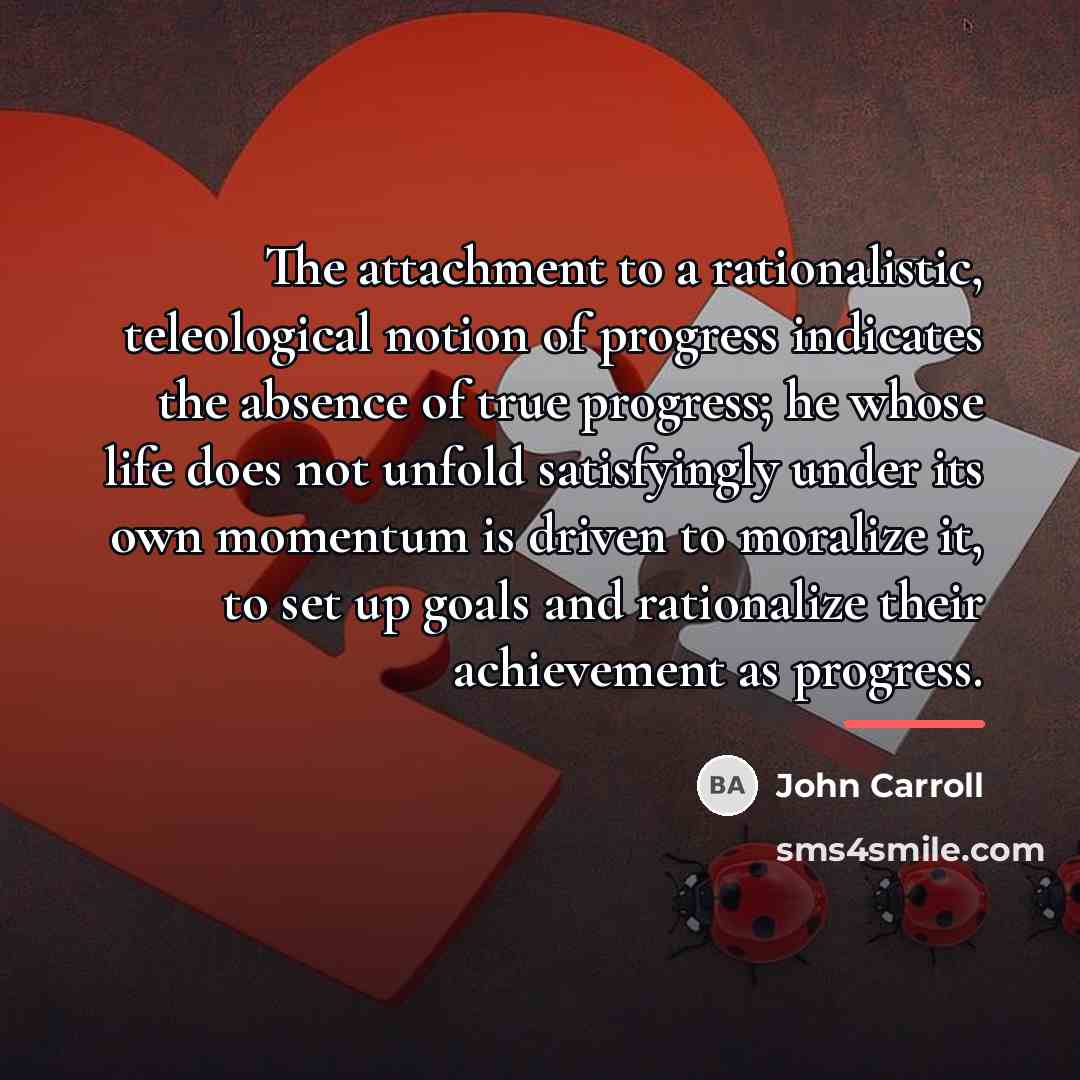
The attachment to a rationalistic, teleological notion of progress indicates the absence of true progress; he whose life does not unfold satisfyingly… — John Carroll Absence Copy Share Image
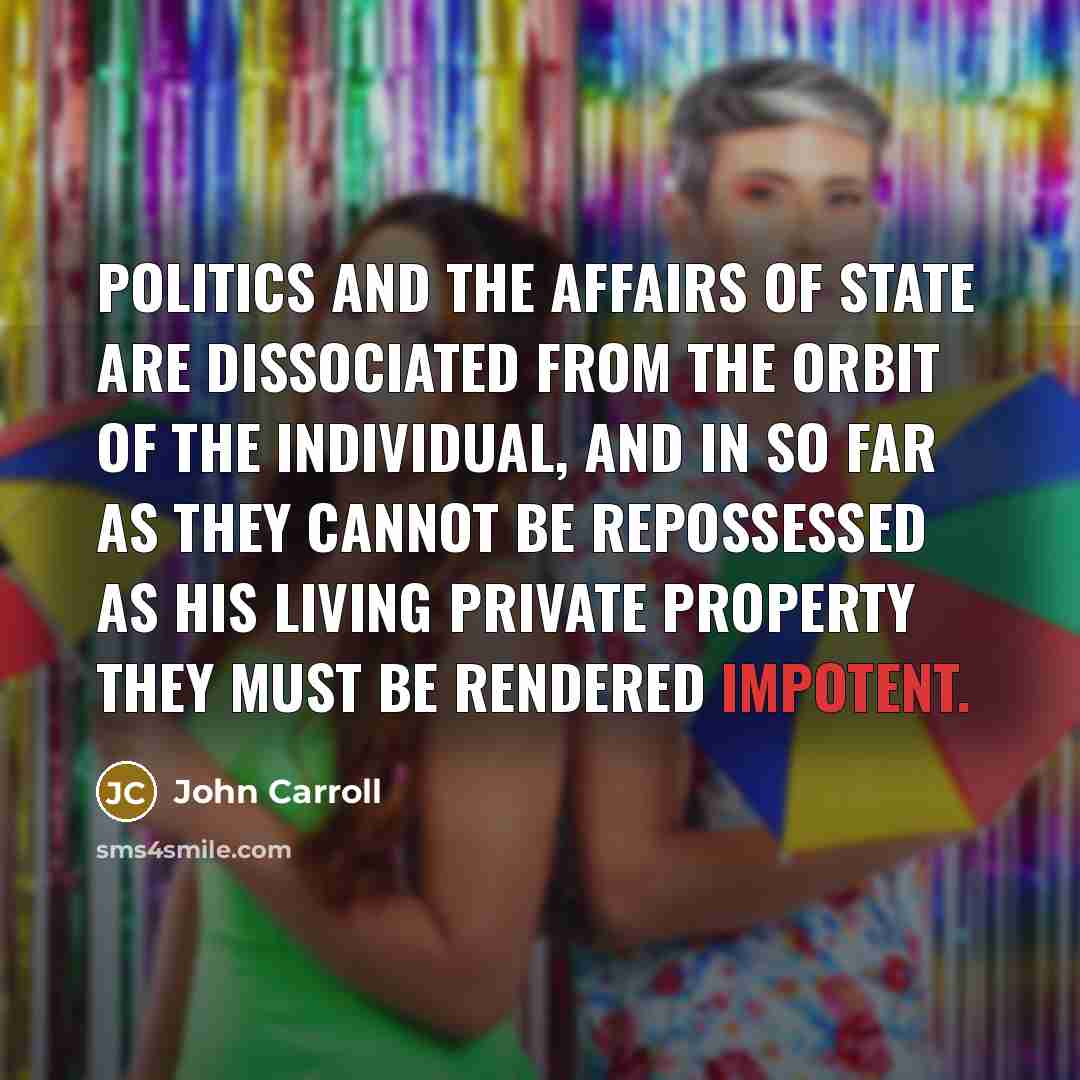
Politics and the affairs of State are dissociated from the orbit of the individual, and in so far as they cannot be… — John Carroll Affair Copy Share Image
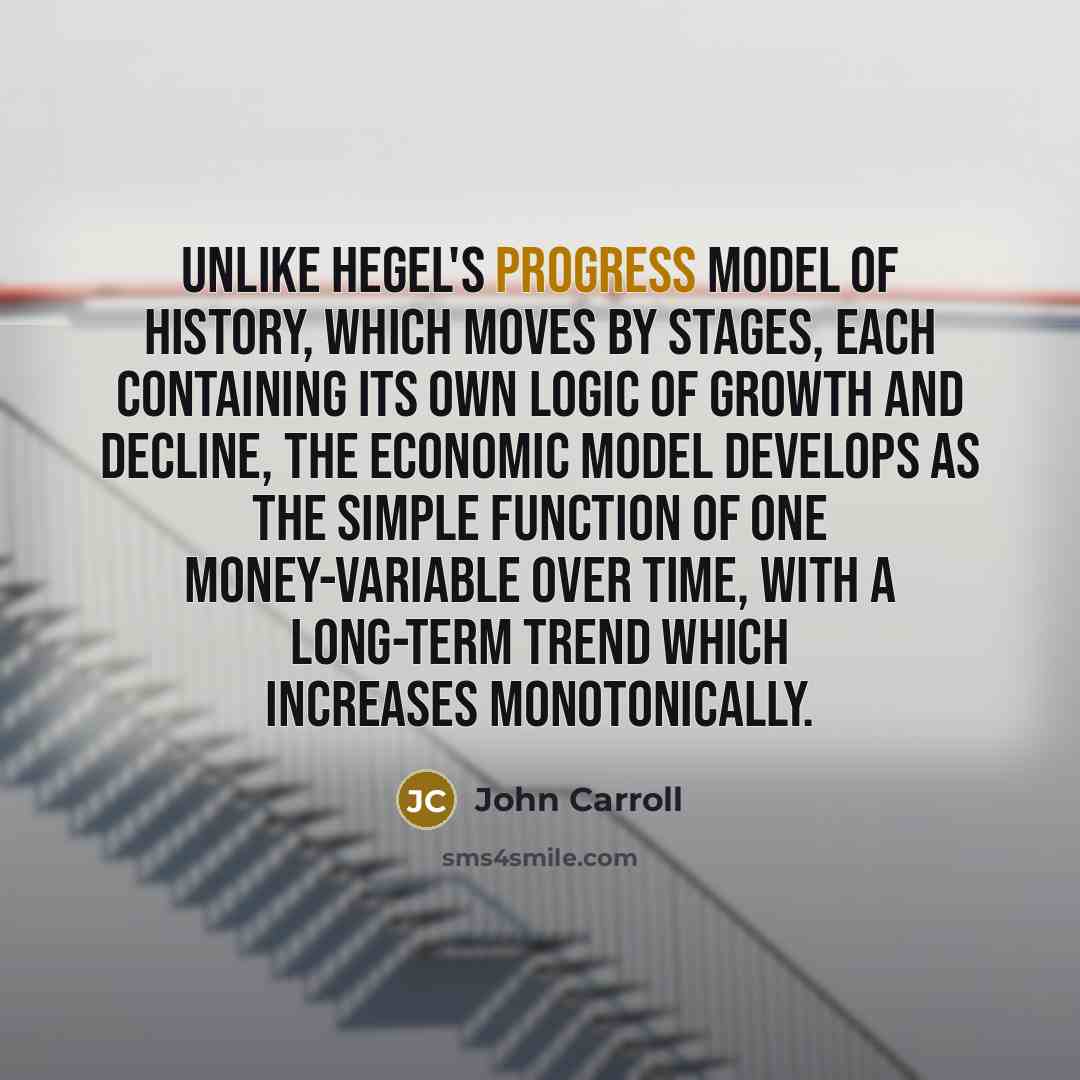
Unlike Hegel's progress model of history, which moves by stages, each containing its own logic of growth and decline, the economic model… — John Carroll Containing Copy Share Image
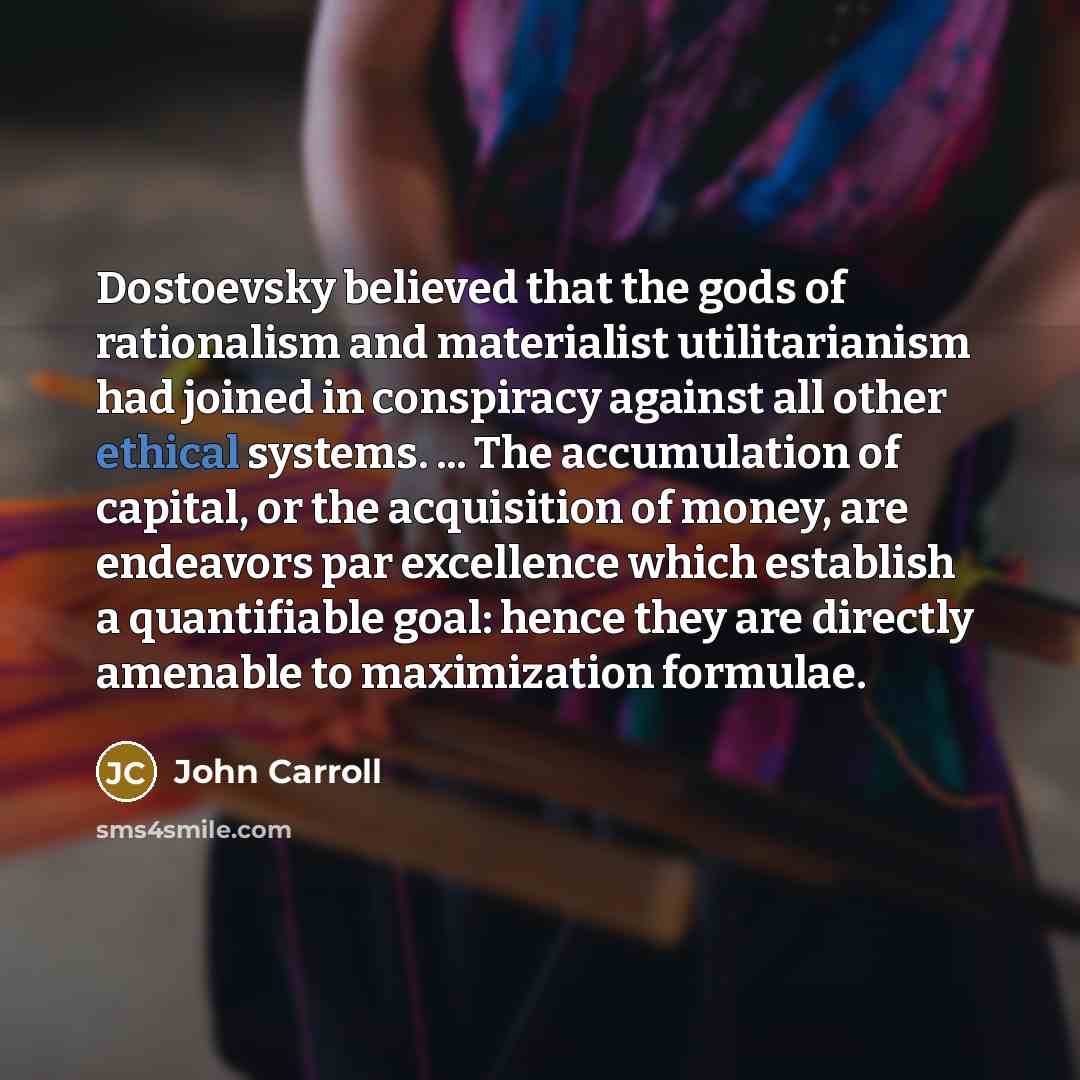
Dostoevsky believed that the gods of rationalism and materialist utilitarianism had joined in conspiracy against all other ethical systems. ... The accumulation… — John Carroll Accumulation Copy Share Image
Nietzsche ... argues that all that passes in the life of a society is ephemeral and banausic except for the presence of… — John Carroll Arguing Copy Share Image
Modern anthropology ... opposes the utilitarian assumption that the primitive chants as he sows seed because he believes that otherwise it will… — John Carroll Achievement Copy Share Image
Utilitarianism had found [in Samuel Smiles' Self-Help] its portrait gallery of heroes, inscribed with a vigorous exhortation to all men to strive… — John Carroll Bourgeois Copy Share Image
The act of greatest subversion ... is the one of indifference. A man, or a group, finds it unbearable that someone can… — John Carroll Belief Copy Share Image
Unless the fundamental categories of economics such as 'property' were to be redefined in a radically personal way the liberal rationalist curse… — John Carroll Benefits Copy Share Image
Dostoevsky's underground man ... observes his contemporaries striving to establish false goals where there are no naturally generated ones. ... He argues… — John Carroll Absolutes Copy Share Image
Stirner and Nietzsche [adopt] a mode of thinking which is personal, introspective, and which while often operating on alternative systems of belief… — John Carroll Action Copy Share Image
There is a strain in Marx of the cleric, of the vulgar moralist. He paints the capitalist and the bourgeois as incarnations… — John Carroll Bourgeois Copy Share Image
For Dostoevsky, Fourier is one of the industrious ant-hill engineers, busy, protected by the delusion that his goal, the will-ordered society, is… — John Carroll Ants Copy Share Image
[Marx] explicates ideology as socially determined, [Stirner] as psychologically determined: both accuse it of remaining oblivious to its own determinations. — John Carroll Determination Copy Share Image
“Nietzsche saw in the Protestant ethic, in both its religious and secular (economic) forms, a final protest before the emergence into dominance… — John Carroll Absence Copy Share Image
Stirner and Nietzsche ... reveal how prone morality is to being used as a means of rationalization, a cloak for concealing violent… — John Carroll Character Copy Share Image
Nietzsche himself was a great moralist; his writings abound with value judgments about individuals, character types, modes of thinking, and national traits.… — John Carroll Character Copy Share Image
What stands most explicitly as critique in Nietzsche's late work in not a development from earlier interests but a return to two… — John Carroll Antichrist Copy Share Image
Life is more than thought: what a man feels, and what his senses awaken in him, are more indispensable to his life's… — John Carroll Academia Copy Share Image
Nietzsche ... combines, in effect, Christ's harsh sayings: 'let the dead bury their dead' and 'narrow is the way which leadeth unto life'. — John Carroll Christ Copy Share Image
In so far as the intention of education is to train the child for a vocation it is a millstone around his… — John Carroll Career Copy Share Image
Man at his best is a system-breaker, an iconoclast seeking not only variety, but destruction. — John Carroll Destruction Copy Share Image
Education is the strongest weapon available for restricting the questions people ask, controlling what they think, and ensuring that they get their… — John Carroll Asks Copy Share Image
Men become utilitarian out of fear of the alternative the chaos of tangled or tepid desires, of rootlessness and boredom. — John Carroll Alternatives Copy Share Image
A teleology directed to material ends has been substituted for the lust for adventure, variety, and play. — John Carroll Adventure Copy Share Image
Stirner's political praxis is quixotic. It accepts the established hierarchies of constraint as given. ... Not liable to any radical change, they… — John Carroll Accepting Copy Share Image
Ownership of thought depends on the thinker not subordinating himself to a 'ruling thought'. This is particularly difficult, argues Stirner, ... for… — John Carroll Arguing Copy Share Image
For Stirner, the social axiom of conservative, liberal, and socialist schools of political thought alike is in itself repressive: it disguises as… — John Carroll Axioms Copy Share Image
The virtual suppression of ethical discussion after 1845 produces the semblance of purely descriptive analysis, dressed in the mantle of positivist objectivity,… — John Carroll Analysis Copy Share Image
The dialectical critique of positivist habits of mind ... is interested only in behaviour which is 'important' to the actor; that is,… — John Carroll Actors Copy Share Image

![“The garden [of Eden] is the realm of pure beauty from which man is expelled when he becomes interested in ethics, in the fruit of the tree of knowledge of good and evil. The return into paradise, the homecoming, depends on him penetrating the veils of morality to glimpse again the lineaments of…” quote by John Carroll](https://sms4smile.com/quotes/img-quotes/e74/john-carroll-16284_beauty_the-garden-of-eden-is-the-realm-of-pure_669813.jpg)
![“Utilitarianism had found [in Samuel Smiles' Self-Help] its portrait gallery of heroes, inscribed with a vigorous exhortation to all men to strive in their image; this philistine romanticism established the bourgeois hero-prototype the penniless office-boy who works his way to economic fortune and…” quote by John Carroll](https://sms4smile.com/quotes/img-quotes/b69/john-carroll-16284_bourgeois_utilitarianism-had-found-in-samuel-smile_1733275.jpg)
![“Stirner and Nietzsche [adopt] a mode of thinking which is personal, introspective, and which while often operating on alternative systems of belief and action does so only as a means of better grasping one dominant goal the patterns of individual redemption. Stirner and Nietzsche are not primarily…” quote by John Carroll](https://sms4smile.com/quotes/img-quotes/27e/john-carroll-16284_action_stirner-and-nietzsche-adopt-a-mode-of-th_1295463.jpg)
![“[Marx] explicates ideology as socially determined, [Stirner] as psychologically determined: both accuse it of remaining oblivious to its own determinations.” quote by John Carroll](https://sms4smile.com/quotes/img-quotes/495/john-carroll-16284_determination_marx-explicates-ideology-as-socially-det_1896530.jpg)