Catastrophe Quote by Arthur Koestler
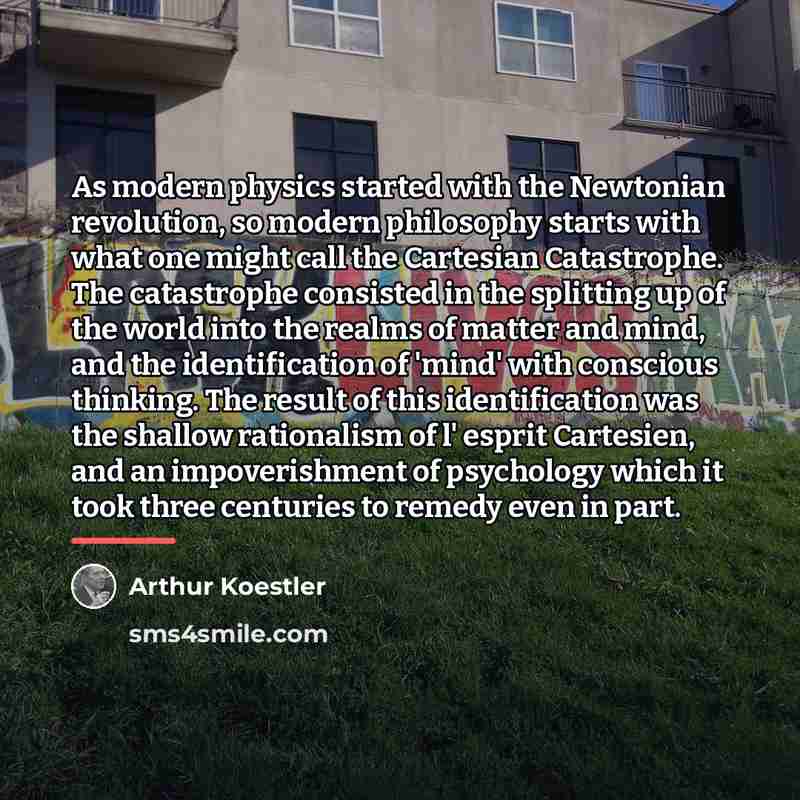
“As modern physics started with the Newtonian revolution, so modern philosophy starts with what one might call the Cartesian Catastrophe. The catastrophe consisted in the splitting up of the world into the realms of matter and mind, and the identification of 'mind' with conscious thinking. The result of this identification was the shallow rationalism of l' esprit Cartesien, and an impoverishment of psychology which it took three centuries to remedy even in part.”
About This Quote
The quote argues that the split between matter and mind, initiated by Cartesian philosophy, led to shallow rationalism and a weakened psychology, a problem that took centuries to address.
In simple terms: Dividing world into matter and mind caused weak rationalism and poor psychology.
Key Takeaway
Recognize the limits of separating mind and matter.
Themes
philosophy
psychology
history of ideas
mind-body
rationalism
Mood
reflective
critical
thoughtful
Type
analytical
philosophical
historical
When to use this quote
- academic discourse
- self‑reflection
- education reform
- interdisciplinary research
Key Concepts
Cartesian dualism
shallow rationalism
psychological impoverishment
Questions to Reflect On
- How does separating mind and matter affect our understanding of consciousness?
- Can integrating mind and matter improve psychological science?
A Different Perspective
The split may oversimplify complex interactions between consciousness and physical reality.