Ask questions Quote by Anthony Venn-Brown
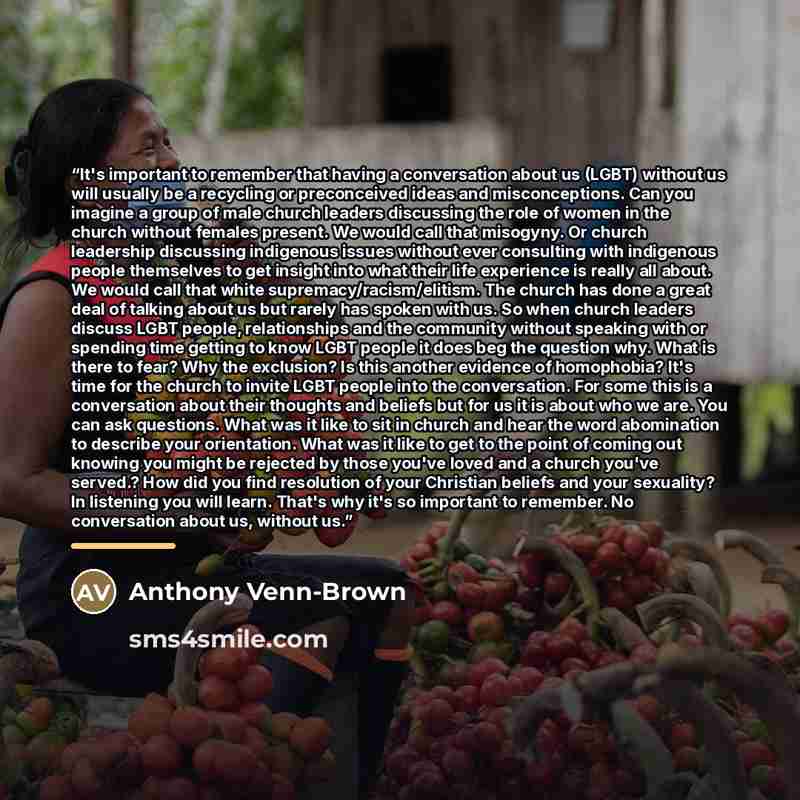
““It's important to remember that having a conversation about us (LGBT) without us will usually be a recycling or preconceived ideas and misconceptions. Can you imagine a group of male church leaders discussing the role of women in the church without females present. We would call that misogyny. Or church leadership discussing indigenous issues without ever consulting with indigenous people themselves to get insight into what their life experience is really all about. We would call that white supremacy/racism/elitism. The church has done a great deal of talking about us but rarely has spoken with us. So when church leaders discuss LGBT people, relationships and the community without speaking with or spending time getting to know LGBT people it does beg the question why. What is there to fear? Why the exclusion? Is this another evidence of homophobia? It's time for the church to invite LGBT people into the conversation. For some this is a conversation about their thoughts and beliefs but for us it is about who we are. You can ask questions. What was it like to sit in church and hear the word abomination to describe your orientation. What was it like to get to the point of coming out knowing you might be rejected by those you've loved and a church you've served.? How did you find resolution of your Christian beliefs and your sexuality? In listening you will learn. That's why it's so important to remember. No conversation about us, without us.””
About This Quote
Source Speech: Public advocacy on LGBT inclusion, 2020
Excluding marginalized voices leads to misunderstanding and reinforces oppression; genuine dialogue requires their direct participation.
In simple terms: Leaving out those affected creates false assumptions.
Key Takeaway
Include LGBT people in discussions.
Themes
inclusion
dialogue
justice
faith
representation
Mood
reflective
hopeful
Type
advocacy
inspirational
When to use this quote
- church meetings
- policy development
- community workshops
- educational seminars
Key Concepts
intersectionality
power dynamics
empathy
Questions to Reflect On
- How can institutions rebuild trust with excluded groups?
- What steps ensure authentic participation?
A Different Perspective
Challenges include entrenched biases and fear of change within institutions.