Realizations Quote by Alfred Korzybski
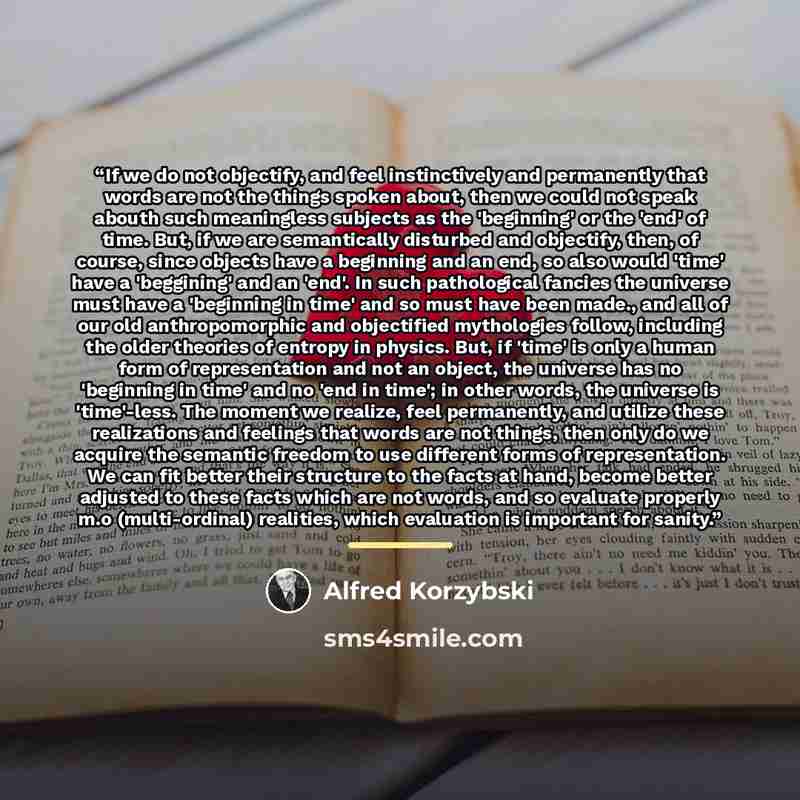
““If we do not objectify, and feel instinctively and permanently that words are not the things spoken about, then we could not speak abouth such meaningless subjects as the 'beginning' or the 'end' of time. But, if we are semantically disturbed and objectify, then, of course, since objects have a beginning and an end, so also would 'time' have a 'beggining' and an 'end'. In such pathological fancies the universe must have a 'beginning in time' and so must have been made., and all of our old anthropomorphic and objectified mythologies follow, including the older theories of entropy in physics. But, if 'time' is only a human form of representation and not an object, the universe has no 'beginning in time' and no 'end in time'; in other words, the universe is 'time'-less. The moment we realize, feel permanently, and utilize these realizations and feelings that words are not things, then only do we acquire the semantic freedom to use different forms of representation. We can fit better their structure to the facts at hand, become better adjusted to these facts which are not words, and so evaluate properly m.o (multi-ordinal) realities, which evaluation is important for sanity.””
About This Quote
Source Book: Science and Sanity, 1933
Argues that treating words as objects limits understanding; recognizing language as representation frees thought and aligns perception with reality.
In simple terms: Words are not objects; seeing them as such limits insight.
Key Takeaway
Recognize words as symbols, not things.
Themes
philosophy
language
ontology
cognition
Mood
introspective
analytical
Type
philosophical
educational
When to use this quote
- academic discourse
- philosophical debate
- education
- personal reflection
Key Concepts
semantic realism
conceptual flexibility
Questions to Reflect On
- How does viewing language as representation change thinking?
- What are the risks of over‑abstracting reality?
A Different Perspective
Complex language may be inaccessible to lay audiences.