Books Quote by Alan Wilson Watts
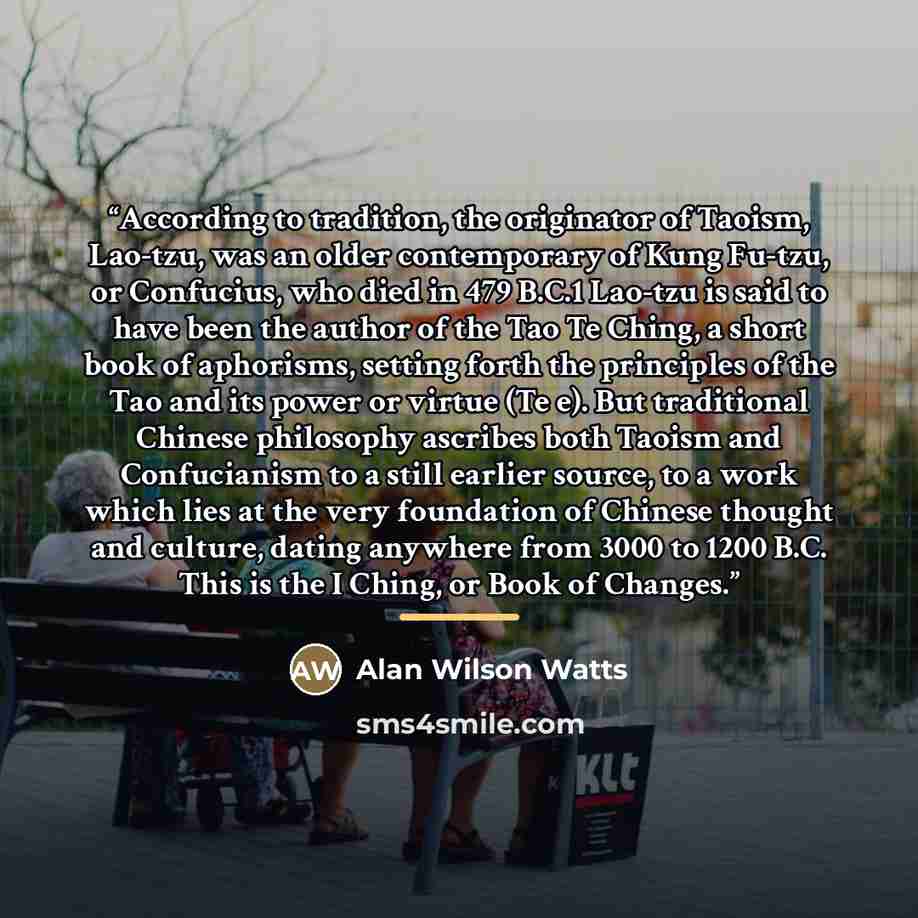
““According to tradition, the originator of Taoism, Lao-tzu, was an older contemporary of Kung Fu-tzu, or Confucius, who died in 479 B.C.1 Lao-tzu is said to have been the author of the Tao Te Ching, a short book of aphorisms, setting forth the principles of the Tao and its power or virtue (Te e). But traditional Chinese philosophy ascribes both Taoism and Confucianism to a still earlier source, to a work which lies at the very foundation of Chinese thought and culture, dating anywhere from 3000 to 1200 B.C. This is the I Ching, or Book of Changes.””
About This Quote
Source Book: The Way of Zen by Alan Watts, 1957
Taoism and Confucianism trace back to ancient Chinese thought, with the I Ching predating both, forming the foundation of Chinese philosophy.
In simple terms: Ancient Chinese thought underlies Taoism and Confucianism.
Key Takeaway
Study the I Ching to understand early Chinese philosophy.
Themes
philosophy
history
culture
foundations
Mood
thoughtful
inquisitive
educational
Type
historical
philosophical
educational
When to use this quote
- Academic study
- personal meditation
- cultural education
- comparative religion
Key Concepts
Taoism
Confucianism
I Ching
ancient wisdom
Questions to Reflect On
- How does the I Ching influence modern thought?
- What parallels exist between Taoism and Confucianism?
A Different Perspective
Complexity may overwhelm beginners.