Adam Quote by Alain de Benoist
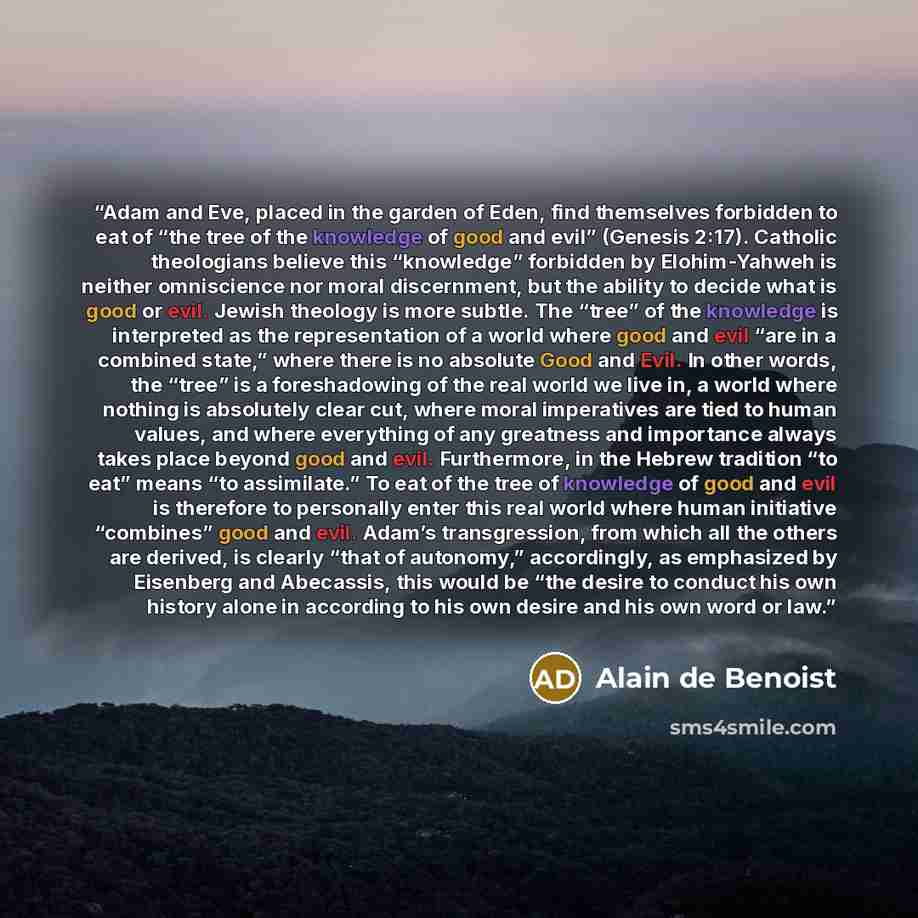
““Adam and Eve, placed in the garden of Eden, find themselves forbidden to eat of “the tree of the knowledge of good and evil” (Genesis 2:17). Catholic theologians believe this “knowledge” forbidden by Elohim-Yahweh is neither omniscience nor moral discernment, but the ability to decide what is good or evil. Jewish theology is more subtle. The “tree” of the knowledge is interpreted as the representation of a world where good and evil “are in a combined state,” where there is no absolute Good and Evil. In other words, the “tree” is a foreshadowing of the real world we live in, a world where nothing is absolutely clear cut, where moral imperatives are tied to human values, and where everything of any greatness and importance always takes place beyond good and evil. Furthermore, in the Hebrew tradition “to eat” means “to assimilate.” To eat of the tree of knowledge of good and evil is therefore to personally enter this real world where human initiative “combines” good and evil. Adam’s transgression, from which all the others are derived, is clearly “that of autonomy,” accordingly, as emphasized by Eisenberg and Abecassis, this would be “the desire to conduct his own history alone in according to his own desire and his own word or law.””
About This Quote
Source Book: Theology of the Garden, Alain de Benoist, 1998
The story symbolizes humanity’s transition from a clear moral binary to a world where good and evil intertwine, emphasizing personal autonomy and the responsibility of choices.
In simple terms: Humanity moves from simple moral rules to complex, personal decisions.
Key Takeaway
Recognize and own the moral complexity of your actions.
Themes
autonomy
morality
human nature
responsibility
theology
Mood
thoughtful
reflective
serious
Type
philosophical
theological
inspirational
When to use this quote
- personal decision making
- ethical debates
- spiritual reflection
- education on moral philosophy
Key Concepts
free will
ethical relativism
existential choice
Questions to Reflect On
- How do you navigate moral ambiguity in daily life?
- What does personal autonomy mean in your community?
A Different Perspective
The narrative may oversimplify diverse theological interpretations and ignore cultural variations.











![“Adam Clayton Powell's entire political career has to be looked at in the entire context of the American history and the history of, and the position of the Afro- American or negro in American history. [He] has done a remarkable job in fighting for rights of black people in this country. On the…” quote by Malcolm X](https://sms4smile.com/quotes/img-quotes/caa/malcolm-x-213_adam_adam-clayton-powell-s-entire-political-c_6932.jpg)