Man relates to material things through direct insight rather than reason. — Immanuel Kant Copy Share Image
Have the courage to use your own reason- That is the motto of enlightenment. "Foundations of the Metaphysics of Morals" (1785) — Immanuel Kant Copy Share Image
The sum total of all possible knowledge of God is not possible for a human being, not even through a true revelation.… — Immanuel Kant Copy Share Image
The universal and lasting establishment of peace constitutes not merely a part, but the whole final purpose and end of the science… — Immanuel Kant Copy Share Image
Nature has willed that man should, by himself, produce everything that goes beyond the mechanical ordering of his animal existence, and that… — Immanuel Kant Copy Share Image
Reason does not work instinctively, but requires trial, practice, and instruction in order to gradually progress from one level of insight to… — Immanuel Kant Copy Share Image
Enlightenment is man's emergence from his self-imposed immaturity...No thing is required for this enlightenment.. .except freedom; and the freedom in question is… — Immanuel Kant Copy Share Image
The science of mathematics presents the most brilliant example of how pure reason may successfully enlarge its domain without the aid of… — Immanuel Kant Copy Share Image
We find that the more a cultivated reason devotes itself to the aim of enjoying life and happiness, the further does man… — Immanuel Kant Copy Share Image
All the interests of my reason, speculative as well as practical, combine in the three following questions: 1. What can I know?… — Immanuel Kant Copy Share Image
“...[R]eason of itself, independent on all experience, ordains what ought to take place, that accordingly actions of which perhaps the world has… — Immanuel Kant Copy Share Image
Reason in a creature is a faculty of widening the rules and purposes of the use of all its powers far beyond… — Immanuel Kant Copy Share Image
Reason must approach nature with the view, indeed, of receiving information from it, not, however, in the character of a pupil, who… — Immanuel Kant Copy Share Image
“Even as to himself, a man cannot pretend to know what he is in himself from the knowledge he has by internal… — Immanuel Kant Copy Share Image
“...new prejudices will serve as well as old ones to harness the great unthinking masses. For this enlightenment, however, nothing is required… — Immanuel Kant Copy Share Image
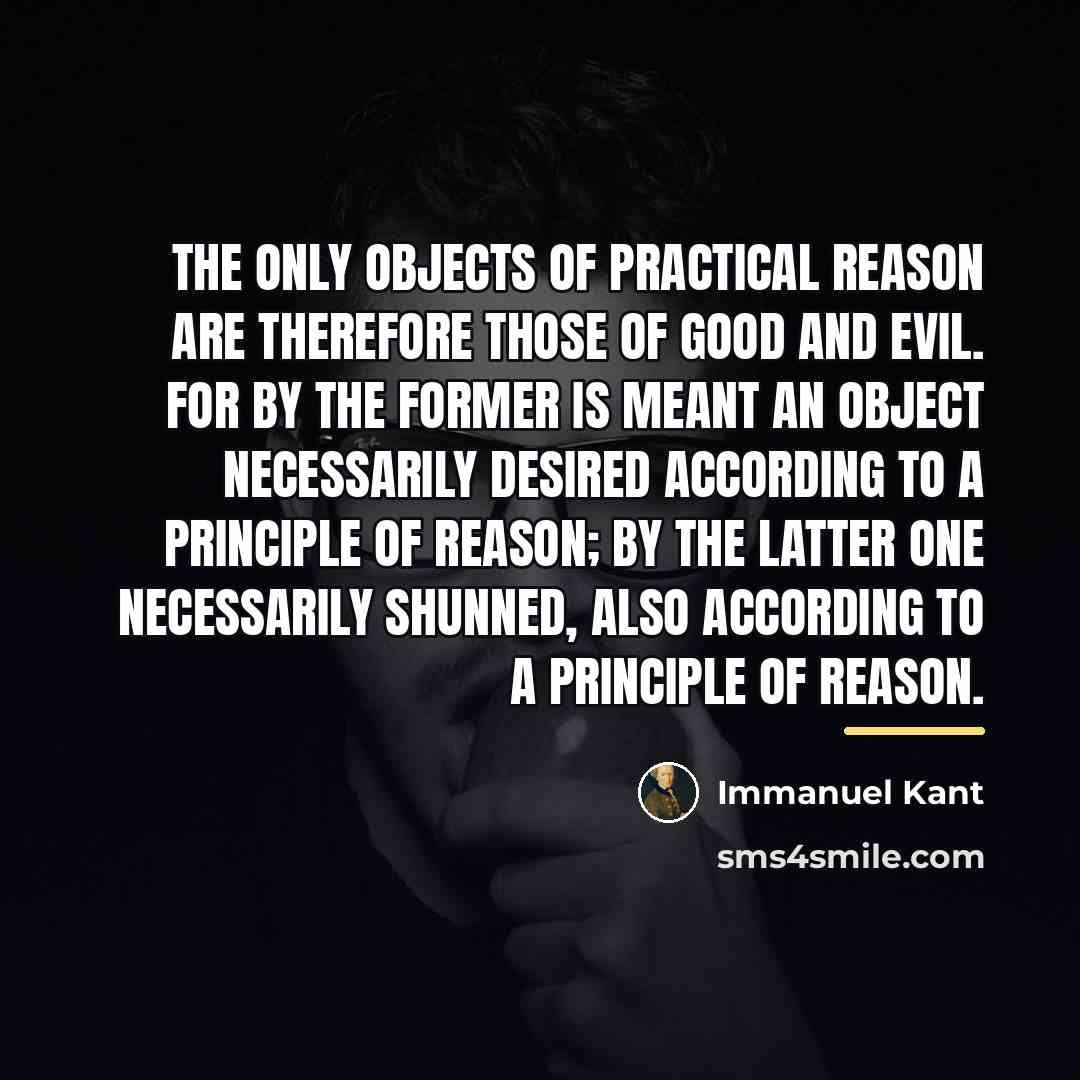
The only objects of practical reason are therefore those of good and evil. For by the former is meant an object necessarily… — Immanuel Kant Copy Share Image
“...[H]uman reason in its pure use, so long as it was not critically examined, has first tried all possible wrong ways before… — Immanuel Kant Copy Share Image
“Enlightenment is man's emergence from his self-imposed immaturity. Nothing is required for this enlightenment except freedom; and the freedom in question is… — Immanuel Kant Copy Share Image
“Human reason, in one sphere of its cognition, is called upon to consider questions, which it cannot decline, as they are presented… — Immanuel Kant Copy Share Image
Even if a civil society were to be dissolved by the consent of all its members (e.g., if a people inhabiting an island decided… — Immanuel Kant Copy Share Image
How then is perfection to be sought? Wherein lies our hope? In education, and in nothing else. — Immanuel Kant Copy Share Image
Heaven has given human beings three things to balance the odds of life: hope, sleep, and laughter. — Immanuel Kant Copy Share Image
Beauty presents an indeterminate concept of Understanding, the sublime an indeterminate concept of Reason. — Immanuel Kant Copy Share Image
Freedom is that faculty that enlarges the usefulness of all other faculties. — Immanuel Kant Copy Share Image
Philosophical knowledge is the knowledge gained by reason from concepts ; mathematical knowledge is the knowledge gained by reason from the construction of concepts. — Immanuel Kant Copy Share Image
A categorical imperative would be one which represented an action as objectively necessary in itself, without reference to any other purpose. — Immanuel Kant Copy Share Image
When I could have used a wife, I could not support one; and when I could support one, I no longer needed any — Immanuel Kant Copy Share Image
Enlightenment is the liberation of man from his self-caused state of minority... Supere aude! Dare to use your own understanding!is thus the motto of… — Immanuel Kant Copy Share Image
The ideal of the supreme being is nothing but a regulative principle of reason which directs us to look upon all connection in the… — Immanuel Kant Copy Share Image
“Jeg skal alltid handle slik at den regelen jeg handler etter kunne gjelde som allmenn lov.” — Immanuel Kant Copy Share Image
Deaths, births, and marriages, considering how much they are separately dependent on the freedom of the human will, should seem to be subject to… — Immanuel Kant Copy Share Image
![“...[R]eason of itself, independent on all experience, ordains what ought to take place, that accordingly actions of which perhaps the world has hitherto never given an example, the feasibility even if which might be very much doubted by one who founds everything on experience, are nevertheless…” quote by Immanuel Kant](https://sms4smile.com/quotes/img-quotes/7fe/immanuel-kant-532_every-man_r-eason-of-itself-independent-on-all-exp_2854960.jpg)
![“...[H]uman reason in its pure use, so long as it was not critically examined, has first tried all possible wrong ways before it succeeded in finding the one true way.” quote by Immanuel Kant](https://sms4smile.com/quotes/img-quotes/da1/immanuel-kant-532_failure_h-uman-reason-in-its-pure-use-so-long-as_1157524.jpg)