“It admits two ultimate realities, namely, puruṣa and prakṛti, which are independent of each other in respect of their existence.” — Satischandra Chatterjee Copy Share Image
“The puruṣa is an intelligent principle, of which consciousness (caitanya) is not an attribute, but the very essence. It is the self which is quite distinct from the body, the senses and the mind (manas).” — Satischandra Chatterjee Copy Share Image
“And no view of the world and life can supply a better foundation for such superior qualities than the one which inspres man with… — Satischandra Chatterjee Copy Share Image
“Every soul, even when supposed to be finite, is really nothing other than Brahman.” — Satischandra Chatterjee Copy Share Image
“It admits two ultimate realities, namely, puruṣa and prakṛti, which are independent of each other in respect of their existence.” — Satischandra Chatterjee Copy Share Image
“this conception is panentheism—(pan—all, en—in, theos—God), not pantheism; all is not equal to God, but all is in God, who is greater than all.” — Satischandra Chatterjee Copy Share Image
“A deeper significance is attached to sacrifice, when the worshipping self and the gods worshipped are realised to be the same.” — Satischandra Chatterjee Copy Share Image
“Brahman (or Ātman) is also described in many passages not as Creator, but as a Reality” — Satischandra Chatterjee Copy Share Image
“The puruṣa is an intelligent principle, of which consciousness (caitanya) is not an attribute, but the very essence. It is the self which is… — Satischandra Chatterjee Copy Share Image
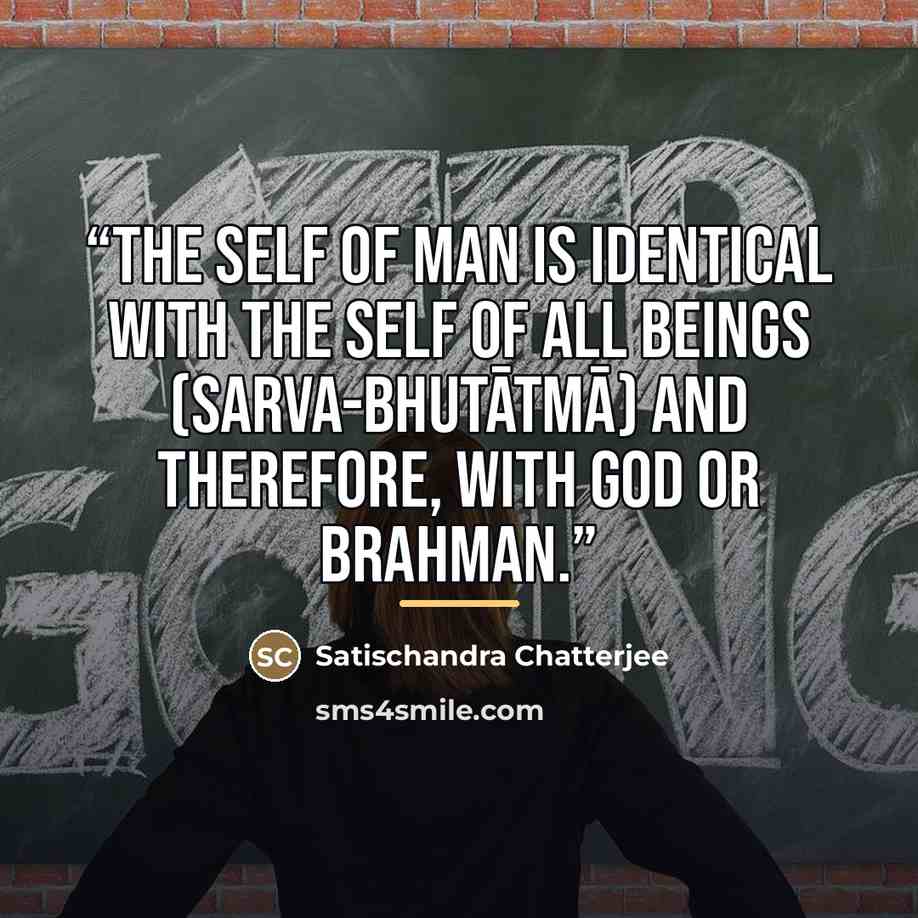
“the self of man is identical with the Self of all beings (sarva-bhutātmā) and therefore, with God or Brahman.” — Satischandra Chatterjee Copy Share Image
“Indian monotheism in its living forms, from the Vedic age till now, has believed 'rather in the unity of the gods in God, than… — Satischandra Chatterjee Copy Share Image