“Staying on target means understanding and measuring only what you need to in order to drill to the root cause and find… — Nat Greene Goals Copy Share Image
“Defining the acceptable and unacceptable ranges for this variable means that the problem definition is objective and immune to opinion.” — Nat Greene Means Problem Copy Share Image
“Being willing to expose your ignorance can be hard, until you learn the costs of not doing so.” — Nat Greene Ignorance Copy Share Image
“Even when diving into a problem, there’s a fear of looking ignorant or “stupid” by asking questions one is “supposed to know.” — Nat Greene Asking questions Copy Share Image
“When you move down your tree, keep in mind there may be multiple variables contributing to the failure.” — Nat Greene Failure Copy Share Image
“They realized they were on the frontier of understanding, and the assumptions they formed from past experience were detrimental.” — Nat Greene Learning Copy Share Image
“Always check that you are operating at the right level and get the facts to confirm that, even when you are not… — Nat Greene Copy Share Image
“Many people accept the world the way it is, and don’t see the incredible potential that is locked behind hard problems.” — Nat Greene Copy Share Image
“By eliminating the variables closest to the primary variable, we immediately eliminate many potential root causes, and we can avoid collecting data… — Nat Greene Copy Share Image
“It is possible, with lots of hard work, dedication, and timely help, to make a good writer out of a merely competent… — Nat Greene Competent Copy Share Image
“Perhaps many aid organizations make assumptions about the problem they are solving, and throw hundreds of billions of dollars at the problem… — Nat Greene Copy Share Image
“For problems of any significant difficulty, you need to start with your hands in your pockets, and your senses open. You need… — Nat Greene Adversity Copy Share Image
“The “curse of knowledge” is a cognitive bias that leads people highly informed about a topic to be unable to think about… — Nat Greene Bias Copy Share Image
“One of the most dangerous—and most pervasive—mistakes when creating a problem definition is letting some assumption about the key drivers sneak in… — Nat Greene Motivation Copy Share Image
“There are in fact two things, science and opinion; the former begets knowledge, the latter ignorance. —HIPPOCRATES, ANCIENT GREEK FOUNDER OF THE… — Nat Greene Ancient greek Copy Share Image
“A problem well-stated is a problem half-solved.1 —CHARLES KETTERING, AMERICAN ENGINEER, HOLDER OF 186 PATENTS, INVENTOR OF THE ELECTRICAL STARTING MOTOR, LEADED… — Nat Greene Inventor Copy Share Image
“As some of my Canadian friends have told me: “There is no such thing as bad weather; just the wrong clothes.” This… — Nat Greene Bad weather Copy Share Image
“People mythologize hard problems in this way because it is comforting. If a problem becomes a supernatural titan, we can tell ourselves… — Nat Greene Root cause Copy Share Image
“Know what problem you’re solving. Often, people work on the wrong problem entirely by making some implicit assumption about what’s causing it.… — Nat Greene Problem solving Copy Share Image
“Utilizing an expert means asking them questions that will help you understand a science, process, or asset; it means getting their help… — Nat Greene Expert Copy Share Image
“When a system isn’t working right, someone has to understand how it’s meant to work, at the right depth, in order to… — Nat Greene Dig deep Copy Share Image
“Great problem-solvers aren’t afraid of their ignorance, and they’re not afraid of others seeing it. Great questions shatter assumptions, provoke new insight,… — Nat Greene Ignorance Copy Share Image
“A great problem-solver won’t attempt to learn everything: To do so will waste tremendous time without making progress. Spending a few weeks… — Nat Greene Education Copy Share Image
“Successfully solving hard problems requires knowing what problem you’re solving. You should put great care into defining the problem in an accurate… — Nat Greene Problem solving Copy Share Image
“If you believe that success is inevitable, you’re less likely to work your tail off in order to achieve it. Hard problems… — Nat Greene Faith Copy Share Image
“Variable Analysis 1. Define the problem. a. What problem are you trying to solve? b. Determine the primary variable • Closely inspect… — Nat Greene Variable Analysis Copy Share Image
“The practice of guessing so obviously fails in detective work that it’s almost shocking that we guess when we have important problems… — Nat Greene Copy Share Image
“Perhaps the most useful approach for defining the problem well is structuring it as a measurable variable.” — Nat Greene Copy Share Image
“Great problem-solvers avoid being trapped into solving the wrong problem by defining the problem without prejudice or assumption” — Nat Greene Problem solvers Copy Share Image
“Simplicity is the ultimate sophistication. —LEONARDO DA VINCI, 15TH-CENTURY PAINTER AND INVENTOR” — Nat Greene Painting Copy Share Image
“I never guess. It is a shocking habit—destructive to the logical faculty.1 —SHERLOCK HOLMES, IN SIGN OF THE FOUR” — Nat Greene Sherlock Copy Share Image
“People are socialized not to “challenge” what respected people believe.” — Nat Greene Respect Copy Share Image
“Don’t ask SMEs to make business decisions for you without stepping back and considering a possible conflict of interest.” — Nat Greene Business Copy Share Image
“Whether you believe you can do a thing or not, you are right. —HENRY FORD, AMERICAN INDUSTRIALIST” — Nat Greene Henry Ford Copy Share Image
“most people believe they’re making fact-based decisions, when they are, in fact, making opinion-based ones.” — Nat Greene Decision making Copy Share Image
“Noticing and eliminating distractions will enable you to stay on target when you’re facing down your next complex problem.” — Nat Greene Distractions Copy Share Image
“You must unlearn what you have learned.1 —YODA, IN STAR WARS: EPISODE V—THE EMPIRE STRIKES” — Nat Greene Star wars Copy Share Image
“Don’t confuse believing in a simple solution with hoping that a simple guess will work.” — Nat Greene Copy Share Image
“If you don’t believe in a simple solution, you are very unlikely to find it, whether it is there or not.” — Nat Greene Solution Copy Share Image
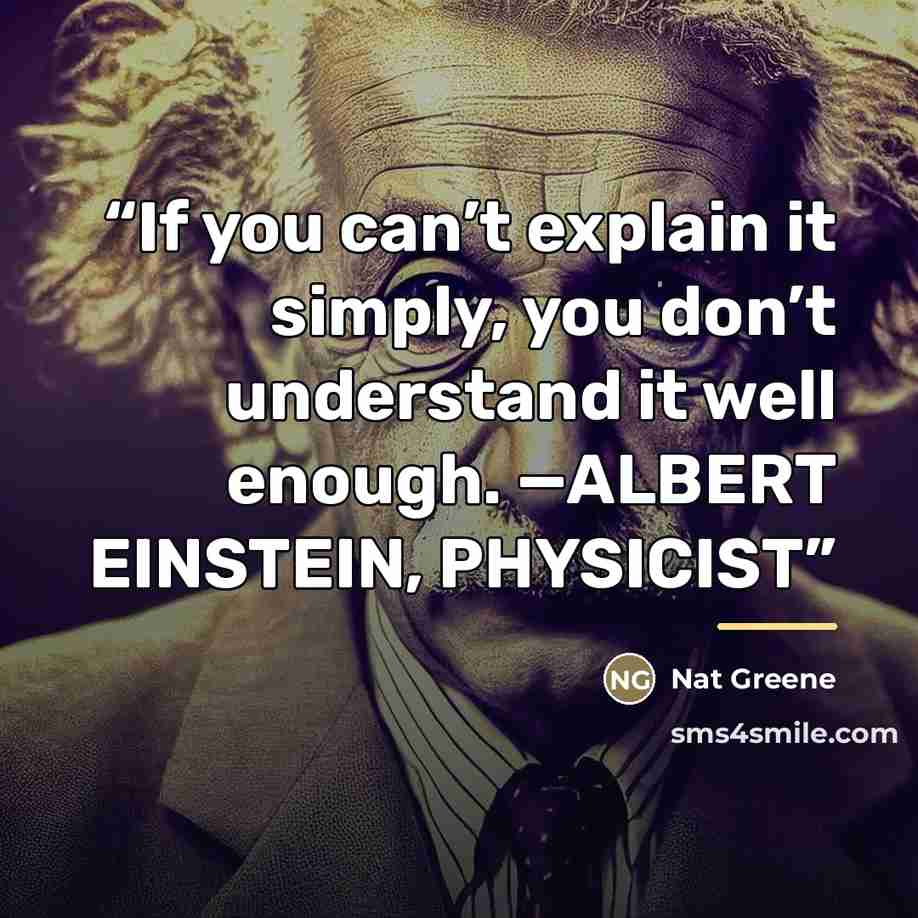
“If you can’t explain it simply, you don’t understand it well enough. —ALBERT EINSTEIN, PHYSICIST” — Nat Greene Albert einstein Copy Share Image