History may be servitude. History may be freedom. See, now they vanish. The faces and places, with the self which, as it… — T. S. Eliot Copy Share Image
The naming of cats is a difficult matter. It isn't just one of your holiday games. You may think at first I'm… — T. S. Eliot Copy Share Image
What a poem means is as much what it means to others as what it means to the author; and indeed, in… — T. S. Eliot Copy Share Image
Religion, as distinguished from modern paganism, implies a life in conformity with nature. It may be observed that the natural life and… — T. S. Eliot Copy Share Image
Writing every day is a way of keeping the engine running, and then something good may come out of it. — T. S. Eliot Copy Share Image
We fight for lost causes because we know that our defeat and dismay may be the preface to our successors' victory, though… — T. S. Eliot Copy Share Image
The fool,fixed in his folly,may think He can turn the wheel on which he turns. — T. S. Eliot Copy Share Image
As things are, and as fundamentally they must always be, poetry is not a career, but a mug's game. No honest poet… — T. S. Eliot Copy Share Image
The Nobel is a ticket to one's own funeral. No one has ever done anything after he got it. — T. S. Eliot Copy Share Image
Dear Mother, I am getting on nicely in my work at the bank, and like it ... I want to find out something about… — T. S. Eliot Copy Share Image
For love would be love of the wrong thing; there is yet faith, But the faith and the love and the hope are all… — T. S. Eliot Copy Share Image
All significant truths are private truths. As they become public they cease to become truths; they become facts, or at best, part of the… — T. S. Eliot Copy Share Image
When forced to work within a strict framework, the imagination is taxed to its utmost and will produce its richest ideas. Given total freedom,… — T. S. Eliot Copy Share Image
Honest criticism and sensitive appreciation are directed not upon the poet but upon the poetry. — T. S. Eliot Copy Share Image
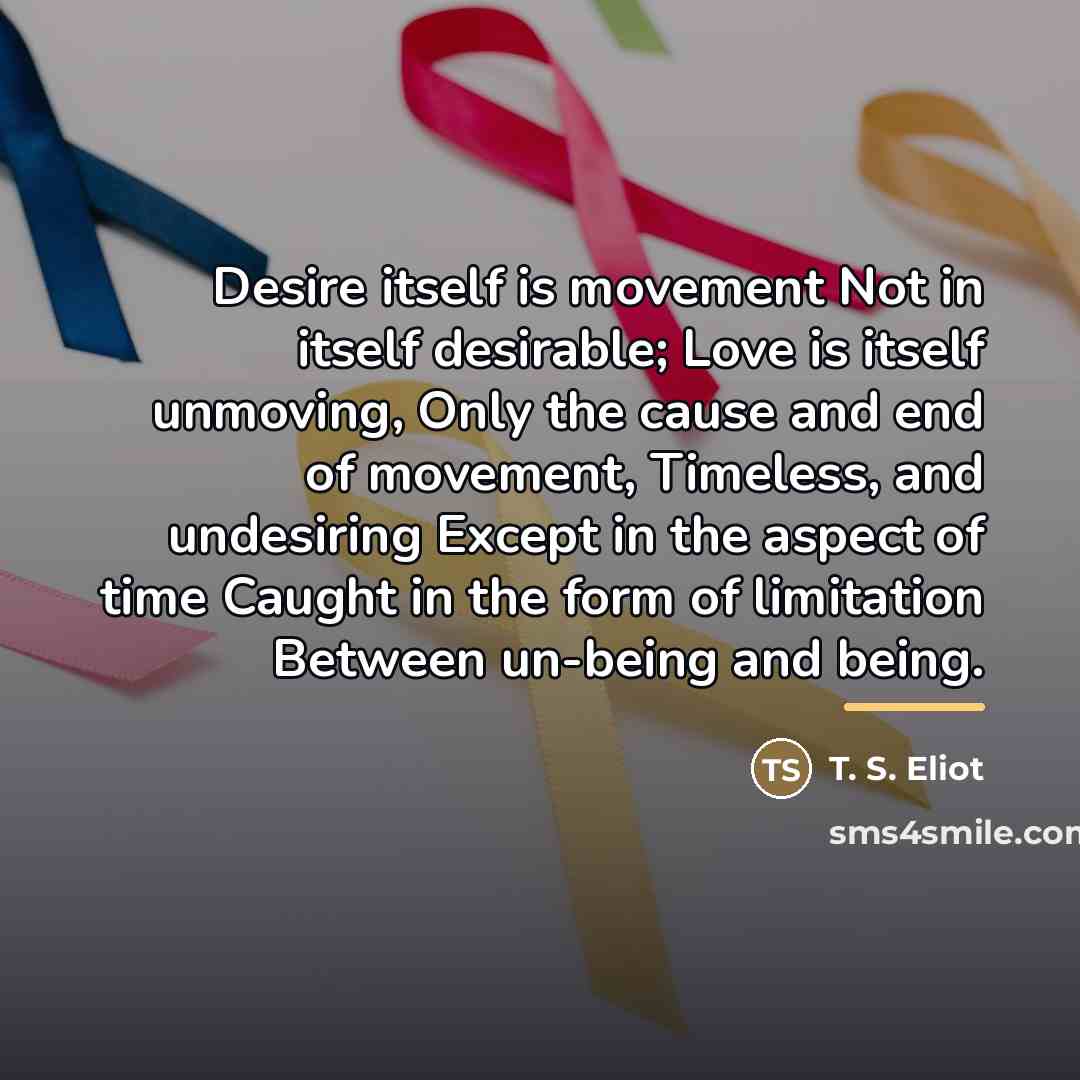
Desire itself is movement Not in itself desirable; Love is itself unmoving, Only the cause and end of movement, Timeless, and undesiring Except in… — T. S. Eliot Copy Share Image
the ordinary man's experience is chaotic, irregular, fragmentary. [He] falls in love or reads Spinoza, and these two experiences have nothing to do with… — T. S. Eliot Copy Share Image


![“the ordinary man's experience is chaotic, irregular, fragmentary. [He] falls in love or reads Spinoza, and these two experiences have nothing to do with each other, or with the noise of the typewriter, or the smell of cooking; in the mind of the poet these experiences are always forming new wholes” quote by T. S. Eliot](https://sms4smile.com/quotes/img-quotes/18e/t-s-eliot-633_art_the-ordinary-man-s-experience-is-chaotic_93688.jpg)