The most important thing for poets to do is to write as little as possible. — T. S. Eliot Copy Share Image
I was too slow a mover to be a boxer. It was much easier to be a poet. — T. S. Eliot Copy Share Image
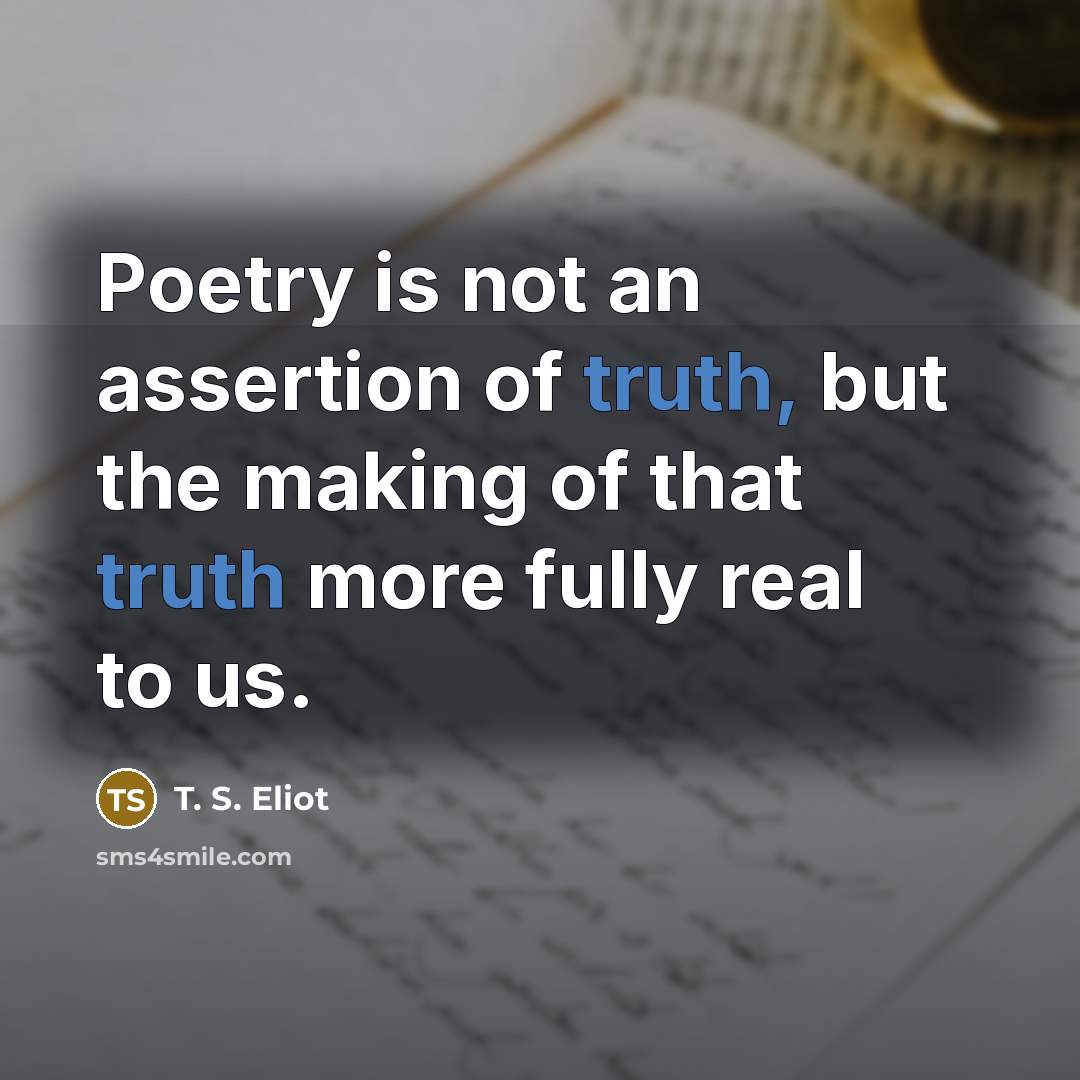
Poetry is not an assertion of truth, but the making of that truth more fully real to us. — T. S. Eliot Copy Share Image
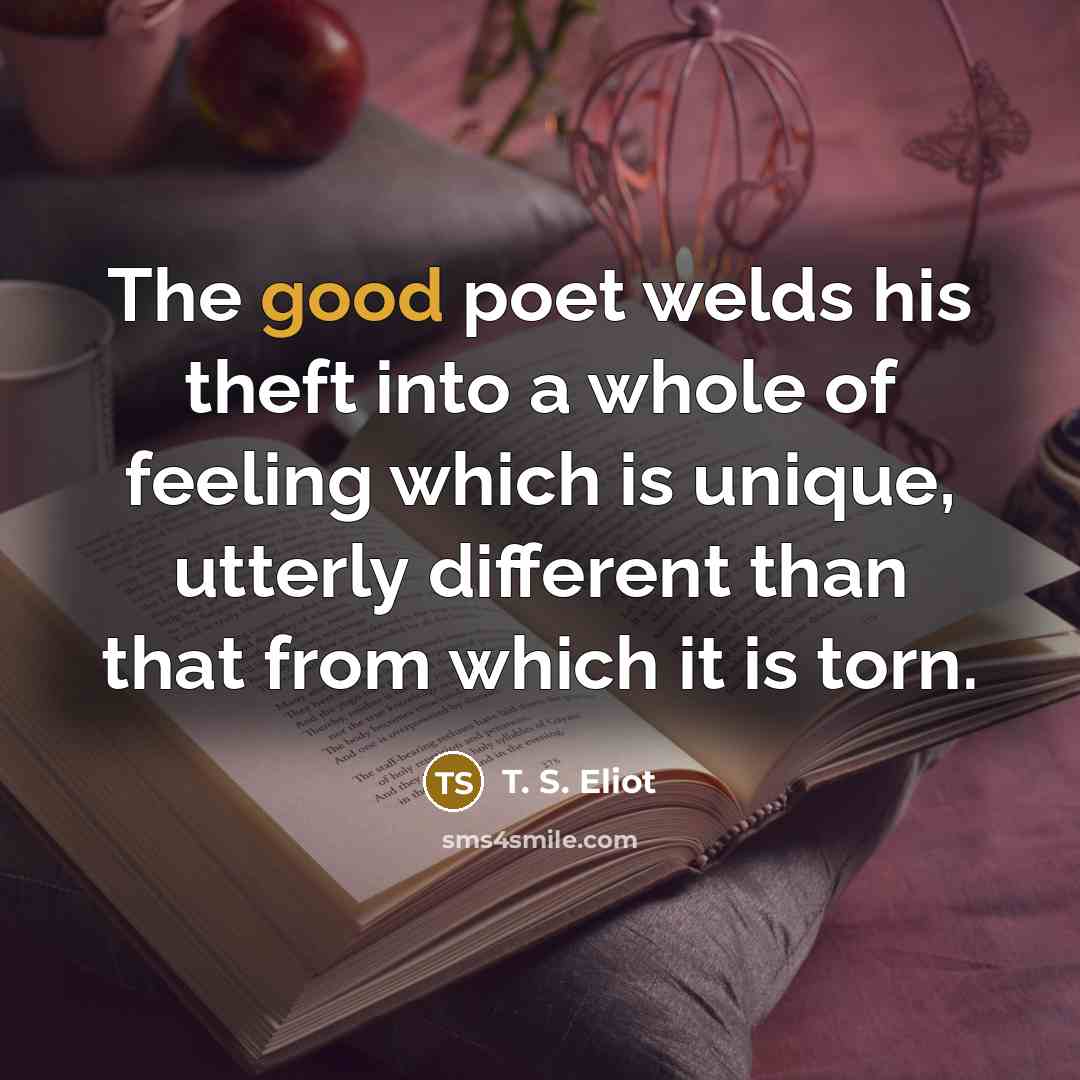
The good poet welds his theft into a whole of feeling which is unique, utterly different than that from which it is… — T. S. Eliot Copy Share Image
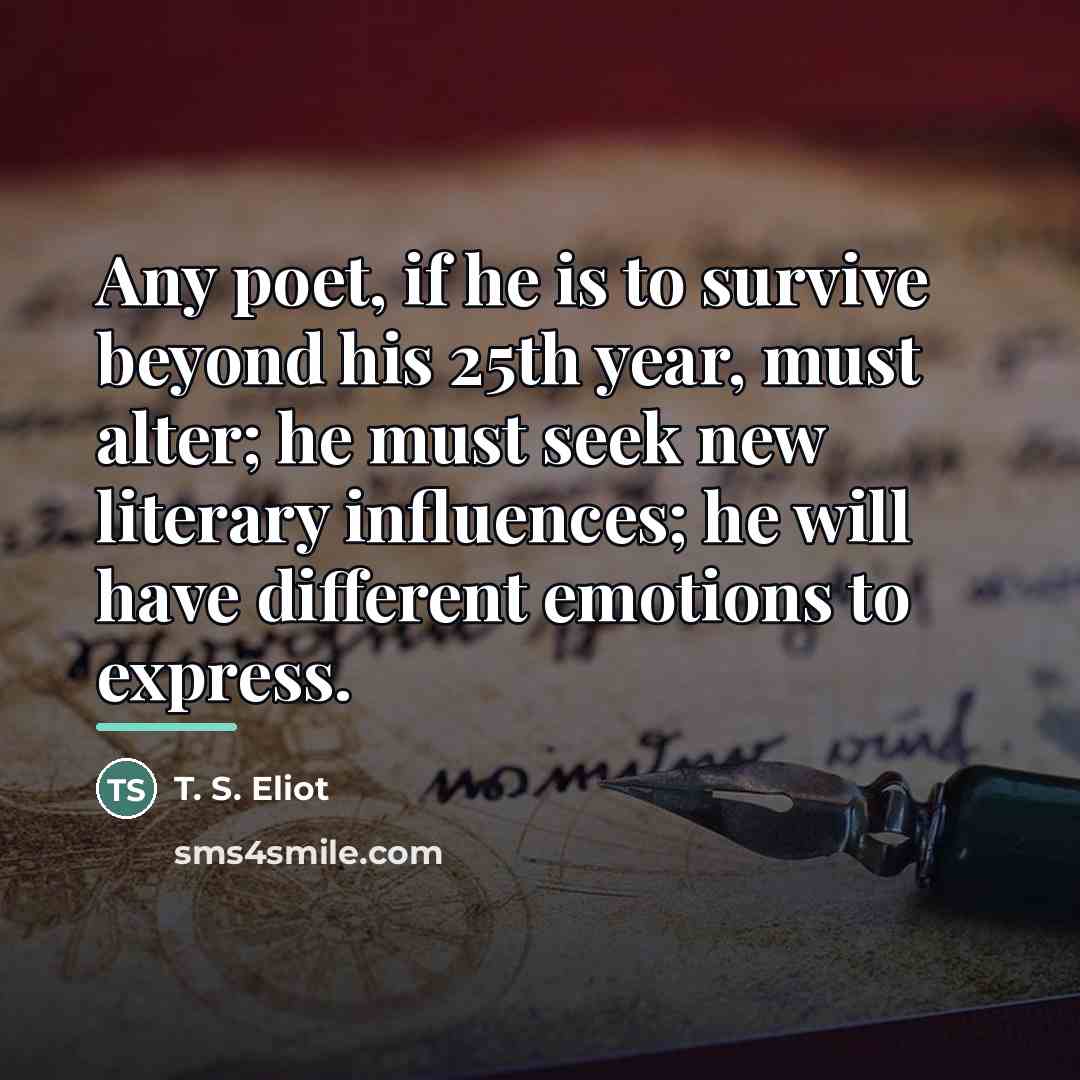
Any poet, if he is to survive beyond his 25th year, must alter; he must seek new literary influences; he will have… — T. S. Eliot Copy Share Image
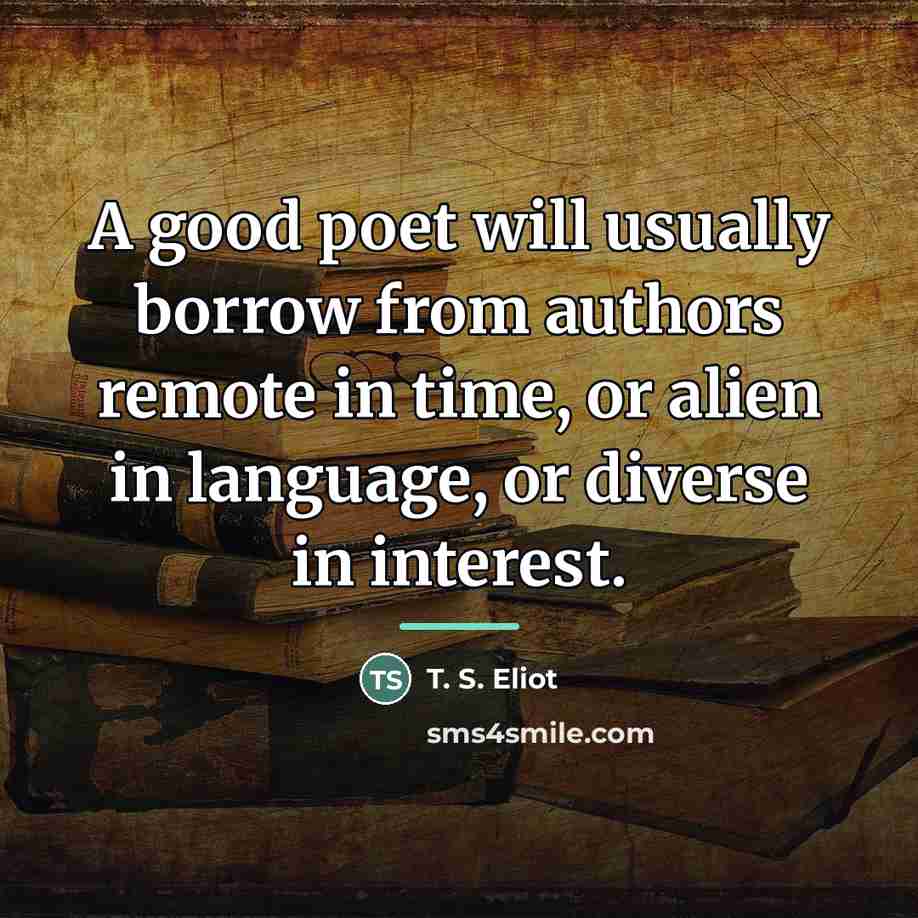
A good poet will usually borrow from authors remote in time, or alien in language, or diverse in interest. — T. S. Eliot Copy Share Image
When a poet's mind is perfectly equipped for its work, it is constantly amalgamating disparate experience ?in the mind of the poet… — T. S. Eliot Copy Share Image
It seems just possible that a poem might happen to a very young man: but a poem is not poetry -That is… — T. S. Eliot Copy Share Image
With a poem you can say 'I got my feeling into words for myself. I now have the equivalent in words for… — T. S. Eliot Copy Share Image
If we are moved by a poem, it has meant something, perhaps something important, to us; if we are not moved, then… — T. S. Eliot Copy Share Image
When a great poet has lived, certain things have been done once for all, and cannot be achieved again. — T. S. Eliot Copy Share Image
What a poem means is as much what it means to others as what it means to the author; and indeed, in… — T. S. Eliot Copy Share Image
Tennyson and Browning are poets, and they think; but they do not feel their thought as immediately as the odour of a… — T. S. Eliot Copy Share Image
Poetry may make us from time to time a little more aware of the deeper, unnamed feelings which form the substratum of… — T. S. Eliot Copy Share Image
[On The Waste Land:] Various critics have done me the honor to interpret the poem in terms of criticism of the contemporary… — T. S. Eliot Copy Share Image
the ordinary man's experience is chaotic, irregular, fragmentary. [He] falls in love or reads Spinoza, and these two experiences have nothing to… — T. S. Eliot Copy Share Image
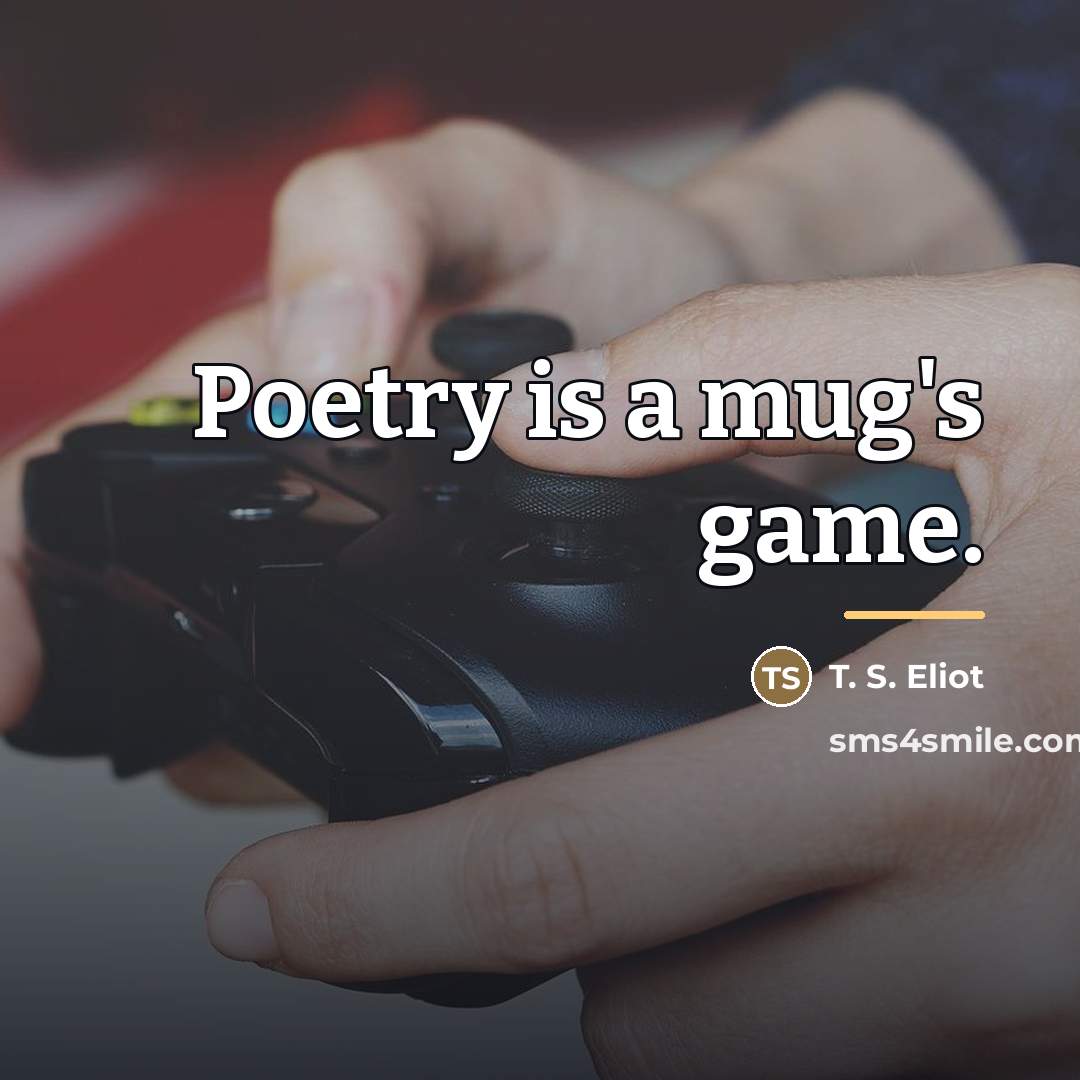
As things are, and as fundamentally they must always be, poetry is not a career, but a mug's game. No honest poet… — T. S. Eliot Copy Share Image
I think it was rather an advantage not having any living poets in England or America in whom one took any particular… — T. S. Eliot Copy Share Image
Poets in our civilization, as it exists at present, must be difficult...The poet must become more and more comprehensive, more allusive, more… — T. S. Eliot Copy Share Image
When oxygen and sulphur dioxide are mixed in the presence of a filiament of platinum, they form sulphurous acid. This combination takes… — T. S. Eliot Copy Share Image
Not only every great poet, but every genuine, but lesser poet, fulfils once for all some possibility of language, and so leaves… — T. S. Eliot Copy Share Image
Poetry should help, not only to refine the language of the time, but to prevent it from changing too rapidly. — T. S. Eliot Copy Share Image
The business of the poet is not to find new emotions, but to use the ordinary ones and, in working them up… — T. S. Eliot Copy Share Image
All art emulates the condition of ritual. That is what it comes from and to that it must always return for nourishment. — T. S. Eliot Copy Share Image
“Quick now, here, now, always-- A condition of complete simplicity (Costing not less than everything)” — T. S. Eliot Copy Share Image
The bad poet is usually unconscious where he ought to be conscious, and conscious where he ought to be unconscious. — T. S. Eliot Copy Share Image
The good poet welds his theft into a whole of feeling which is unique, utterly different from that from which it was… — T. S. Eliot Copy Share Image
Taking the question in general, I should say, in the case of many poets, that the most important thing for them to… — T. S. Eliot Copy Share Image
The majority of poems one outgrows and outlives, as one outgrows and outlives the majority of human passions. — T. S. Eliot Copy Share Image
Honest criticism and sensitive appreciation are directed not upon the poet but upon the poetry. — T. S. Eliot Copy Share Image
It is a test (a positive test, I do not assert that it is always valid negatively), that genuine poetry can communicate… — T. S. Eliot Copy Share Image
The Nobel is a ticket to one's own funeral. No one has ever done anything after he got it. — T. S. Eliot Copy Share Image
Dear Mother, I am getting on nicely in my work at the bank, and like it ... I want to find out something about… — T. S. Eliot Copy Share Image
For love would be love of the wrong thing; there is yet faith, But the faith and the love and the hope are all… — T. S. Eliot Copy Share Image
All significant truths are private truths. As they become public they cease to become truths; they become facts, or at best, part of the… — T. S. Eliot Copy Share Image
When forced to work within a strict framework, the imagination is taxed to its utmost and will produce its richest ideas. Given total freedom,… — T. S. Eliot Copy Share Image
Honest criticism and sensitive appreciation are directed not upon the poet but upon the poetry. — T. S. Eliot Copy Share Image
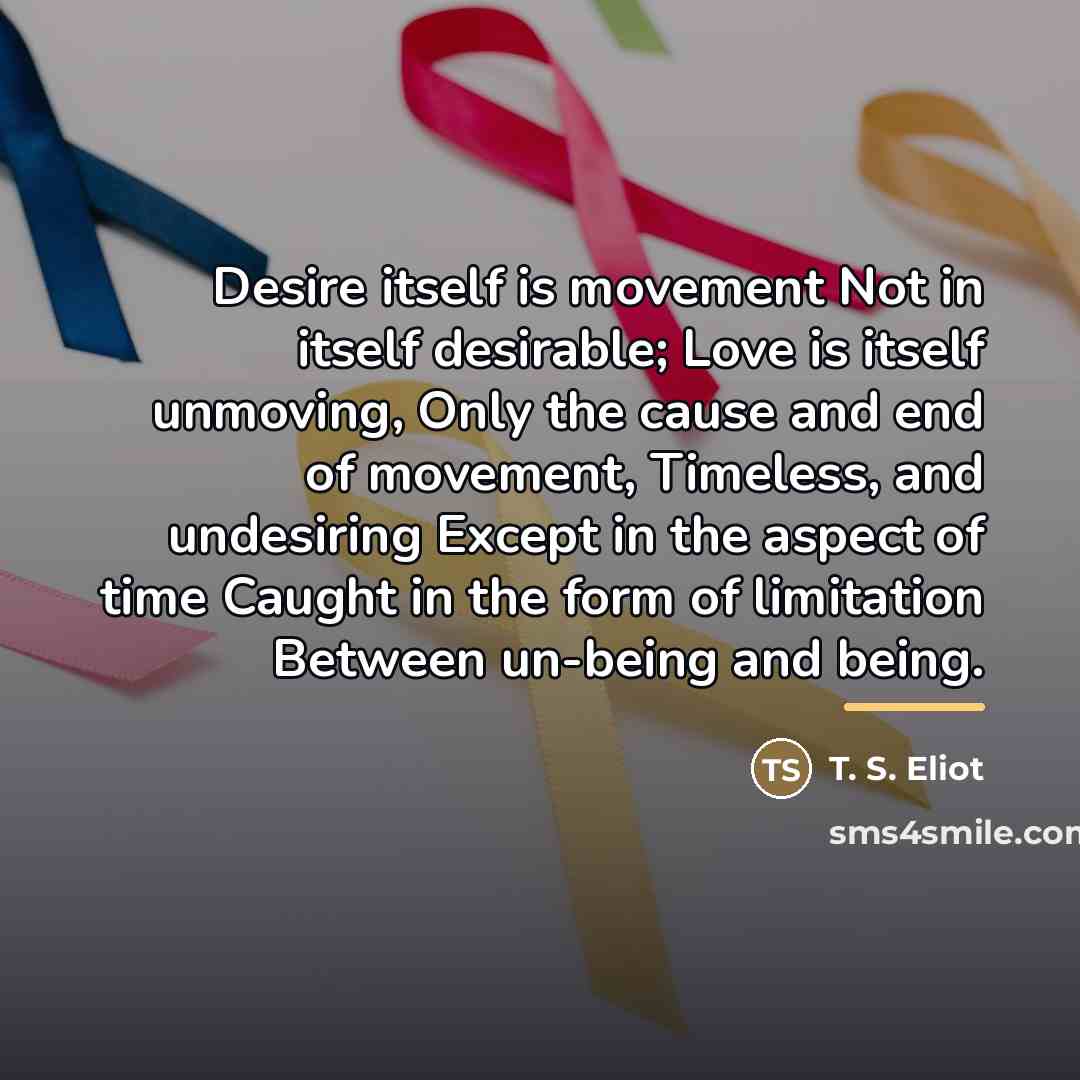
Desire itself is movement Not in itself desirable; Love is itself unmoving, Only the cause and end of movement, Timeless, and undesiring Except in… — T. S. Eliot Copy Share Image
the ordinary man's experience is chaotic, irregular, fragmentary. [He] falls in love or reads Spinoza, and these two experiences have nothing to do with… — T. S. Eliot Copy Share Image

![“[On The Waste Land:] Various critics have done me the honor to interpret the poem in terms of criticism of the contemporary world, have considered it, indeed, as an important bit of social criticism. To me it was only the relief of a personal and wholly insignificant grouse against life; it is…” quote by T. S. Eliot](https://sms4smile.com/quotes/img-quotes/e07/t-s-eliot-633_bits_on-the-waste-land-various-critics-have-d_2387391.jpg)
![“the ordinary man's experience is chaotic, irregular, fragmentary. [He] falls in love or reads Spinoza, and these two experiences have nothing to do with each other, or with the noise of the typewriter, or the smell of cooking; in the mind of the poet these experiences are always forming new wholes” quote by T. S. Eliot](https://sms4smile.com/quotes/img-quotes/18e/t-s-eliot-633_art_the-ordinary-man-s-experience-is-chaotic_93688.jpg)