“When trade and consumer marketing conflict, trade will often ‘win’ (especially towards the end of the financial year) because its effects are… — Greg Thain Copy Share Image
“Manufacturers’ allocation of funds between consumer investment and retailer investment continues to swing inexorably towards the retailers, who attract in excess of… — Greg Thain Copy Share Image
“They could see the economic attractiveness of being able to strip out the burgeoning brand-related costs from manufacturer brands and make a… — Greg Thain Copy Share Image
“The benefit of the retailer master brand model is that $202 million is a colossal amount of advertising for one brand in… — Greg Thain Copy Share Image
“A well-planned category will satisfy the largest proportion of shoppers, actualise every potential sale and prompt unplanned purchases. Profits will be affected… — Greg Thain Copy Share Image
“Presence elasticity is higher for new products because manufacturers will be spending fortunes to encourage trial, and the interest and satisfaction that… — Greg Thain Copy Share Image
“Role of quality: The quality of the shopping experience provides weaker differential advantages than quality can bring to product brands, but it can… — Greg Thain Copy Share Image
“They need to rediscover what made them successful in the first place: consumer insight, customer knowledge, innovation and brand-building. The adoption of… — Greg Thain Copy Share Image
“only manufacturers can pursue a more specific type of branding where they discover new consumer wants, satisfy them with a functionally or… — Greg Thain Copy Share Image
“Consumers can now scan the code on the product when they are running low, and it will be ordered and delivered within… — Greg Thain Copy Share Image
“Top brands stayed on top because of the continual investment and commitment of the manufacturers during a time when mass media gave… — Greg Thain Copy Share Image
“Following the logic, retailers have to advertise these sub-brands, as presence on the shelf alone is unlikely to give them meaning in… — Greg Thain Copy Share Image
“Manufacturers must seek to widen their distribution and proactively embrace new customers and distribution channels, be it hard discounters such as Aldi,… — Greg Thain Copy Share Image
“This shows that price is imperative for all FMCG retailers. They must always do two things well: Be genuinely price competitive on… — Greg Thain Copy Share Image
“Because retail brands are barely differentiated, they are relatively fragile when compared to the largest manufacturer brands, despite having, in general, much… — Greg Thain Copy Share Image
“mature markets are dominated by two phenomena: Product parity: When technological development plateaus, advantages created by technology disappear and competitors produce goods of… — Greg Thain Copy Share Image
“unlike retailers, who control the store environment, manufacturers have to pay for every opportunity to communicate with their consumers in the minutes… — Greg Thain Copy Share Image
“A short-cut to building mindspace is to buy the rights to a brand, or to buy a company that owns established brands.… — Greg Thain Copy Share Image
“Tesco’s success depends on their ability to replace manufacturer brands with their brands, which they have already achieved on 50% of their… — Greg Thain Copy Share Image
“The manufacturers’ old branding tools are now insufficient to win the battle of the value chain. In order to develop new, more… — Greg Thain Copy Share Image
“Price plays a larger role in the positioning of stores than it does in the positioning of brands. Price rarely provides a… — Greg Thain Copy Share Image
“New brands often gain sales through launch promotion, but find that repeat purchases dwindle, not through technical failure but through lack of… — Greg Thain Copy Share Image
“Marketing aims/image: A retailer that has positioning aims (e.g. trying to improve its image with respect to healthy food or trying to… — Greg Thain Copy Share Image
“retailers use a master brand model, supporting one brand, the chain, whereas manufacturers primarily use a product brand model supporting a wide… — Greg Thain Copy Share Image
“Technology, variety where appropriate, advertising muscle and consumer understanding are the key benefits for manufacturer brands, and each is highly sensitive to… — Greg Thain Copy Share Image
“The ideal category offers alternatives in all major segments, covers a range of price points and optimises impulse buying. Since retailers focus… — Greg Thain Copy Share Image
“Copycats target the biggest brands. Unilever’s Lipton Yellow Label tea is the most popular brand in the world, with a 15% market… — Greg Thain Copy Share Image
“retailers are afraid of delisting manufacturers’ brands, or at least the brands they perceive contribute to their store traffic, transaction size or… — Greg Thain Copy Share Image
“The aim is to find socially and legally acceptable ways of allowing price-sensitive shoppers to pay less, while leaving the less-price-sensitive customers… — Greg Thain Copy Share Image
“If the manufacturer can convince the retailer that delisting will hurt consumer satisfaction and possibly lead to store switching, then that will… — Greg Thain Copy Share Image
“For example, a supermarket may sell a branded version of a commodity like milk at a 2–3% margin but, by buying competitively… — Greg Thain Copy Share Image
“These four advantages (brand model, direct consumer contact, control of marketing-mix variables and information) mean that once retailers decide to challenge the… — Greg Thain Copy Share Image
“Selling strategies by retailers are not all bad news for manufacturers. Discounting big brands makes them exceptionally good value and, when advertised… — Greg Thain Copy Share Image
“Retailers, in general, welcome brand proliferation from manufacturers but are increasingly wary of SKU proliferation within brands. While the number of brands… — Greg Thain Copy Share Image
“The premium private label strategy is only possible when manufacturers have allowed a quality–value gap to open. This happens when manufacturers’ either… — Greg Thain Copy Share Image
“Retailers have to generate increased sales in each location to justify the investment, and every manufacturer has to demonstrate how their brands… — Greg Thain Copy Share Image
“if management is under pressure to deliver profits in the short term, quick-response promotions are a more attractive investment than design improvements.… — Greg Thain Copy Share Image
“Enrolling card holders gives a retailer the chance to find out more about its customer base (where they live, family composition, family… — Greg Thain Copy Share Image
“THE LONGEVITY OF product brands, even those having no apparent technological advantage, is a striking characteristic of FMCG markets, as can be… — Greg Thain Copy Share Image
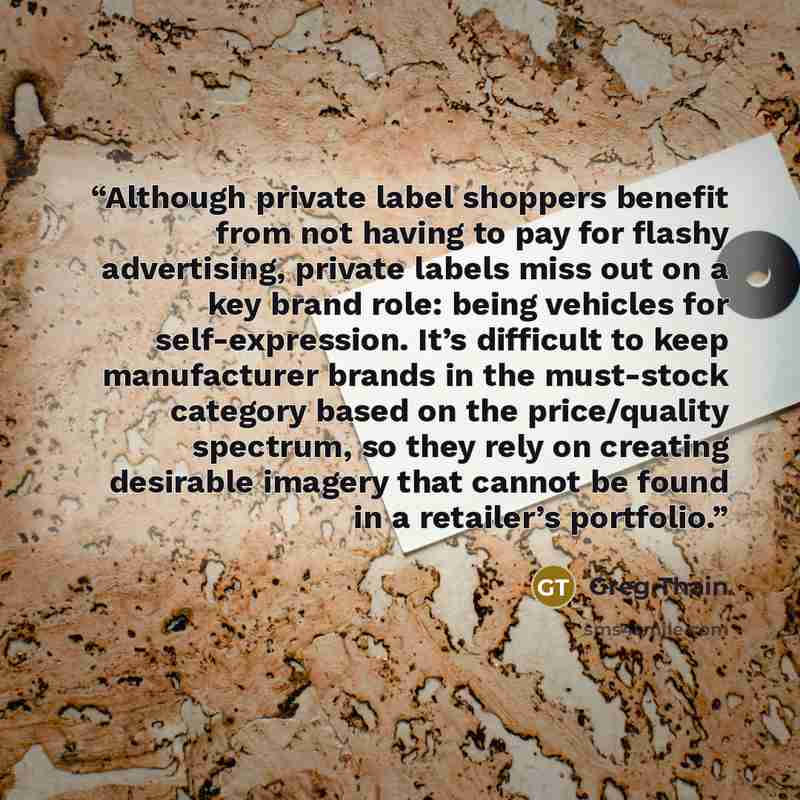
“Although private label shoppers benefit from not having to pay for flashy advertising, private labels miss out on a key brand role:… — Greg Thain Copy Share Image
“Marketing aims/image: A retailer that has positioning aims (e.g. trying to improve its image with respect to healthy food or trying to upstage wholesaler… — Greg Thain Copy Share
“Every dominant brand (such as those listed in Table 5.1) has had to reinvest in mindspace every year to keep its position. However, things… — Greg Thain Copy Share
“consolidation, coupled with a desire among the survivors to restore normal profit levels, helps to usher in an era of orderly competition based on… — Greg Thain Copy Share
“If the manufacturer can convince the retailer that delisting will hurt consumer satisfaction and possibly lead to store switching, then that will be second… — Greg Thain Copy Share
“As retailers have become competitors of manufacturers in many product categories, they reserve more shelfspace for their private label brands and dominate advertising spending… — Greg Thain Copy Share
“High fixed costs mean that high volumes are an ever-essential objective. One” — Greg Thain Copy Share
“Importance of price: Price is imperative for FMCG retailers, much more so than for manufacturers. Retailers must constantly keep their real prices competitive and put… — Greg Thain Copy Share
“Hoping to create a little prestige, some retailers develop and advertise premium clothes sub-brands. In 2006, Myer, one of Australia’s largest retailers, launched a… — Greg Thain Copy Share
“The shift of power to retailers is not an inevitable phenomenon: technological changes and associated innovative ideas have been instrumental in moving power and… — Greg Thain Copy Share
“Because retail brands are barely differentiated, they are relatively fragile when compared to the largest manufacturer brands, despite having, in general, much higher awareness… — Greg Thain Copy Share
“There are some FMCG categories where retailers are destined to control mindspace. These are the low-technology, low-image, low-novelty areas. Retailers are likely to be… — Greg Thain Copy Share
“In markets where consumers are sensitive to quality differences (e.g. washing powder, instant coffee, sanitary protection) the share for generics and copycats usually plateaus… — Greg Thain Copy Share
“Direct consumer contact is an advantage for retailers, as 70% of shoppers make purchase decisions in stores and are thus open to last-minute persuasion. The” — Greg Thain Copy Share
“Fresh produce and other ‘destination’ products can create a sustainable differential advantage, as they have the potential for deciding the destination of the shopper.… — Greg Thain Copy Share
“PRIVATE LABEL IS booming. In Europe and the United States during the period 2000–2010, private label was responsible for the majority of the growth… — Greg Thain Copy Share