“Columbus never found the Ten Lost Tribes. However, he did unknowingly stumble upon two continents new to Europeans that would, in time,… — Phyllis Goldstein Copy Share Image
“By the mid-1700s, people were becoming aware of that dramatic rise in immigration, and it aroused strong feelings. One Tory opponent of… — Phyllis Goldstein Copy Share Image
“so many Jews in Alexandria spoke only Greek that the Hebrew Scriptures were translated into Greek for their benefit. Yet they remained… — Phyllis Goldstein Copy Share Image
“By 629, the Byzantines were in control of Jerusalem again. Although Jews scrambled to make peace with the authorities, Christian religious leaders… — Phyllis Goldstein Copy Share Image
“Zionism is to the Jewish people what the liberation movements of Africa and Asia have been to their own people….” — Phyllis Goldstein Copy Share Image
“injustice is directly created by that fine policy which denies the poor Jews protection and residence, but receives with open arms those… — Phyllis Goldstein Copy Share Image
“By the sixth century, Jews were so well established on the peninsula that the king of Yemen converted to Judaism.” — Phyllis Goldstein Copy Share Image
“In many ways, England was home to the first modern Jewish community in the world.” — Phyllis Goldstein Copy Share Image
“So the myth that Jews belonged to a distinct and inferior race continued to grow throughout Europe. That myth gave individuals and… — Phyllis Goldstein Copy Share Image
“Mendelssohn was keenly aware of the difference between the respect he received and the disdain shown to other Jews. In a letter… — Phyllis Goldstein Copy Share Image
“By the end of the eleventh century, Jews were being squeezed out of international trade and into occupations forbidden to Jews, Christians,… — Phyllis Goldstein Copy Share Image
“In May 1860, Adolphe Crémieux and other French Jewish leaders held a meeting in Paris to create a new organization known as… — Phyllis Goldstein Copy Share Image
“Why, then, were Jews allowed to live among Christians? The answer dates back to the teachings of St. Augustine (see Chapter 2).… — Phyllis Goldstein Copy Share Image
“In contrast to much of northern Europe, where Jews faced persecution, Spain was a haven. From the eighth century onward, Jews there… — Phyllis Goldstein Copy Share Image
“Thus, for many Christians, showing contempt for Jews became a way of affirming their own faith.” — Phyllis Goldstein Copy Share Image
“In 1378, a high-ranking Franciscan priest named Ferrán Martínez began a campaign against Jews in Castile. In sermon after sermon, he called… — Phyllis Goldstein Copy Share Image
“In 1555 the church had a new pope, Paul IV, and he was even more determined to end all heresies than earlier… — Phyllis Goldstein Copy Share Image
“Many young Jewish men—and a few young women—responded enthusiastically to the idea of broadening their education. But they quickly found that knowledge… — Phyllis Goldstein Copy Share Image
“Religious differences were often a barrier to close ties between Jews and Christians. The word religion comes from a Latin word meaning… — Phyllis Goldstein Copy Share Image
“In the ancient world, Jews were not easily distinguished from their neighbors. They did the same kinds of work, built similar homes,… — Phyllis Goldstein Copy Share Image
“In Jerusalem, the Persians, with the help of their Jewish allies, murdered about 60,000 Christians and sold 35,000 into slavery. It was… — Phyllis Goldstein Copy Share Image
“The separation of Christianity from Judaism did not happen simply or quickly. It was not a single event but rather a sometimes… — Phyllis Goldstein Copy Share Image
“In this age of empires, Jews’ insistence on maintaining their own religion and their own cultural traditions made them outsiders in both… — Phyllis Goldstein Copy Share Image
“The exiled Jews who settled in Babylonia were able to maintain their identity, in part because they were allowed to practice their… — Phyllis Goldstein Copy Share Image
“Most young American Jews in the 1960s also knew very little about the Holocaust. Brooks Susman, who would later become a rabbi,… — Phyllis Goldstein Copy Share Image
“As accusations spread, so did the false belief that Jews routinely engaged in the practice of ritual murder. An accusation made repeatedly tends to… — Phyllis Goldstein Copy Share Image
“Still, by the end of the thirteenth century, most European Jews were forced to wear badges or distinguishing clothing. The aim was to humiliate… — Phyllis Goldstein Copy Share Image
“Mendelssohn’s books on philosophy and literature were hailed throughout Europe. He was described as “exceptional”—an “un-Jewish Jew,” one of a kind, a genius.” — Phyllis Goldstein Copy Share Image
“135 years later, in 586 BCE, the Babylonians conquered Judea, the southern kingdom. They destroyed the Temple in Jerusalem and forced thousands of Jews… — Phyllis Goldstein Copy Share Image
“In Arab nations, many people opposed Zionism because they believed that the UN had no right to establish a Jewish state on what they… — Phyllis Goldstein Copy Share Image
“After the Black Death in the mid-1300s, the persecution of Jews intensified, and many Jews in Europe moved farther east. Some left because life… — Phyllis Goldstein Copy Share Image
“Many Jews in the Byzantine Empire welcomed the Persians. Some saw their arrival as an opportunity to win independence or even just a little… — Phyllis Goldstein Copy Share Image
“In 1255, a five-year-old boy was found dead in a well in Lincoln, England. Many historians today believe that young Hugh accidentally fell into… — Phyllis Goldstein Copy Share Image
“The Greeks and Egyptians in Alexandria understood Flaccus’s announcement to mean that they could now treat Jews as they pleased. After all, people without… — Phyllis Goldstein Copy Share Image
“For hundreds of years, Christians had been trying to convert the Jews, and now, for the first time, they had real success. Suddenly thousands… — Phyllis Goldstein Copy Share Image
“With each new rumor, each new accusation, the way Christians thought about Jews became more and more distorted. Jews were increasingly seen as a… — Phyllis Goldstein Copy Share Image
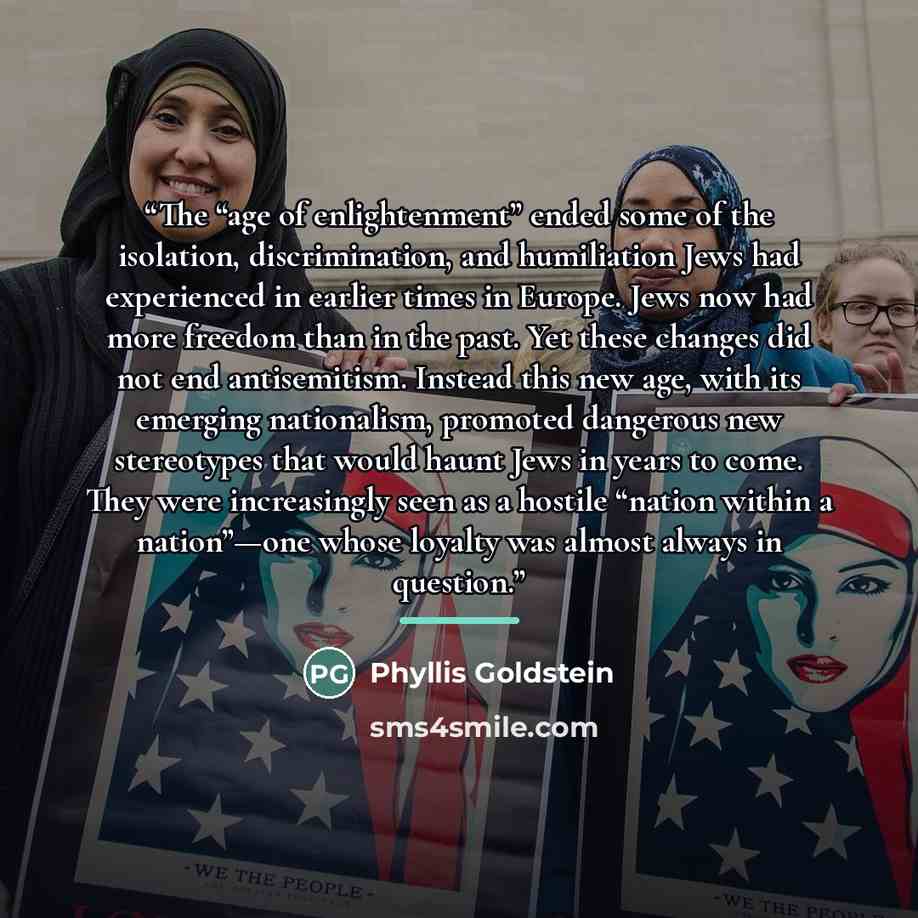
“The “age of enlightenment” ended some of the isolation, discrimination, and humiliation Jews had experienced in earlier times in Europe. Jews now had more… — Phyllis Goldstein Copy Share Image