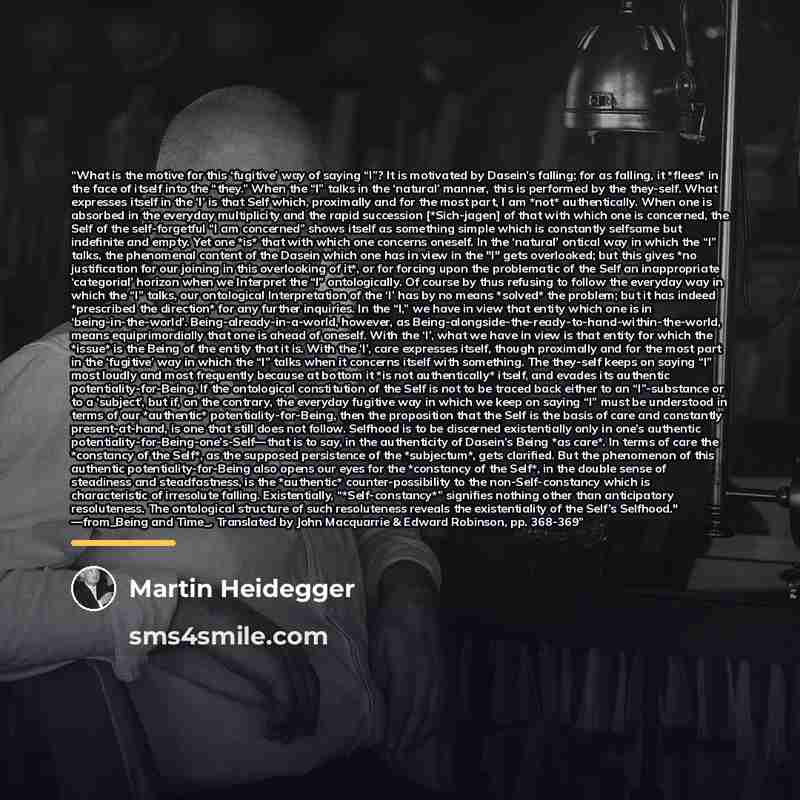
“What is the motive for this ‘fugitive’ way of saying “I”? It is motivated by Dasein’s falling; for as falling, it *flees*… — Martin Heidegger Copy Share Image
Of course, if one's reading Kierkegaard for personal interest that's fine - but it's sloppy scholarship just to cherry pick what suits… — George Pattison Copy Share Image
“The ‘I’ is a bare consciousness, accompanying all concepts. In the ‘I’, ‘nothing more is represented than a transcendental subject of thoughts’.… — Martin Heidegger Copy Share Image
If you read philosophical texts of the tradition, you'll notice they almost never said 'I,' and didn't speak in the first person.… — Jacques Derrida Copy Share Image
“Heidegger’s philosophy is neither atheism nor theism, but a description of the world from which God is absent.” — William Barrett Copy Share Image
Chuang Tzu and Heidegger both emphasise the virtue of 'spontaneity' - a sort of mindful responsiveness to things as they are. It's… — David E. Cooper Copy Share Image
For me, the existentialists are important critics of 'absolutist' claims, and Heidegger and Merleau-Ponty are, at least in their later writings, also… — David E. Cooper Copy Share Image
Religious life is about something real in human experience that is not constrained by what Wittgenstein called 'all that is the case'.… — George Pattison Copy Share Image
Every stroke a tennis player plays is different, yet we perceive them as playing in a distinctive and unique way. It's what… — George Pattison Copy Share Image
My 'heroes' are those - like Chuang Tzu and Heidegger - who recognize that the world of experience is a human world,… — David E. Cooper Copy Share Image
There are really three players: 'absolutists', for whom it is possible to describe reality as it anyway is; 'constructivists' or 'humanists', for… — David E. Cooper Copy Share Image
“If anything in Kafka's theology can be called Jewish, it is his virtual lack of any concept of 'Nature'. There is in… — Günther Anders Copy Share Image
What it does remind us is that 'God' is not to be separated from the quest for the Kingdom of God and… — George Pattison Copy Share Image
“Heidegger’s concept for the kind of being we ourselves are is Dasein. Literally it means ‘being-there’.We are the sort of beings who… — Lars Fr. H. Svendsen Copy Share Image
Heidegger makes the distinction between being absorbed in the way things are in the world and being aware that things are in… — Irvin D. Yalom Copy Share Image
“Human existence can relate to beings only if it holds itself out into the nothing. Going beyond beings occurs in the essence… — Martin Heidegger Copy Share Image
“Heidegger’s parlamblings on ‘Nothing’ and ‘Not’ and ‘the Nothing that Nothings’ were the last supposedly respectable gasp of classical philosophy.” — John Gardner Copy Share Image
“Dasein *is authentically itself* in the primordial individualization of the reticent resoluteness which exacts anxiety of itself. *As something that keeps *silent*,… — Martin Heidegger Copy Share Image
“Philosophy is metaphysics. Metaphysics thinks beings as a whole―the world, man, God―with respect to Being, with respect to the belonging together of… — Martin Heidegger Copy Share Image
Even if we're in a state of hopelessness, a sense of expectation is an integral part of our relationship to time. Hopelessness… — Jacques Derrida Copy Share Image
“The Japanese psychiatrist Kimura Bin, director of the Psychiatric Hos- pital of Kyoto and translator of Binswanger, sought to deepen Heidegger’s anal-… — Giorgio Agamben Copy Share Image
“The novel was born with the Modern Era, which made man, to quote Heidegger, the "only real subject," the ground for everything.… — Milan Kundera Copy Share Image
“On the other hand, it is also characteristic of the state of philosophical inquiry today and has been for a long time… — Martin Heidegger Copy Share Image
“Metaphysics thinks about beings as beings. Wherever the question is asked what beings are, beings as such are in sight. Metaphysical representation… — Martin Heidegger Copy Share Image