However, whatever frightening mask it might assume, the…
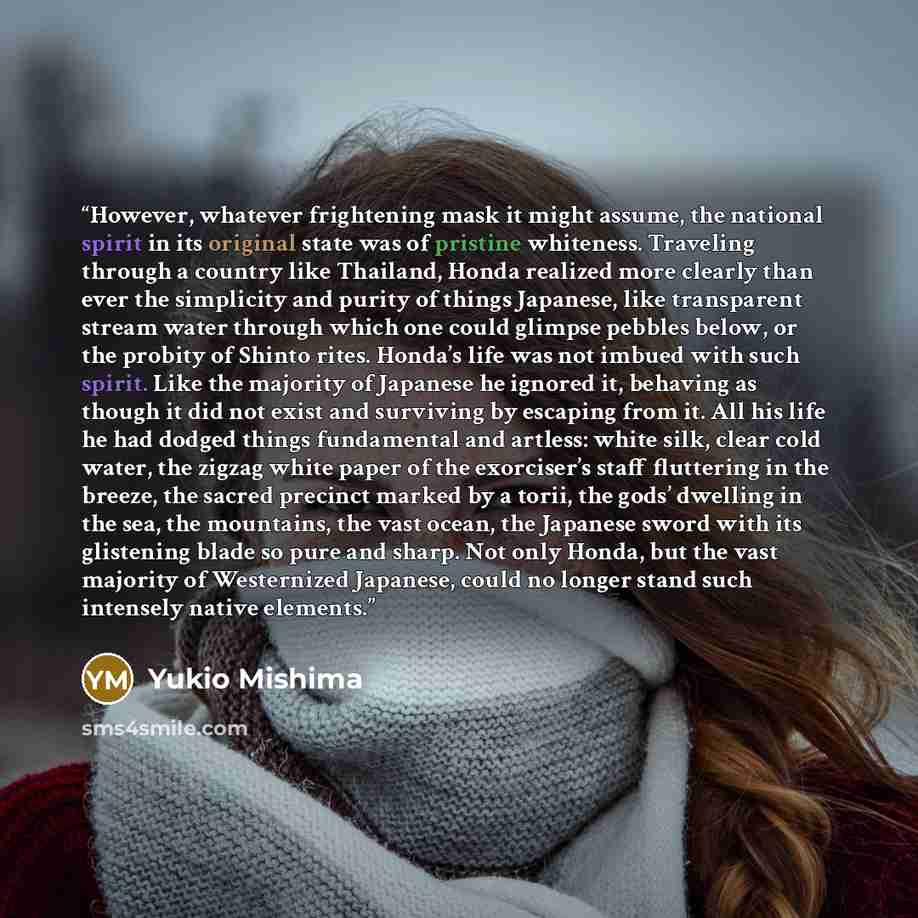
““However, whatever frightening mask it might assume, the national spirit in its original state was of pristine whiteness. Traveling through a country like Thailand, Honda realized more clearly than ever the simplicity and purity of things Japanese, like transparent stream water through which one could glimpse pebbles below, or the probity of Shinto rites. Honda’s life was not imbued with such spirit. Like the majority of Japanese he ignored it, behaving as though it did not exist and surviving by escaping from it. All his life he had dodged things fundamental and artless: white silk, clear cold water, the zigzag white paper of the exorciser’s staff fluttering in the breeze, the sacred precinct marked by a torii, the gods’ dwelling in the sea, the mountains, the vast ocean, the Japanese sword with its glistening blade so pure and sharp. Not only Honda, but the vast majority of Westernized Japanese, could no longer stand such intensely native elements.””
About This Quote
This interpretation was drafted with AI assistance. It is one reading of the quote, not the author's own explanation.
The author laments the loss of pure, unadorned Japanese cultural elements among modernized Japanese, contrasting them with Western influences.
In simple terms: Modern Japanese have forgotten simple, traditional values.
Key Takeaway
Seek to appreciate and preserve authentic cultural practices.
Themes
cultural loss
modernization
tradition
identity
Mood
melancholic
critical
Type
cultural
reflective
When to use this quote
- travel experiences
- cultural education
- heritage preservation
Key Concepts
nostalgia
purity
cultural critique
Questions to Reflect On
- What aspects of tradition are worth preserving?
- How can modernity and tradition coexist?
A Different Perspective
The critique may romanticize the past and ignore benefits of cultural exchange.