Here indeed was the great defect of the Greek mind: it was…
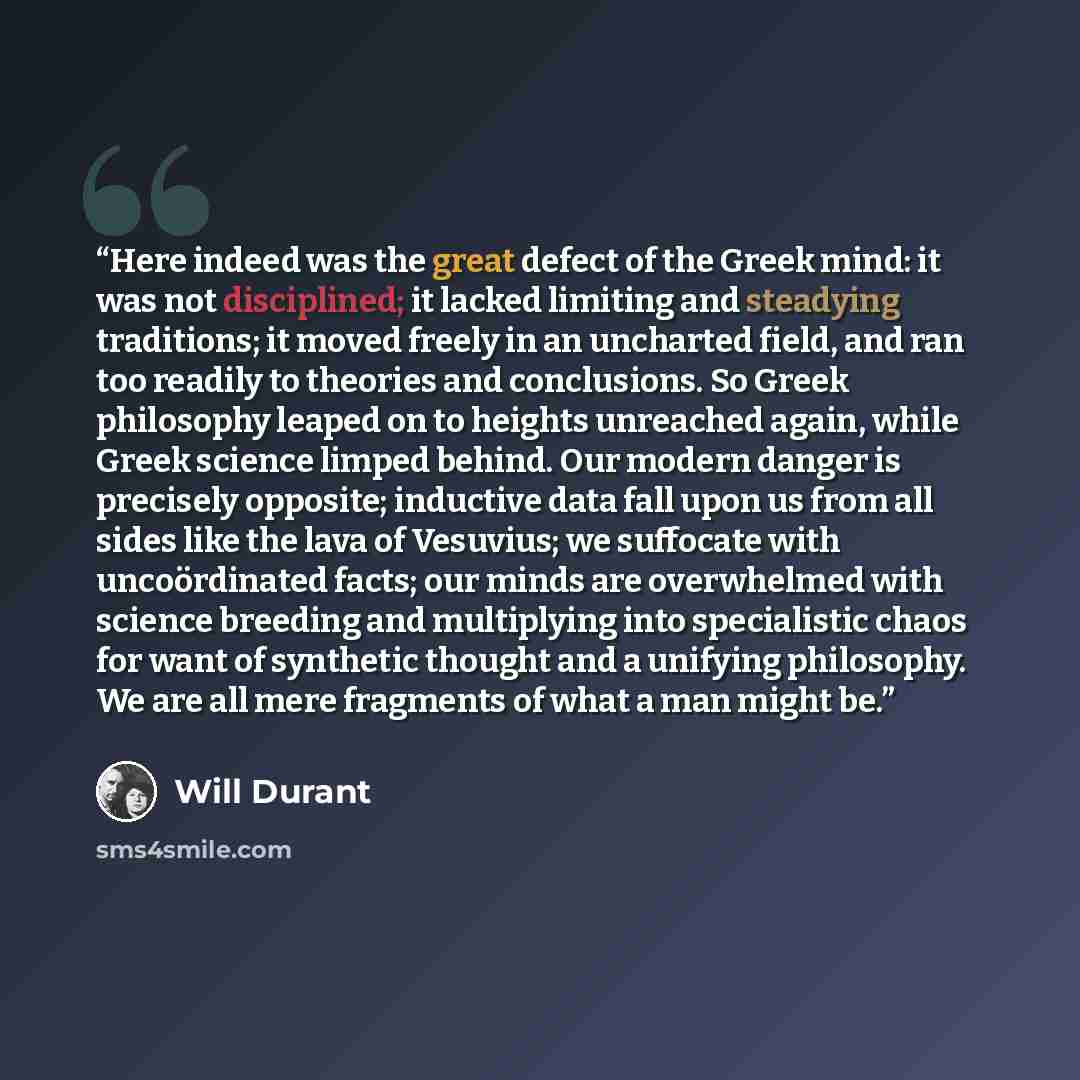
““Here indeed was the great defect of the Greek mind: it was not disciplined; it lacked limiting and steadying traditions; it moved freely in an uncharted field, and ran too readily to theories and conclusions. So Greek philosophy leaped on to heights unreached again, while Greek science limped behind. Our modern danger is precisely opposite; inductive data fall upon us from all sides like the lava of Vesuvius; we suffocate with uncoördinated facts; our minds are overwhelmed with science breeding and multiplying into specialistic chaos for want of synthetic thought and a unifying philosophy. We are all mere fragments of what a man might be.””
About This Quote
This interpretation was drafted with AI assistance. It is one reading of the quote, not the author's own explanation.
Greek thought was free‑wheeling but lacked structure, leading to philosophical breakthroughs but scientific stagnation; modern times suffer from data overload and fragmented knowledge.
In simple terms: Greek freedom vs. modern overload.
Key Takeaway
Balance creativity with disciplined synthesis.
Themes
philosophy
science
knowledge management
Mood
analytical
concerned
Type
theoretical
critical.
When to use this quote
- academic research
- policy making
- education reform
Key Concepts
synthetic thought
interdisciplinary integration
Questions to Reflect On
- How can we foster integrative thinking today?
- What structures help synthesize diverse information?
A Different Perspective
Too much data can overwhelm without unifying frameworks.