Aeneas' mother is a star?" "No; a goddess." I said…
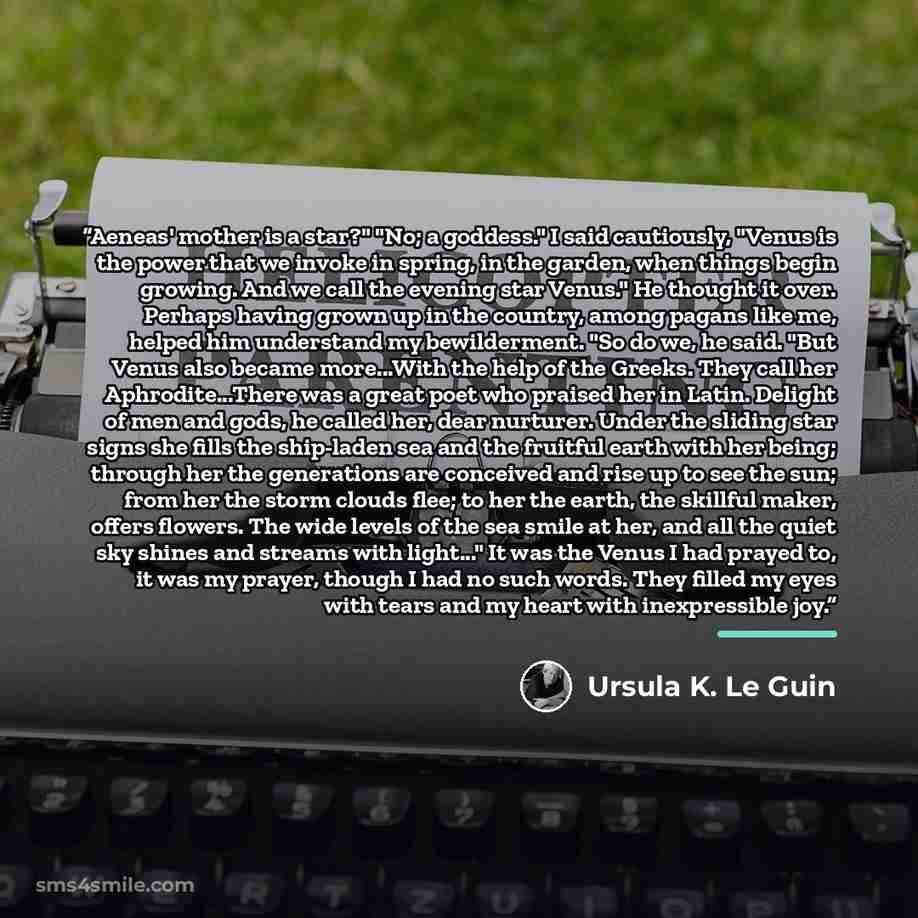
““Aeneas' mother is a star?" "No; a goddess." I said cautiously, "Venus is the power that we invoke in spring, in the garden, when things begin growing. And we call the evening star Venus." He thought it over. Perhaps having grown up in the country, among pagans like me, helped him understand my bewilderment. "So do we, he said. "But Venus also became more...With the help of the Greeks. They call her Aphrodite...There was a great poet who praised her in Latin. Delight of men and gods, he called her, dear nurturer. Under the sliding star signs she fills the ship-laden sea and the fruitful earth with her being; through her the generations are conceived and rise up to see the sun; from her the storm clouds flee; to her the earth, the skillful maker, offers flowers. The wide levels of the sea smile at her, and all the quiet sky shines and streams with light..." It was the Venus I had prayed to, it was my prayer, though I had no such words. They filled my eyes with tears and my heart with inexpressible joy.””
About This Quote
This interpretation was drafted with AI assistance. It is one reading of the quote, not the author's own explanation.
The speaker reflects on the layered identities of Venus, linking myth, nature, and personal reverence, illustrating how divine archetypes embody seasonal renewal and human hope.
In simple terms: Venus as a spring deity and source of renewal.
Key Takeaway
Myths shape personal meaning.
Themes
mythology
nature
renewal
identity
spirituality
Mood
reverent
hopeful
awe
Type
narrative
reflective
poetic
When to use this quote
- personal prayer
- conversational revelation
- cultural exchange
Key Concepts
symbolism
cultural syncretism
emotional resonance
Practical Applications
- inspiring poetic writing
- enhancing spiritual reflection
Questions to Reflect On
- How do myths influence personal belief?
- What does Venus represent in different cultures?