After that summer, after being friends with Won-a-nee and…
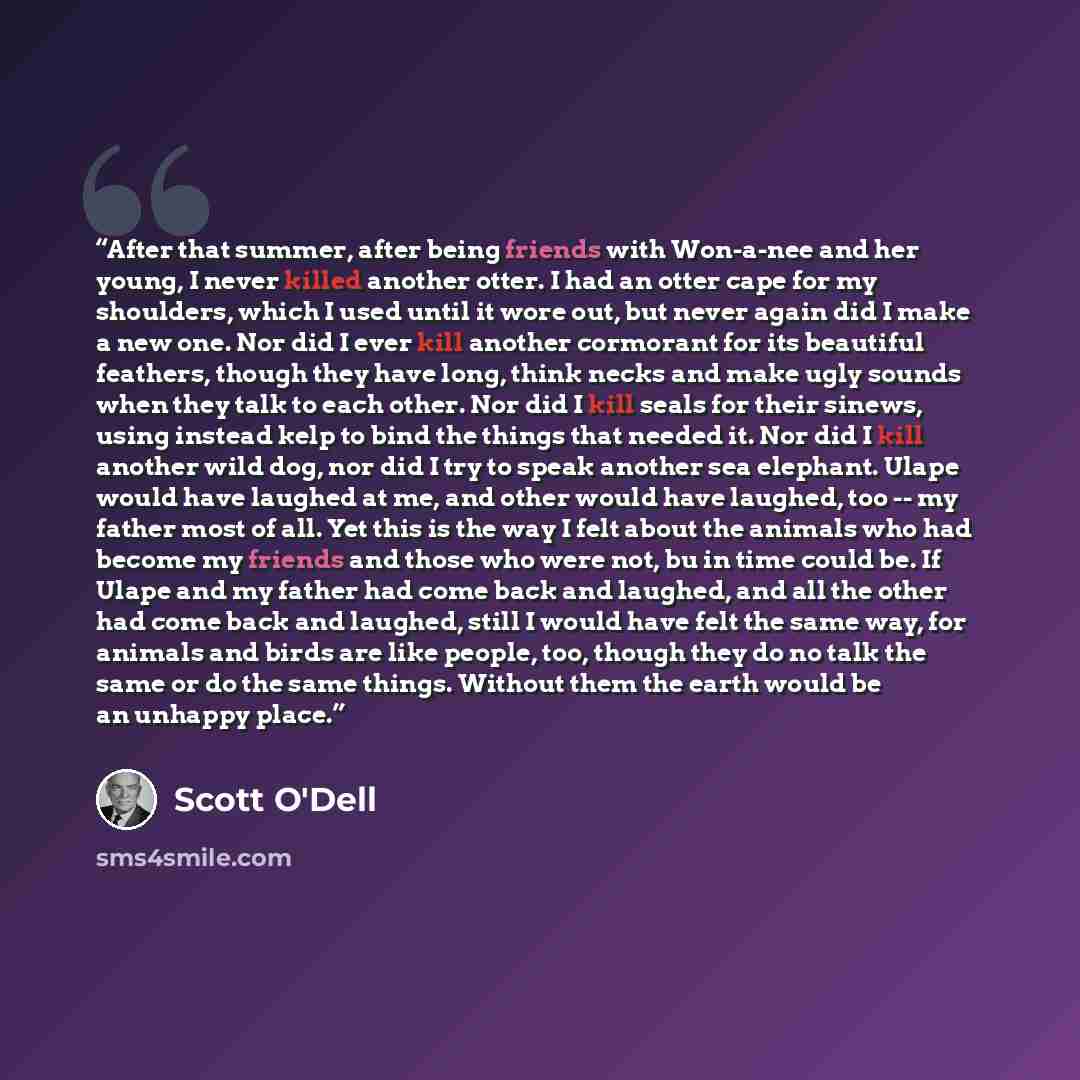
““After that summer, after being friends with Won-a-nee and her young, I never killed another otter. I had an otter cape for my shoulders, which I used until it wore out, but never again did I make a new one. Nor did I ever kill another cormorant for its beautiful feathers, though they have long, think necks and make ugly sounds when they talk to each other. Nor did I kill seals for their sinews, using instead kelp to bind the things that needed it. Nor did I kill another wild dog, nor did I try to speak another sea elephant. Ulape would have laughed at me, and other would have laughed, too -- my father most of all. Yet this is the way I felt about the animals who had become my friends and those who were not, bu in time could be. If Ulape and my father had come back and laughed, and all the other had come back and laughed, still I would have felt the same way, for animals and birds are like people, too, though they do no talk the same or do the same things. Without them the earth would be an unhappy place.””
About This Quote
This interpretation was drafted with AI assistance. It is one reading of the quote, not the author's own explanation.
The narrator learns to respect all animals, seeing them as companions rather than resources, and chooses compassion over exploitation.
In simple terms: Respect animals as friends, not food.
Key Takeaway
Choose compassion over killing.
Themes
compassion
environment
animal rights
empathy
Mood
reflective
melancholic
Type
narrative
ethical
When to use this quote
- hunting
- fishing
- wildlife observation
- conservation education
Key Concepts
ethical stewardship
anthropomorphism
Questions to Reflect On
- How can we extend empathy to all living beings?
- What habits must we change to protect wildlife?
A Different Perspective
Human habits often conflict with compassion for nature.