Yet some would say, why women's history at all? Surely men…
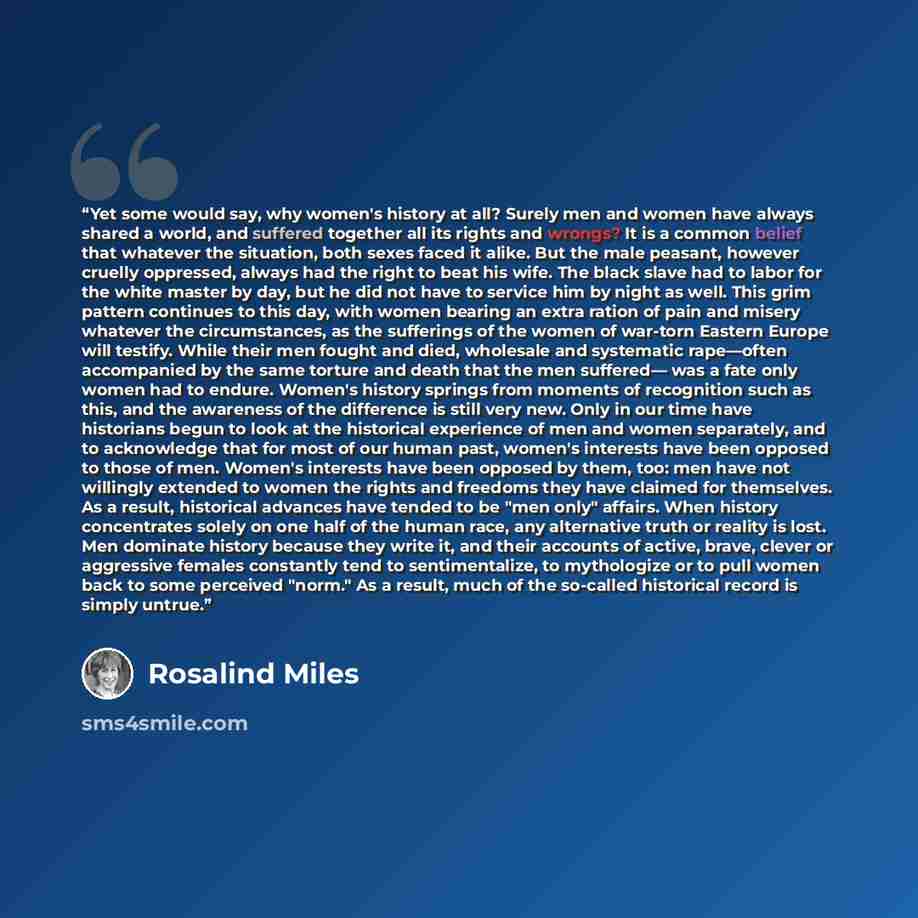
““Yet some would say, why women's history at all? Surely men and women have always shared a world, and suffered together all its rights and wrongs? It is a common belief that whatever the situation, both sexes faced it alike. But the male peasant, however cruelly oppressed, always had the right to beat his wife. The black slave had to labor for the white master by day, but he did not have to service him by night as well. This grim pattern continues to this day, with women bearing an extra ration of pain and misery whatever the circumstances, as the sufferings of the women of war-torn Eastern Europe will testify. While their men fought and died, wholesale and systematic rape—often accompanied by the same torture and death that the men suffered— was a fate only women had to endure. Women's history springs from moments of recognition such as this, and the awareness of the difference is still very new. Only in our time have historians begun to look at the historical experience of men and women separately, and to acknowledge that for most of our human past, women's interests have been opposed to those of men. Women's interests have been opposed by them, too: men have not willingly extended to women the rights and freedoms they have claimed for themselves. As a result, historical advances have tended to be "men only" affairs. When history concentrates solely on one half of the human race, any alternative truth or reality is lost. Men dominate history because they write it, and their accounts of active, brave, clever or aggressive females constantly tend to sentimentalize, to mythologize or to pull women back to some perceived "norm." As a result, much of the so-called historical record is simply untrue.””
About This Quote
This interpretation was drafted with AI assistance. It is one reading of the quote, not the author's own explanation.
The quote argues that women's experiences have been systematically excluded from mainstream history, leading to a distorted view of the past.
In simple terms: History often ignores women's suffering and contributions.
Key Takeaway
Recognize and study women's distinct histories.
Themes
gender inequality
historical bias
women's rights
power dynamics
Mood
critical
reflective
determined
Type
analytical
historical
advocacy
When to use this quote
- academic research
- curriculum design
- public policy
- media representation
- activism
Key Concepts
patriarchal narratives
intersectionality
historical revisionism
Questions to Reflect On
- How can we integrate women's perspectives without erasing men's?
- What sources can reveal hidden women's histories?
A Different Perspective
The claim may overgeneralize male experiences and ignore male allies.