At first Christ was a man – nothing more. Mary was his…
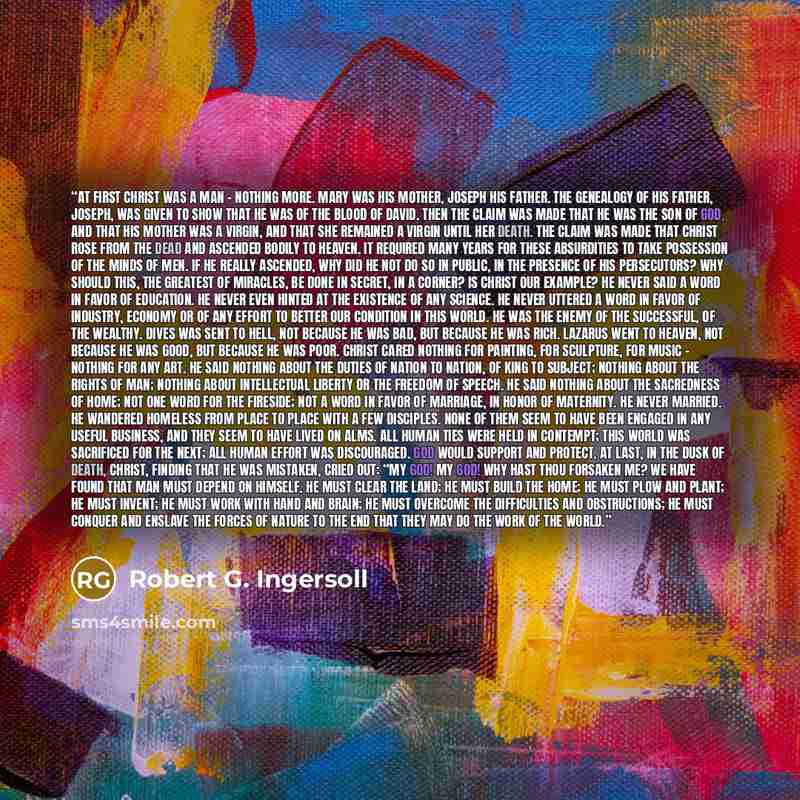
““At first Christ was a man – nothing more. Mary was his mother, Joseph his father. The genealogy of his father, Joseph, was given to show that he was of the blood of David. Then the claim was made that he was the son of God, and that his mother was a virgin, and that she remained a virgin until her death. The claim was made that Christ rose from the dead and ascended bodily to heaven. It required many years for these absurdities to take possession of the minds of men. If he really ascended, why did he not do so in public, in the presence of his persecutors? Why should this, the greatest of miracles, be done in secret, in a corner? Is Christ our example? He never said a word in favor of education. He never even hinted at the existence of any science. He never uttered a word in favor of industry, economy or of any effort to better our condition in this world. He was the enemy of the successful, of the wealthy. Dives was sent to hell, not because he was bad, but because he was rich. Lazarus went to heaven, not because he was good, but because he was poor. Christ cared nothing for painting, for sculpture, for music – nothing for any art. He said nothing about the duties of nation to nation, of king to subject; nothing about the rights of man; nothing about intellectual liberty or the freedom of speech. He said nothing about the sacredness of home; not one word for the fireside; not a word in favor of marriage, in honor of maternity. He never married. He wandered homeless from place to place with a few disciples. None of them seem to have been engaged in any useful business, and they seem to have lived on alms. All human ties were held in contempt; this world was sacrificed for the next; all human effort was discouraged. God would support and protect. At last, in the dusk of death, Christ, finding that he was mistaken, cried out: “My God! My God! Why hast thou forsaken me? We have found that man must depend on himself. He must clear the land; he must build the home; he must plow and plant; he must invent; he must work with hand and brain; he must overcome the difficulties and obstructions; he must conquer and enslave the forces of nature to the end that they may do the work of the world.””
About This Quote
This interpretation was drafted with AI assistance. It is one reading of the quote, not the author's own explanation.
The passage critiques religious claims about Christ, arguing they lack evidence, contradict reason, and ignore worldly concerns.
In simple terms: It questions the validity and relevance of Christian doctrines.
Key Takeaway
Examine beliefs critically and consider practical impact.
Themes
faith
reason
history
Mood
critical
inquisitive
Type
analysis
philosophical
When to use this quote
- theological debate
- historical analysis
- personal belief systems
Key Concepts
mythology
skepticism
ethics
Questions to Reflect On
- What evidence supports or refutes these claims?
- How do religious narratives shape societies?
A Different Perspective
The critique may overlook positive moral teachings within religion.