The lambs in their arms were as smooth as mushrooms, the…
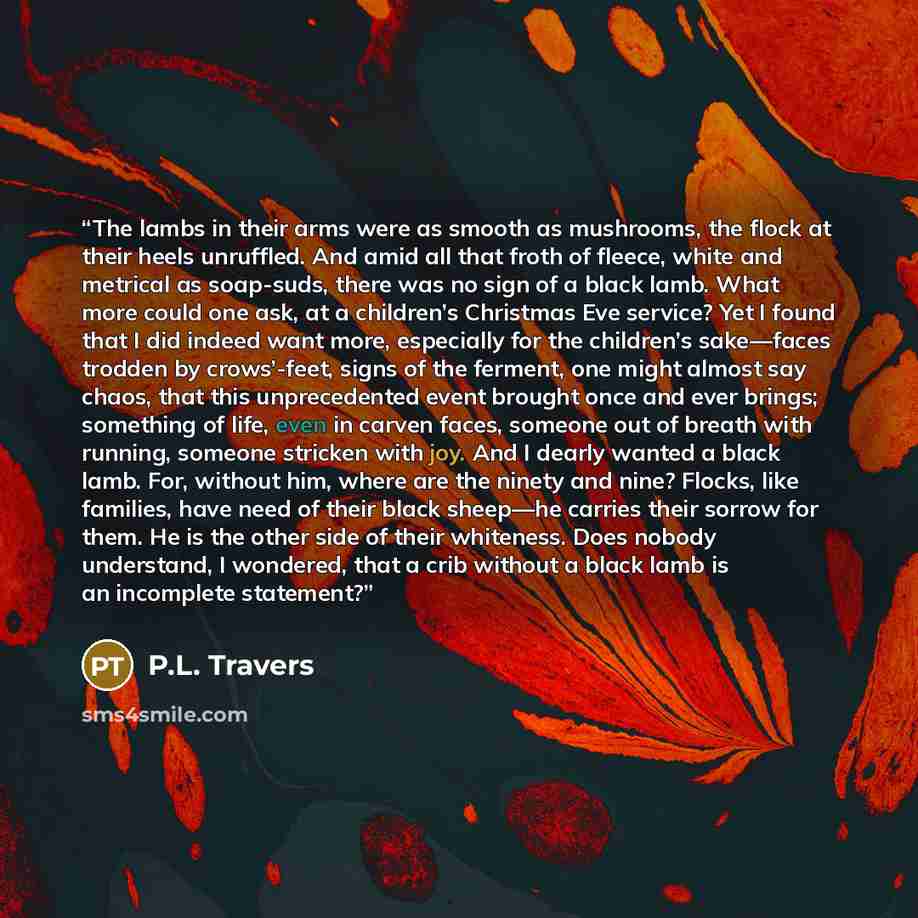
““The lambs in their arms were as smooth as mushrooms, the flock at their heels unruffled. And amid all that froth of fleece, white and metrical as soap-suds, there was no sign of a black lamb. What more could one ask, at a children’s Christmas Eve service? Yet I found that I did indeed want more, especially for the children’s sake—faces trodden by crows’-feet, signs of the ferment, one might almost say chaos, that this unprecedented event brought once and ever brings; something of life, even in carven faces, someone out of breath with running, someone stricken with joy. And I dearly wanted a black lamb. For, without him, where are the ninety and nine? Flocks, like families, have need of their black sheep—he carries their sorrow for them. He is the other side of their whiteness. Does nobody understand, I wondered, that a crib without a black lamb is an incomplete statement?””
About This Quote
This interpretation was drafted with AI assistance. It is one reading of the quote, not the author's own explanation.
The passage uses the black lamb as a metaphor for the imperfect, marginalized individual whose presence completes a community, highlighting the necessity of acknowledging suffering and diversity.
In simple terms: We need the “different or person whole community is,..... people, the black lamb is essential.
Key Takeaway
Recognize and value those who differ.
Themes
inclusion
diversity
community
suffering
identity
Mood
reflective
thoughtful
empathetic
Type
literary
philosophical
social commentary
When to use this quote
- family gatherings
- holiday celebrations
- school classrooms
- social movements
- mental health support
Key Concepts
symbolism
metaphor
otherness
Questions to Reflect On
- How does acknowledging the “black lamb” change our view of community?
- What are the risks of labeling people as “black sheep”?
A Different Perspective
Some may argue that focusing on the “black lamb” could stigmatize difference rather than celebrate it.