Hume, Huxley, and other "immanent " psychologists, tried…
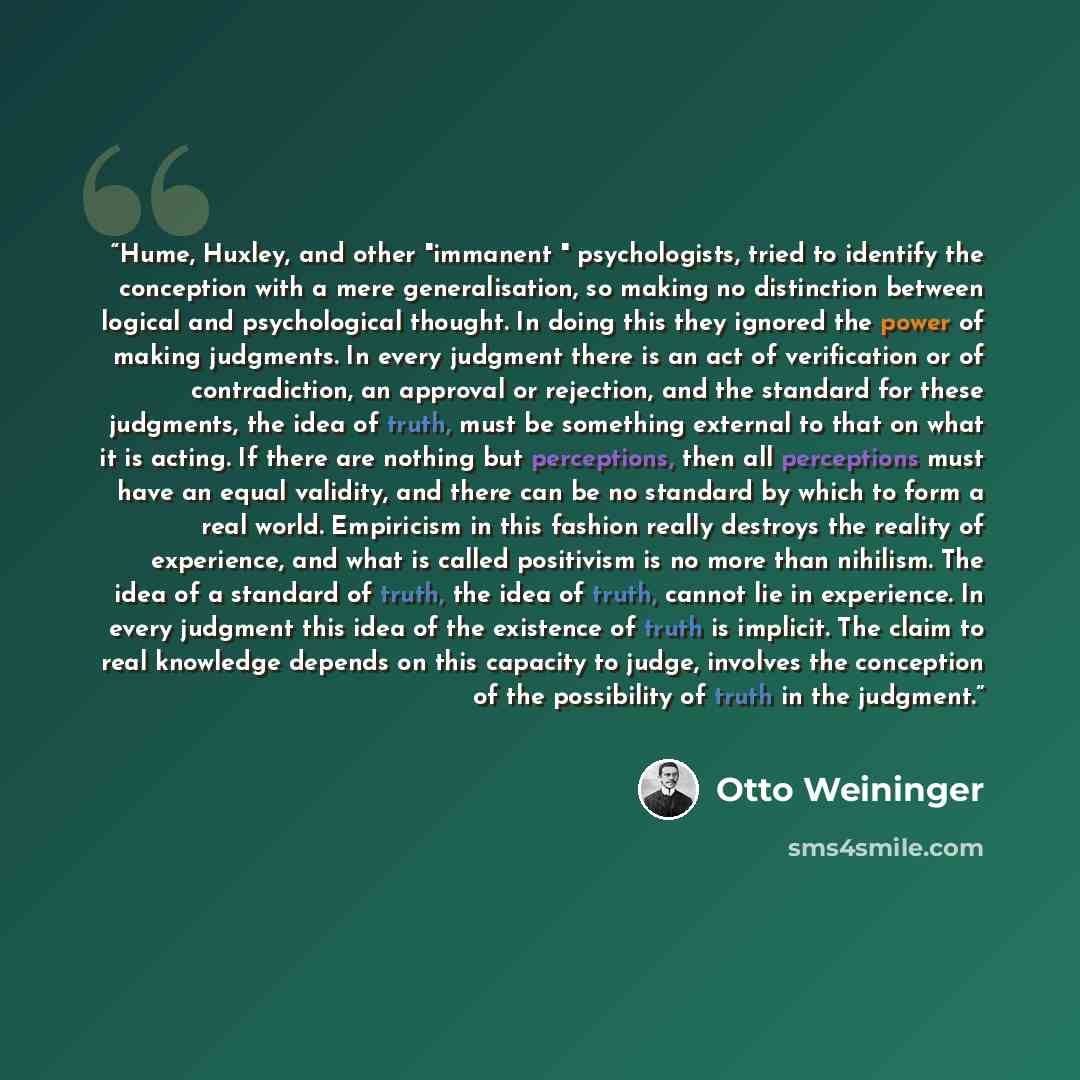
““Hume, Huxley, and other "immanent " psychologists, tried to identify the conception with a mere generalisation, so making no distinction between logical and psychological thought. In doing this they ignored the power of making judgments. In every judgment there is an act of verification or of contradiction, an approval or rejection, and the standard for these judgments, the idea of truth, must be something external to that on what it is acting. If there are nothing but perceptions, then all perceptions must have an equal validity, and there can be no standard by which to form a real world. Empiricism in this fashion really destroys the reality of experience, and what is called positivism is no more than nihilism. The idea of a standard of truth, the idea of truth, cannot lie in experience. In every judgment this idea of the existence of truth is implicit. The claim to real knowledge depends on this capacity to judge, involves the conception of the possibility of truth in the judgment.””
About This Quote
This interpretation was drafted with AI assistance. It is one reading of the quote, not the author's own explanation.
Empiricism that reduces truth to perception lacks an external standard, leading to relativism and nihilism.
In simple terms: Truth cannot be based only on perception; it needs an external standard.
Key Takeaway
Seek standards beyond mere perception for knowledge.
Themes
philosophy
epistemology
truth
empiricism
nihilism
Mood
critical
inquisitive
Type
philosophical
theoretical
When to use this quote
- academic debate
- teaching philosophy
- critical thinking
- skeptical inquiry
Key Concepts
conceptual analysis
philosophical critique
logic
Questions to Reflect On
- Can truth be grounded without external standards?
- How do perceptions contribute to knowledge?
A Different Perspective
The view may neglect the role of intersubjective verification in establishing truth.