Habermas (1971–1973) described ideology as motivated false…
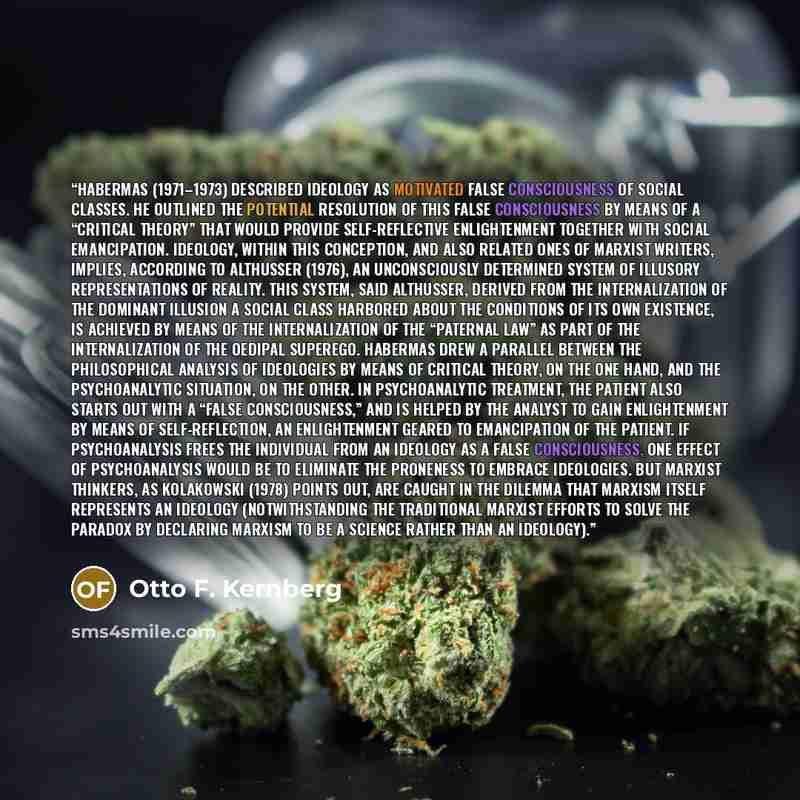
““Habermas (1971–1973) described ideology as motivated false consciousness of social classes. He outlined the potential resolution of this false consciousness by means of a “critical theory” that would provide self-reflective enlightenment together with social emancipation. Ideology, within this conception, and also related ones of Marxist writers, implies, according to Althusser (1976), an unconsciously determined system of illusory representations of reality. This system, said Althusser, derived from the internalization of the dominant illusion a social class harbored about the conditions of its own existence, is achieved by means of the internalization of the “Paternal law” as part of the internalization of the oedipal superego. Habermas drew a parallel between the philosophical analysis of ideologies by means of critical theory, on the one hand, and the psychoanalytic situation, on the other. In psychoanalytic treatment, the patient also starts out with a “false consciousness,” and is helped by the analyst to gain enlightenment by means of self-reflection, an enlightenment geared to emancipation of the patient. If psychoanalysis frees the individual from an ideology as a false consciousness, one effect of psychoanalysis would be to eliminate the proneness to embrace ideologies. But Marxist thinkers, as Kolakowski (1978) points out, are caught in the dilemma that Marxism itself represents an ideology (notwithstanding the traditional Marxist efforts to solve the paradox by declaring Marxism to be a science rather than an ideology).””
About This Quote
This interpretation was drafted with AI assistance. It is one reading of the quote, not the author's own explanation.
Ideology is a socially imposed false consciousness that can be challenged through critical self‑reflection, similar to psychoanalytic insight.
In simple terms: Socially imposed false beliefs can be overcome by critical self‑reflection.
Key Takeaway
Use critical reflection to uncover hidden biases.
Themes
ideology
critical theory
psychoanalysis
social emancipation
Mood
thoughtful
analytical
introspective
Type
philosophical
academic
When to use this quote
- academic lecture
- political activism
- personal therapy
- education
- media analysis
Key Concepts
false consciousness
self‑reflection
marxist critique
psychoanalytic treatment
Questions to Reflect On
- How does your own background shape your perceived reality?
- Can self‑reflection ever be fully objective?
A Different Perspective
Critical theory may overlook power dynamics within the reflective process itself.