Concepts of memory tend to reflect the technology of the…
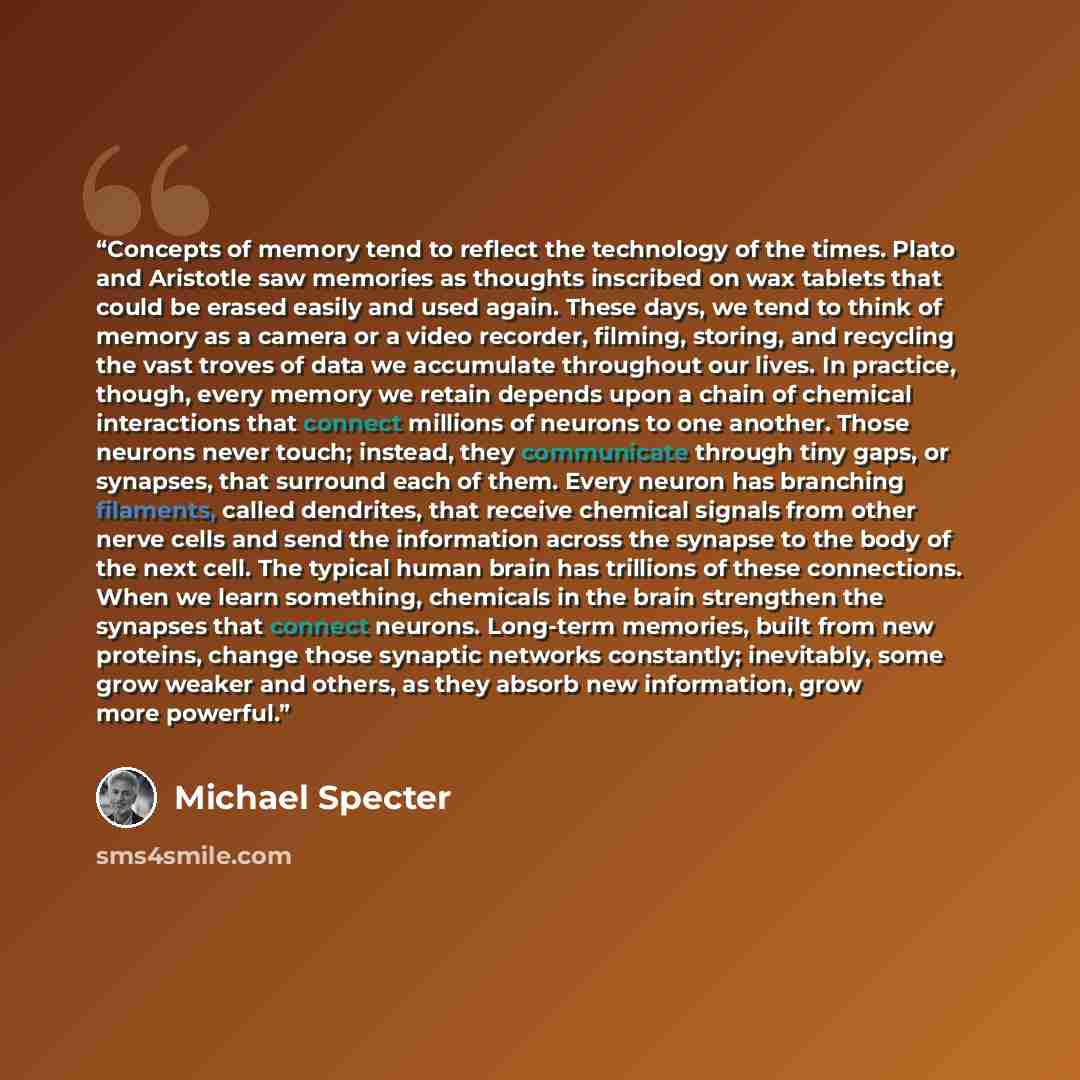
““Concepts of memory tend to reflect the technology of the times. Plato and Aristotle saw memories as thoughts inscribed on wax tablets that could be erased easily and used again. These days, we tend to think of memory as a camera or a video recorder, filming, storing, and recycling the vast troves of data we accumulate throughout our lives. In practice, though, every memory we retain depends upon a chain of chemical interactions that connect millions of neurons to one another. Those neurons never touch; instead, they communicate through tiny gaps, or synapses, that surround each of them. Every neuron has branching filaments, called dendrites, that receive chemical signals from other nerve cells and send the information across the synapse to the body of the next cell. The typical human brain has trillions of these connections. When we learn something, chemicals in the brain strengthen the synapses that connect neurons. Long-term memories, built from new proteins, change those synaptic networks constantly; inevitably, some grow weaker and others, as they absorb new information, grow more powerful.””
About This Quote
This interpretation was drafted with AI assistance. It is one reading of the quote, not the author's own explanation.
Our understanding of memory changes with prevailing technology, but biologically it relies on synaptic connections and chemical processes that constantly remodel.
In simple terms: Memory is shaped by tech metaphors but is fundamentally synaptic chemistry.
Key Takeaway
Recognize the limits of tech analogies for brain function.
Themes
neuroscience
technology
metaphor
learning
memory
Mood
curious
reflective
Type
explanatory
informative
When to use this quote
- education
- personal development
- AI research
- neuroscience communication
Key Concepts
synaptic plasticity
chemical signaling
neural networks
cognitive science
Questions to Reflect On
- How do current tech metaphors influence public perception of brain health?
- What alternative metaphors could better capture synaptic dynamics?
A Different Perspective
Tech metaphors can oversimplify the complexity of neural processes.