Net wages: “It’s not what you make, but what you net”…
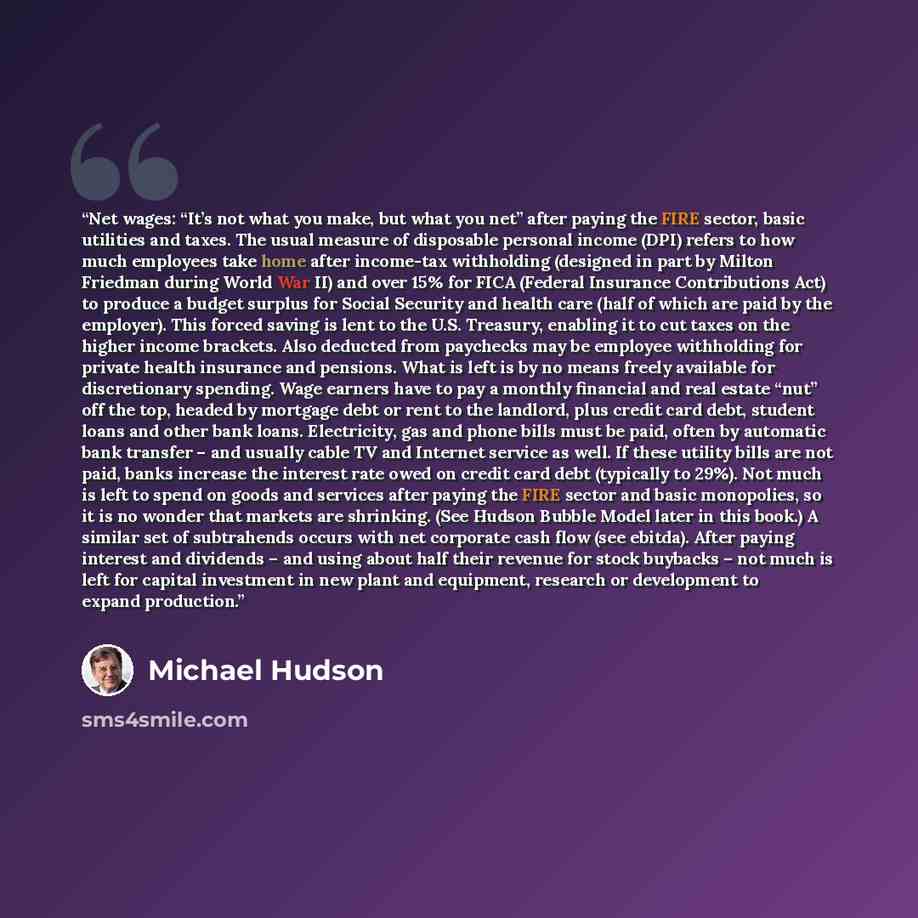
““Net wages: “It’s not what you make, but what you net” after paying the FIRE sector, basic utilities and taxes. The usual measure of disposable personal income (DPI) refers to how much employees take home after income-tax withholding (designed in part by Milton Friedman during World War II) and over 15% for FICA (Federal Insurance Contributions Act) to produce a budget surplus for Social Security and health care (half of which are paid by the employer). This forced saving is lent to the U.S. Treasury, enabling it to cut taxes on the higher income brackets. Also deducted from paychecks may be employee withholding for private health insurance and pensions. What is left is by no means freely available for discretionary spending. Wage earners have to pay a monthly financial and real estate “nut” off the top, headed by mortgage debt or rent to the landlord, plus credit card debt, student loans and other bank loans. Electricity, gas and phone bills must be paid, often by automatic bank transfer – and usually cable TV and Internet service as well. If these utility bills are not paid, banks increase the interest rate owed on credit card debt (typically to 29%). Not much is left to spend on goods and services after paying the FIRE sector and basic monopolies, so it is no wonder that markets are shrinking. (See Hudson Bubble Model later in this book.) A similar set of subtrahends occurs with net corporate cash flow (see ebitda). After paying interest and dividends – and using about half their revenue for stock buybacks – not much is left for capital investment in new plant and equipment, research or development to expand production.””
About This Quote
This interpretation was drafted with AI assistance. It is one reading of the quote, not the author's own explanation.
The quote explains how taxes, mandatory contributions, and essential expenses consume most of wages and corporate cash, leaving little for discretionary spending or investment.
In simple terms: Most income is taken by taxes and essential costs, leaving little for spending or growth.
Key Takeaway
Recognize hidden costs and plan finances accordingly.
Themes
economics
personal finance
corporate finance
tax policy
inflation
Mood
concerned
analytical
critical
Type
explanatory
informative
When to use this quote
- Household budgeting
- retirement planning
- business investment decisions
- policy analysis
Key Concepts
Disposable income
forced savings
mandatory contributions
consumer spending
corporate cash flow
Questions to Reflect On
- How can individuals reduce mandatory expenses?
- What policies could lower the net cost burden on workers?
A Different Perspective
Assumes all expenses are unavoidable; may overlook personal financial strategies or tax deductions.